How to Measure a Ring Size UK for the Perfect Fit
Learn how to measure a ring size UK with easy, accurate methods. Our guide covers using string, paper, and charts for a perfect fit right from home.
Getting your UK ring size spot on is the first, and most crucial, step in finding a ring you’ll never want to take off. It all comes down to measuring the circumference of your finger in millimetres and then matching that number to the correct letter in the UK’s alphabetical sizing system. This guide will show you three reliable ways to do this yourself, right from the comfort of your home.
Your Guide to a Perfect Ring Fit
There’s nothing quite like finding a ring that feels like it was made for you. But that excitement can quickly turn to frustration if the fit is wrong. A ring that’s too snug will be a constant, uncomfortable distraction, while one that’s too loose is always at risk of slipping away for good. This is particularly important with the unique UK sizing system, where just a few millimetres can make all the difference between one letter size and the next.
Trying to guess your size is a gamble that rarely pays off, often leading to disappointment or the added chore of getting the ring resized. Think of this guide as your starting point for getting it right the first time. We’ll walk through some dependable at-home methods so you can measure with confidence, whether you're buying for yourself or planning a surprise. And remember, if a beloved ring isn't quite right, professional services for a ring resize in London can make those final tweaks for a flawless fit.
Knowing how to measure a ring size UK is the first step towards a lifetime of comfortable wear. It eliminates guesswork and ensures your treasured piece feels like it was made just for you.
To help you figure out the best way to measure at home, let's look at a quick comparison of the three most popular methods.
At-Home UK Ring Sizing Methods at a Glance
Each DIY method has its own set of advantages and potential drawbacks. This table breaks down what you can expect from each, helping you choose the one that suits your situation best.
| Method | Tools Needed | Pros | Cons |
|---|---|---|---|
| String or Paper | String or paper strip, pen, ruler | Quick, easy, uses common household items. | Prone to stretching or tearing, which can lead to inaccuracies. |
| Printable Chart | A well-fitting ring, printer, ruler | Good for measuring a ring you already own and love. | Relies on perfect printer scaling (100%) and a perfectly round ring. |
| Ring Sizer Tool | Reusable plastic or metal ring sizer | The most accurate and reliable DIY method. | Requires purchasing a specific tool, though they are inexpensive. |
While a dedicated ring sizer is always my top recommendation for accuracy, the other two methods can work well in a pinch if you're careful. Now, let’s dive into the specifics of each one.
Getting to Grips with UK Ring Sizing
Before you even think about measuring your finger, it’s worth getting your head around the UK ring sizing system. It’s a bit different from what you might see elsewhere. Instead of numbers, we use an alphabetical scale that runs from A to Z, with half-sizes in between. It might seem a little quirky, but it’s actually a very precise system.
Each letter corresponds to a specific inner circumference measured in millimetres. The jump from one size to the next is tiny, which is why a small mistake in your measurement can mean the difference between a ring that’s painfully tight and one that’s at risk of slipping right off. Nailing this is the secret to finding a ring that feels like it was custom-made for you.
A Quick Hop from Inches to Millimetres
This whole system has a pretty interesting backstory. It was originally based on inches, but in 1987, the British Standards Institution (BSI) brought it up to date by switching to the metric system.
Today, the difference between one full alphabetical size and the next is just 1.25 mm in circumference. To give you an idea, a size C ring has an inner circumference of around 40 mm, and each size up adds that crucial 1.25 mm. You can actually dive deeper into the history and details of international ring size standards on Wikipedia if you're curious.
This isn’t just a fun fact; it really drives home why being accurate is so important. When you realise that a size L and a size M are separated by little more than a millimetre, you start to see why every tiny detail in the measuring process really does matter.
The incredibly small steps between UK ring sizes show just how much precision is needed for a great fit. Keeping this in mind will help you measure carefully, so the ring you choose is both comfortable and secure.
Knowing this also comes in handy if you’re buying rings from overseas. A quick look at a conversion chart can save you from a costly and disappointing mistake, ensuring that gorgeous ring you spotted online will actually fit when it arrives. Right, now that you know the system, let’s get you measured.
Practical Ways to Measure Your Finger at Home
You don't need a special trip to a jeweller just to find your ring size. With a couple of household items and a steady hand, you can get a surprisingly accurate measurement from the comfort of your own home. The secret is to be precise, as even a millimetre can make a difference.
The go-to method for many is using a piece of string or a thin strip of paper. It’s wonderfully straightforward. Just wrap it around the base of your finger, making sure it’s snug but not uncomfortably tight – it should feel just like a real ring would.
Once it's wrapped properly, use a fine-tipped pen to mark the exact spot where the end overlaps. This is the most crucial step for getting it right. Then, simply lay the string or paper flat against a ruler and measure the length in millimetres from the start to the mark you made. That number is your finger's circumference.
Using an Existing Ring or a Chart
If you already own a ring that fits the intended finger perfectly, you're in luck. Using a printable ring size chart is another excellent way to find your size. First, find a reliable chart online and print it out, ensuring it's at 100% scale. This is absolutely vital for accuracy; most good charts will have a small ruler on the page you can check against a real one.
Now, take your ring and place it over the circles on the chart. Keep trying until you find a circle where the inside edge of your ring aligns perfectly with the outside edge of the circle on the paper. The letter shown is your UK ring size. This method is incredibly quick, as long as your reference ring isn't bent or warped.
This handy infographic breaks down the whole process, from measuring to finding your fit.
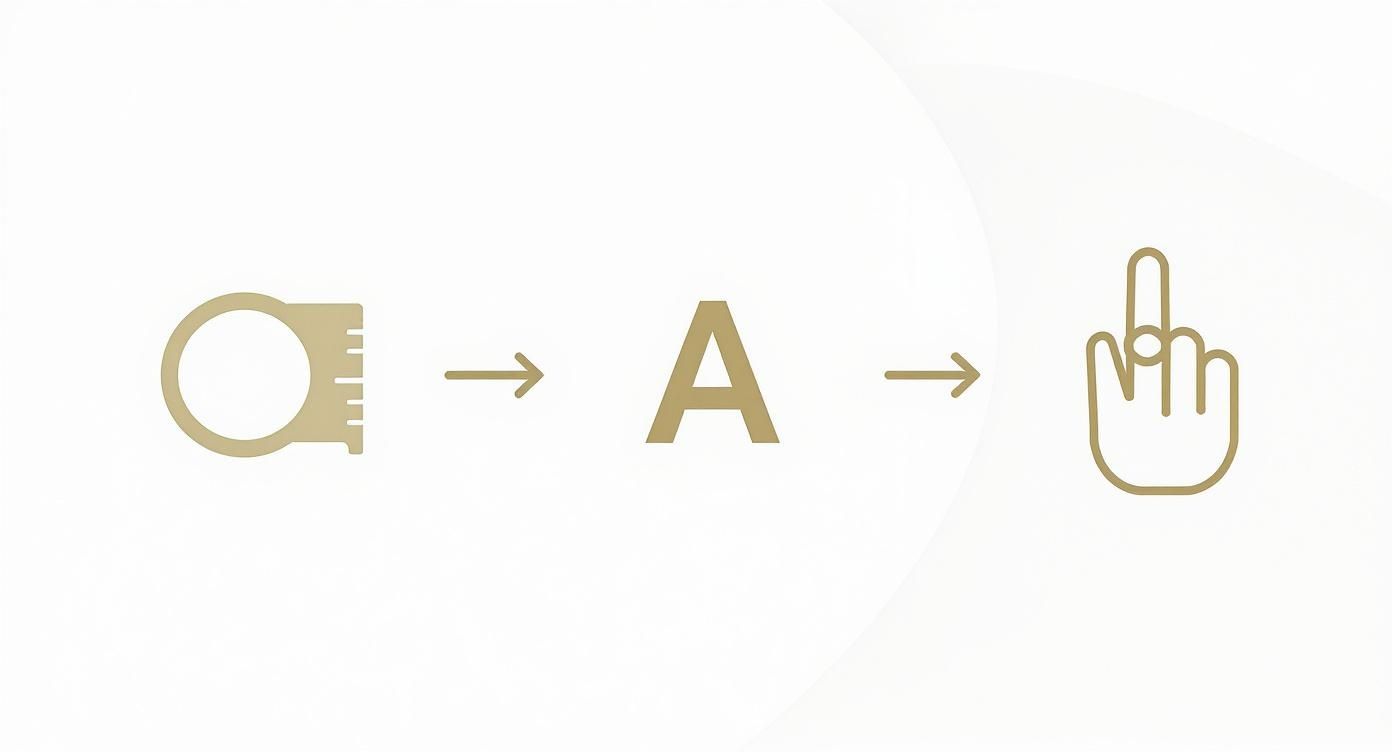
As you can see, getting that circumference measurement spot-on is the first step. From there, you can easily determine the correct UK letter size for a comfortable, secure fit.
Ensuring Accuracy with At-Home Methods
While DIY methods are great, it's true that professional tools like a physical ring sizer will always be the most accurate. This tool is essentially a set of pre-sized rings, so it completely removes any guesswork. That said, you can get very close to a professional result at home by keeping a few expert tips in mind.
A key thing to remember is where you're measuring. The string or paper should sit just below the knuckle, but it must be able to slide over it with just a little bit of resistance. This mimics how you'd actually put a ring on and take it off.
It’s also worth remembering that your fingers change size throughout the day. Temperature, what you’ve eaten, and your activity levels can cause them to swell or shrink by 0.4 to 0.6 mm. That might not sound like much, but it can easily be half a ring size. For the best result, measure your finger at room temperature later in the day, when it’s likely to be at its largest. To dig deeper into these finer points, you can find some fantastic insights on getting the perfect ring size at The Diamond Store.
Insider Tips for an Accurate Measurement
Getting a number from a piece of string is one thing, but making sure it’s the right number is another skill entirely. The secret to a perfect fit often comes down to the little details that we jewellers always keep in mind. Things like timing, temperature, and even the style of the ring can all make a difference.
Believe it or not, your fingers don't stay the same size all day. They tend to be a little smaller in the morning or when you're cold. For the most trustworthy measurement, it's best to size your finger in the late afternoon or evening when you're at a comfortable, stable room temperature. This way, the ring will still feel great even when your finger is at its largest.
Factor in the Ring Band and Your Hand
The ring's design itself plays a surprisingly big role in how it fits. The width of the band is a classic example of something people often forget to consider.
- Wide Bands: If a ring has a band wider than 4mm, it's going to feel much snugger. It’s common practice in the industry to recommend going up half a size to make sure it sits comfortably.
- Thin Bands: A very delicate, thin band naturally has more give, so your standard measurement should be spot on.
Here’s another simple tip that's easy to miss: make sure you measure the correct hand. Your dominant hand is usually a bit larger, sometimes by as much as half a size. Always measure the exact finger on the hand you plan to wear the ring on. Never just assume your left ring finger is the same size as your right!
I always tell my clients to take their measurement three or four different times to see how consistent it is. If you're getting slightly different readings, it’s almost always better to choose the larger size for comfort. A ring that’s a fraction too big is a much simpler fix than one that’s uncomfortably tight.
Ultimately, getting the measurement right from the start is the goal, but don't worry if a final adjustment is needed. If you find your ring isn’t quite the perfect fit, knowing how to resize a ring can offer some valuable peace of mind.
How to Find Your UK Ring Size From a Millimetre Measurement
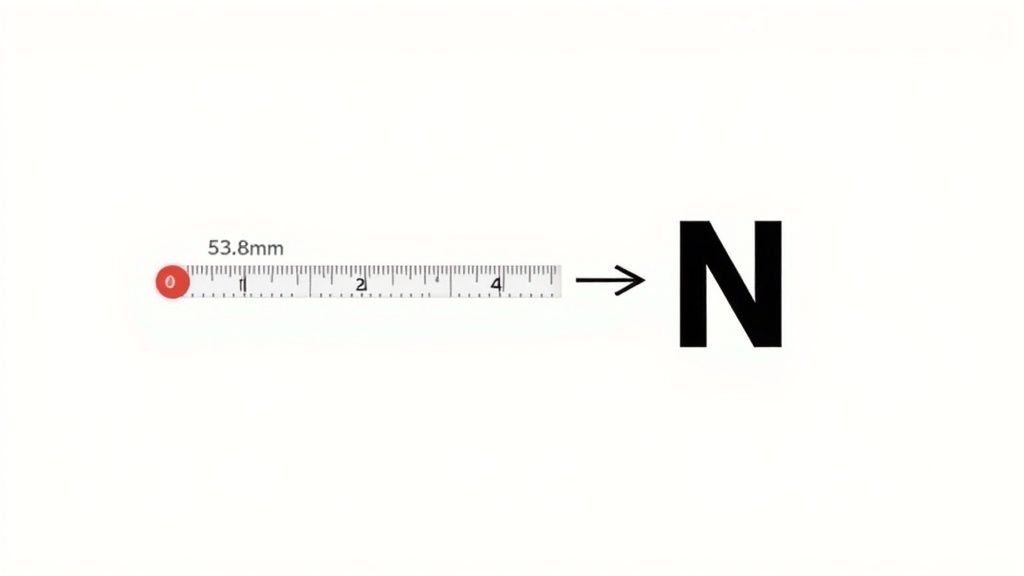
You’ve got your finger’s circumference in millimetres. Great! Now for the easy part: translating that number into its official UK alphabetical size. This is the moment your careful measurement becomes a real, tangible ring size, giving you the confidence to find the perfect fit.
Think of it as simply matching your number to its corresponding letter. For example, if your string or paper strip measured 53.8 mm long, you’d look at a conversion chart and see it lines up perfectly with a UK size N. This direct conversion removes all the guesswork.
It can also be helpful to know the most common sizes. For women, UK ring sizes typically fall between L (51.2 mm) and N (53.8 mm). For men, the average is usually somewhere between T (61.5 mm) and V (64.0 mm). If your measurement lands in these ranges, you're on the right track. You can explore more about global ring size standards and conversions at Lord of London if you're curious.
What If You're Between Two Sizes?
It happens all the time. Your finger measures 52.5 mm, which places you right between a UK size M and an M½. So, what do you do? The best choice usually comes down to the style of the ring you're after.
For rings with a wider band (anything over 4 mm), it’s almost always a good idea to go for the slightly larger size. A wider band covers more of your finger, so a bit of extra room makes for a much more comfortable fit. For a very thin, delicate band, the smaller size is often the safer bet.
This small adjustment can be the difference between a ring that fits well and one that fits perfectly.
To make things even simpler, here is a chart to help you convert your circumference measurement to its UK letter size.
| Inner Circumference (mm) | UK Ring Size |
|---|---|
| 47.8 | I |
| 49.0 | J |
| 50.3 | K |
| 51.5 | L |
| 52.8 | M |
| 54.0 | N |
| 55.3 | O |
| 56.6 | P |
| 57.8 | Q |
| 59.1 | R |
| 60.3 | S |
| 61.6 | T |
| 62.9 | U |
| 64.1 | V |
| 65.4 | W |
| 66.7 | X |
| 67.9 | Y |
| 69.2 | Z |
This table is your quick reference for finding the right size. Just find the closest measurement to yours in the left column and look across to find your official UK ring size.
Your Ring Sizing Questions, Answered
Even with the best tools, a few common questions always seem to come up when you're trying to pin down that perfect ring size. Getting these little details sorted can be the difference between a ring that just fits and one that feels like it was made for you.
Let’s tackle the biggest one first: the dreaded larger knuckle. It can feel like a real puzzle when your knuckle is noticeably wider than the base of your finger, but there's a straightforward approach.
Navigating Tricky Knuckles and Resizing Worries
The key is to measure both the base of your finger and your knuckle. You're looking for a size that sits right in the middle. The goal is a ring that's just big enough to wiggle over the knuckle with a bit of a push, but then sits snugly at the base without spinning around.
Another thing I hear a lot is, "Can any ring be resized?" The short answer, unfortunately, is no.
- Tough Cases: Eternity rings, with their continuous band of gemstones, are incredibly difficult—and often impossible—to resize without ruining the setting.
- Problem Materials: Super-hard metals like titanium and tungsten are generally a no-go for resizing in most workshops.
- Usually Straightforward: Most classic bands made from gold, silver, or platinum can be resized up or down one or two sizes without much fuss.
My best advice? Always ask about the resizing policy before you commit, particularly if it's a complex design. A quick question upfront can save you a world of hassle later on.
If you discover an old favourite can't be resized in the traditional way, don't lose hope. Our guide on where to have a ring resized explores some clever alternatives a good jeweller might be able to offer.
And what about finding someone's size for a surprise? The sneakiest, most reliable method is to "borrow" a ring they already wear on the correct finger and measure that. If you can't manage that, enlisting a close friend is your next best bet. When you're forced to guess, always aim slightly larger—sizing a ring down is far easier than making it bigger.
At Opulence Jewellery Services, our Hatton Garden workshop provides expert, same-day ring resizing to guarantee that perfect fit. See how we can help by visiting us at https://www.opulencejewelleryservices.co.uk.