Find the Perfect Ring Making Workshop London
Discover the best ring making workshop London has to offer. Learn to craft your own unique silver or gold ring with our complete guide to classes and costs.
Imagine the feeling. Taking a simple piece of precious metal and, with your own two hands, shaping it into a beautiful ring you can actually wear. That’s exactly what a ring making workshop in London lets you do. It's a proper, hands-on dive into traditional silversmithing, perfect for crafting anything from a simple silver band to your own wedding rings.
Your Journey into London's Jewellery Craft Scene
London is buzzing with creative energy, making it a fantastic place to get stuck into the art of jewellery making. This guide is your map through all the options out there, cutting through the noise to show you what these hands-on experiences are really like. We'll walk you through everything, from the moment you step into the workshop to the final polish on your finished ring.
The desire for handmade, personal items has brought craft experiences like this into the spotlight. The UK's jewellery manufacturing scene, which includes these brilliant workshops, has seen solid growth, with the market now worth around £1.0 billion. You can see more on this trend over at IBISWorld. It just shows how much we've all started to value bespoke, personal creations over things that are simply mass-produced.
What You Will Discover
In this guide, we'll explore the different kinds of classes you can find and the key silversmithing techniques you'll get to learn. You'll figure out how to pick a workshop that suits your budget and the occasion, making sure you have the best time possible. We’ll also touch on why looking after your new creation is so important, because expert jewellery repair in Hatton Garden is the secret to keeping it looking perfect for years.
By the end of this guide, you won't just know about ring making; you'll feel ready and excited to create a piece of jewellery that tells your own story.
So, whether you're planning one of the following, you're in the right place:
- A unique and creative date
- A memorable hen party activity
- The personal journey of making your own wedding bands
- A solo adventure to learn a new skill
Consider this your first step into a truly rewarding craft experience, right in the heart of London.
What to Expect at a Ring Making Workshop
Walking into a professional jewellery workshop for the first time is a unique experience. Surrounded by strange-looking tools, fiery torches, and the hum of machinery, it can feel a little intimidating. But a good ring making workshop in London is designed to cut through all that, guiding you from a simple strip of metal to a finished, wearable ring in just a few hours.
Your session will kick off with a friendly welcome and a quick but essential safety chat. Your tutor will then show you to your own workbench, which will be fully kitted out with everything you need—files, saws, hammers, and a soldering torch. Don't worry, they'll show you exactly how to handle each tool safely and get the best results.
From Metal Strip to Perfect Circle
The first real hands-on task is annealing. This is where you use a controlled flame to gently heat the metal, which softens it up and makes it easy to work with. Think of it like warming up clay before you start sculpting; it stops the metal from becoming brittle and cracking under pressure.
Once your metal is softened, you’ll start giving it its shape. You'll bend the strip around a steel cone called a mandrel, using a soft-headed mallet to gently tap it into a circle. It’s a gradual, satisfying process that coaxes the metal into the perfect ring shape, ready for the next bit of magic.
This simple journey is what it's all about.
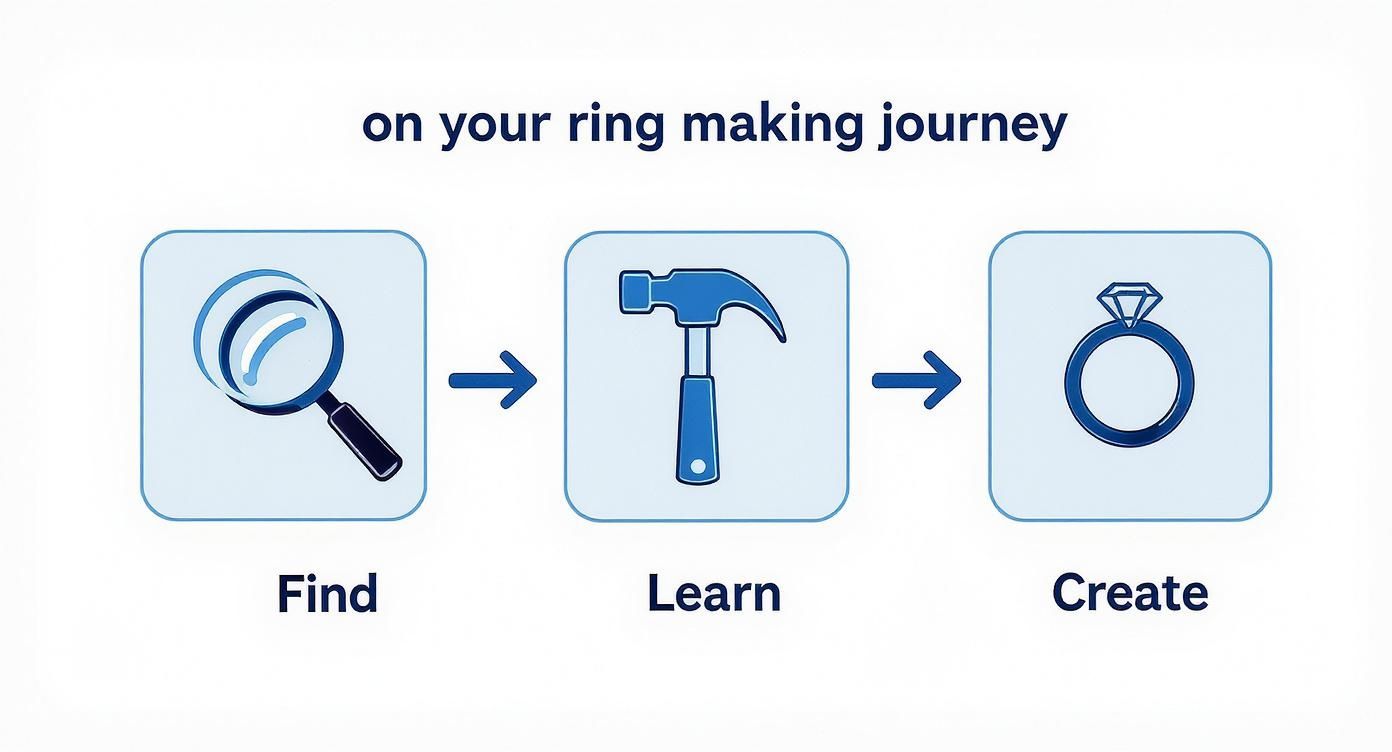
As you can see, it’s a clear path from discovering the craft to learning the skills and finally creating something uniquely yours.
The Magic of Soldering and Finishing
With your ring formed into a perfect circle, the next step is to make it whole. This is done through soldering, where a tiny piece of silver solder is placed on the join and melted with the torch, permanently fusing the two ends. It’s a surprisingly quick and satisfying moment when your ring becomes a single, seamless loop. Your tutor will be right there to guide you.
After soldering, your ring will look a bit rough around the edges, but this is where the final transformation begins. The finishing stages are where your piece really starts to shine and look like something you’d find in a jewellery shop.
Here's what the finishing process involves:
- Filing: Using special jeweller's files, you’ll smooth down the soldered join and refine the overall shape of your ring.
- Sanding: You'll work through different grades of emery paper to buff away any marks left from the tools, creating a clean, uniform surface.
- Polishing: The grand finale! Using a polishing motor or special hand-polishing cloths, you’ll bring your creation to a brilliant, professional shine.
By the time you’re done, you won’t just have a new piece of jewellery. You'll have the pride and satisfaction of having made it with your own two hands—a brilliant memory from a truly unique London experience.
How to Choose the Right London Workshop for You
London is packed with incredible ring-making experiences, but picking the right one comes down to a simple question: what do you want to achieve? Are you looking for a fun, creative afternoon out with a friend? Or are you planning something truly momentous, like crafting the very wedding bands you'll exchange at the altar? Knowing your goal is the first step.
With so many options out there, from short taster sessions to immersive private classes, it helps to think about the key details. Consider the occasion, how much time you have, the kind of metal you dream of working with, and your budget. Getting clear on this will point you towards a ring making workshop in London that’s a perfect fit.
There’s no denying the popularity of rings in the UK. They’re a huge part of our national jewellery story. In fact, rings make up the biggest slice of the pie, holding a massive 38.08% revenue share of the UK jewellery market. As market analysis from Grand View Research shows, that makes them the single most valuable category. This love for rings is exactly why you’ll find such a fantastic range of workshops across the capital.
Comparing Your Workshop Options
To help you decide, let's break down the most common types of workshops. A beginner's "taster" session is a world away from a dedicated wedding ring experience, and understanding the difference is key to having a brilliant day.
Think of a taster workshop as your entry pass into the world of silversmithing. It’s usually a half-day class where you'll focus on making a simple, elegant sterling silver band. The vibe is relaxed and social, making it perfect for a unique date, a birthday celebration, or just trying a new skill for yourself. You'll get hands-on with the core techniques—annealing, forming, soldering, and polishing—all in a friendly group setting.
A "make your own wedding rings" workshop, on the other hand, is a much more personal and focused affair. These are almost always full-day, private sessions for just you and your partner. Here, the emphasis is on meticulous craftsmanship as you work with precious metals like gold or platinum to create bands that will last a lifetime. While the investment is higher, the payoff is a pair of deeply meaningful symbols that you've poured your own story into.
Choosing the right workshop isn't just about the activity; it's about matching the experience to the memory you want to create. One is a fun, creative outing, while the other is a profound, once-in-a-lifetime project.
Here's a quick table to help you compare the options and find the best fit for your ring-making day in London.
Comparing London Ring Making Workshops
| Workshop Type | Typical Duration | Common Materials | Average Cost Range | Best For |
|---|---|---|---|---|
| Silver Ring Taster | 2-4 Hours | Sterling Silver | £80 - £150 per person | Fun dates, hen parties, creative solo outings, learning a new skill. |
| Wedding Ring Workshop | Full Day (6-8 Hours) | Gold, Platinum, Palladium | £500+ (plus metal costs) | Couples wanting a deeply personal and meaningful wedding ring experience. |
By weighing up these factors, you can confidently book the perfect ring making workshop London has to offer. You’ll be all set for a day that’s just as rewarding and memorable as the beautiful ring you take home.
Explore Bespoke and Advanced Ring Making Options
So, you’ve shaped and soldered your first silver band. You’re holding it in your hand, feeling proud, and probably wondering… what’s next? Moving beyond a beginner's session opens up a whole world of creativity, letting you craft something that’s truly, uniquely yours.
This is where you bridge the gap between a fun afternoon craft and the real art of bespoke jewellery. Many studios offering a ring making workshop in London have advanced or bespoke options for anyone looking to create something more intricate. It’s the perfect next step if you’ve officially caught the jewellery-making bug.
The Sculptural Art of Lost Wax Carving
One of the most popular advanced techniques you'll come across is lost wax carving. Instead of bending and hammering metal directly, you start by sculpting your ring from a special block of jeweller's wax. Think of it as creating a miniature sculpture. You can carve away, build up, and add incredible detail to create organic shapes and bold forms that would be a serious challenge with traditional silversmithing.
Once your wax model is perfect, it’s encased in a plaster-like material and fired in a kiln. The wax melts and drains away (hence the "lost wax" name), leaving a perfect, hollow impression of your design. Molten metal is then poured into this mould, creating a solid metal replica of your original wax ring.
This method is brilliant for:
- Intricate Designs: Perfect for detailed patterns, lettering, or sculptural features.
- Organic Shapes: Allows for flowing, natural forms that feel less constructed.
- Unique Profiles: Go chunky, asymmetrical, or completely unconventional.
The process is incredibly freeing. It shifts ring making from a construction job into a sculptural one.
Adding a Personal Touch with Stone Setting
Another way to elevate your creation is by adding a gemstone. While intricate claw setting is a highly specialised skill, many workshops offer introductions to setting a simple cabochon (a smooth, dome-shaped stone) into your ring. This is usually done with a bezel setting, where you create a tiny metal collar that you press over the stone to hold it securely.
Adding a stone instantly personalises your piece. You could choose a birthstone, a favourite colour, or just a gem you find beautiful. It’s a fantastic way to add meaning and a splash of colour, making your handcrafted ring feel even more special.
These advanced options turn a simple workshop experience into a genuine design journey. You go from following instructions to becoming the true architect of your jewellery, infusing it with your own style.
If you feel inspired to take that next step and bring a unique vision to life, exploring these techniques is a must. For more ideas, you might find our guide on how to design your own ring helpful.
Preparing for Your Workshop Day
So, you’ve booked your ring-making workshop in London. Fantastic! A little bit of prep work before you arrive will make all the difference, helping you to relax, get comfortable, and dive straight into the creative side of things on the day.
Knowing what to wear is a great start. Think practical and comfortable. You’ll be working with tools and metal, which can get a little dusty, so it’s best to leave your favourite outfit at home and opt for something casual. Most importantly, closed-toe shoes are essential. You’ll be in a proper workshop environment, so for safety’s sake, no sandals, heels, or flip-flops.
Safety and Practical Tips
In any workshop, your safety comes first. That means making sure nothing can get caught in machinery or get too close to a flame. It’s pretty straightforward stuff:
- Tie back long hair: This one’s non-negotiable. If you have long hair, please make sure it’s tied up securely.
- Remove loose items: Dangling jewellery, scarves, and even long, flowing sleeves can be a hazard, so it's best to avoid them.
- Know your ring size: It really helps to have your ring size sorted before you arrive. If you’re not sure, have a look at our quick guide on how to measure a ring size in the UK.
Taking care of these small details ensures the day runs smoothly, leaving you more time to focus on the fun part—actually making your ring. People truly value these hands-on experiences, which is reflected in the 4,456 specialist jewellery stores now operating across the UK. You can read more about the growth of craft experiences and jewellery industry statistics here.
Managing Your Expectations
One last thing—and it’s an important one. Remember that you’re here to create something by hand. It’s not going to be a machine-made, perfectly uniform piece. Your finished ring will have its own quirks and character.
Those tiny imperfections aren’t flaws; they're the story of your day. They’re what make the piece uniquely yours, far more special than anything you could buy off a shelf.
Come prepared, relax, and get ready to enjoy the process. You’re not just making a piece of jewellery; you’re making a memory.
Your Workshop Questions, Answered
Planning a creative day out is exciting, but a few practical questions always come up. Here are some clear, straightforward answers to the queries we hear most often about ring making workshops in London. Think of this as the final piece of the puzzle to clear up any hesitations so you can book with total confidence.
We’ll cover everything from skill levels and wedding rings to costs and what to wear, making sure you feel completely ready for a brilliant day at the jeweller's bench.
Do I Need Any Jewellery Making Experience?
Absolutely not. This is the number one worry we hear, but you can put it to rest. The vast majority of ring making workshops are designed from the ground up for complete beginners.
Your tutors aren't just skilled jewellers; they're excellent teachers. They know exactly how to break down the process into simple, manageable steps—from the right way to hold a file to safely using a soldering torch. The whole point is to learn and have fun, ensuring everyone leaves with a finished ring they're proud of, no matter their creative background.
The entire experience is designed to be accessible and encouraging. You don't need to be 'arty' or 'good with your hands'—just bring your enthusiasm and a willingness to try something new.
Can I Make My Own Wedding Rings at a Workshop?
Yes, and it’s an incredibly popular and meaningful choice for couples. Many London studios offer dedicated ‘make your own wedding rings’ workshops, which are a step up from the shorter taster sessions. These are usually full-day, private experiences just for you and your partner.
You’ll work with precious metals like gold, white gold, or platinum under the close, personal guidance of a professional jeweller. The process is more meticulous, focusing on creating a pair of perfectly finished bands built to last a lifetime. It’s a truly memorable way to craft the ultimate symbol of your partnership, and the experience often includes special touches like professional hallmarking and a celebratory glass of bubbly.
What Is the Average Cost of a London Workshop?
The cost of a ring making workshop in London depends on the length of the class, the complexity of the design, and most importantly, the metal you choose. It helps to have a clear idea of the different price points.
- Silver Ring Taster Sessions: These are the most accessible option. A half-day class where you make a sterling silver ring usually ranges from £80 to £150 per person. This price typically includes all the silver and tools needed.
- Wedding Ring Workshops: Crafting your own wedding bands is a bigger investment. These private, full-day experiences often start from around £500 for the tuition, plus the cost of your chosen metal. The price of gold or platinum changes with the market and depends on the width and thickness of your rings, so the final cost can vary a lot.
Always confirm the total price with the studio when you book. That way, there are no surprises and you can budget properly for your special day.
What Should I Wear to the Workshop?
Think practical. You’ll be in a working studio, so safety and comfort are key. Here’s what you need to remember:
- Wear Comfortable, Casual Clothes: Choose an outfit you don’t mind getting a little dusty. Avoid anything precious, delicate, or restrictive.
- Closed-Toe Shoes Are Essential: This is a non-negotiable safety rule in every workshop. No sandals, flip-flops, or high heels. Sturdy shoes like trainers or boots are perfect.
- Tie Back Long Hair: If you have long hair, it must be tied back securely to keep it clear of flames and any moving tools.
- Avoid Dangling Items: Take off any loose jewellery, scarves, or ties. Long, flowing sleeves are also a bad idea as they can easily get caught.
Following these simple guidelines ensures everyone has a safe and enjoyable time.
Ready to create a piece of jewellery that tells your story? At Opulence Jewellery Services, our Hatton Garden workshop is at the heart of London's craft scene. While we specialise in expert repairs and bespoke designs, we celebrate the hands-on artistry that goes into every piece. Discover how our skilled jewellers can help bring your vision to life or restore your most treasured items.