Engagement Rings Custom Design: The Ultimate Guide
25 November 2025 17 min read Hatton Garden, London
Discover engagement rings custom design: a complete UK guide from concept to finished ring with expert jewellers.
Choosing an engagement ring is one of the most personal decisions you'll ever make. More and more, couples are stepping away from off-the-shelf rings to create a truly one-of-a-kind symbol of their story with an engagement rings custom design.
It's a chance to design something that perfectly captures your journey together.
Crafting a Ring as Unique as Your Story
When you move beyond a standard catalogue, you start a deeply rewarding journey. This guide is your roadmap to the world of bespoke design, a process that’s far more accessible than you might think. It's about co-creating a future heirloom, piece by piece.
This isn't just a passing trend. It reflects a real shift in what people value: meaningful, ethically sourced pieces that tell a story. The UK jewellery market was valued at £4.4 billion in 2023 and is on track to hit £7.8 billion by 2025, with rings leading the way. Custom design is a huge part of that growth because it answers the call for something truly unique.
Why Choose a Custom Design?
Going bespoke means the final ring is a perfect reflection of your partner's taste and your life together. It lets you:
Infuse Personal Symbolism: Weave in meaningful details, from birthstones to hidden engravings that only you two understand.
Achieve a Perfect Fit: Design a ring that’s not just the right size, but also complements their hand shape, skin tone, and daily life.
Control Every Element: You have the final say on everything—the metal, the gemstone's origin and cut, and the smallest details of the setting.
The real magic of custom design is in the collaboration. It’s a partnership between your vision and a jeweller's expertise, turning a concept into a tangible symbol of commitment that will be cherished for generations.
We’ll demystify the entire process for you, from turning that first spark of an idea into a workable design to seeing a skilled artisan bring it to life. Our guide on custom engagement ring designs offers even more insight into the creative side.
We'll cover budgeting, choosing materials, approving the design, and the final crafting, so you feel confident and excited every step of the way. This is about more than just picking a stone and a setting; it’s about crafting a legacy.
Laying the Groundwork for a Perfect Custom Ring
Before you even step foot in a workshop, a bit of prep work makes all the difference. This isn't homework; it's about turning your first consultation into a genuinely productive design session, making sure your vision and budget are aligned right from the start.
The journey really begins with two things: figuring out a realistic budget and pulling together some meaningful inspiration. Nailing these down beforehand helps you explain your ideas clearly and gives your jeweller the right framework to bring your dream ring to life.
Establishing Your Budget
Setting a clear budget is the most practical first step. It guides every single decision, from the choice of metal to the size and quality of the centre stone.
A custom ring's price tag isn't just one number; it's a sum of its parts. Knowing what drives the cost helps you put your money where it matters most to you.
Precious Metal Choice: Platinum is denser and rarer than gold, so it typically costs more. White gold is a fantastic alternative but does need a fresh coat of rhodium plating every so often to stay bright white—a small maintenance cost to bear in mind.
Gemstone Selection: The biggest factor. A stone's rarity, carat weight, and quality (the famous 4 Cs: cut, colour, clarity) will significantly influence the final price.
Design Complexity: The more intricate the design, the more time and skill it demands. Details like filigree, pavé settings, or hand-engraving all add to the labour and, therefore, the cost.
As of 2025, the average spend on an engagement ring here in the UK is somewhere between £1,800 and £3,200. Bespoke designs usually sit at the higher end of that scale, which reflects the individual craftsmanship involved.
It's also interesting to see how tastes are changing. Modern couples are all about individuality and value, which is why lab-grown diamonds now make up over 70% of preferences for UK millennials.
To help you visualise where your money goes, here's a rough breakdown.
Custom Ring Budget Allocation Guide
This table shows how a hypothetical £3,000 budget might be split. Of course, you can adjust these percentages based on what's most important to you—a bigger stone or a more intricate setting, for example.
Component
Example Budget Percentage (e.g., £3,000 Total)
Key Considerations
Centre Stone
50-70% (£1,500 - £2,100)
This is the star of the show. Lab-grown vs. natural, carat size, and quality will be the main drivers here.
Metal & Setting
20-30% (£600 - £900)
Influenced by metal choice (e.g., platinum vs. 18k gold) and the complexity of the mount.
Accent Stones
5-10% (£150 - £300)
Small diamonds or gemstones for a halo or pavé band. Adds sparkle without a huge cost jump.
Labour & Design
10-15% (£300 - £450)
This covers the goldsmith's time for CAD design, casting, setting, and finishing.
Ultimately, a well-defined budget isn't a restriction; it's a creative tool. It empowers you and your jeweller to find the most beautiful and effective ways to realise your vision within your comfort zone.
Gathering Your Inspiration
With a budget sorted, the fun really starts: collecting inspiration. This is your chance to translate feelings and abstract ideas into something visual. Don't just look at other rings! The best ideas for an engagement rings custom design often come from unexpected places.
Think about sources that reflect your partner’s personality and style:
Architecture: The clean, bold lines of a modern building or the intricate details of a Victorian arch.
Nature: The gentle curve of a vine, the geometric shape of a snowflake, or the texture of tree bark.
Art & History: A pattern from a favourite painting or the distinct style of an era like Art Deco or Art Nouveau.
Heirlooms: Maybe it’s a tiny detail from a grandparent's brooch or the setting style of a family ring.
Get a mood board going—a physical corkboard or a Pinterest board both work perfectly. Collect images and, most importantly, add little notes about what you like in each one. Is it the colour contrast? The overall silhouette? A tiny, specific detail?
This collection becomes a visual language you can share with your designer. It helps them see the world through your eyes and craft a ring that’s genuinely personal. And as you gather ideas, think about metals, too. You can explore the difference between white gold and platinum in our guide to see which might suit your design best.
Choosing Your Diamonds, Metals, and Gemstones
The materials you choose are the very heart and soul of your ring. This is where your personal taste truly comes to life, turning a beautiful object into a meaningful emblem. Getting these decisions right ensures the final piece isn't just stunning, but also durable enough for a lifetime of wear.
Most people start with the centre stone. For many, that means a diamond. Understanding its quality is simpler than it seems; jewellers use the 'Four Cs' as a universal language, and grasping the basics empowers you to make a smart choice for your engagement rings custom design.
Demystifying the Four Cs
These four factors work together to define a diamond’s beauty and value. The trick is knowing you can prioritise one 'C' over another to fit your budget and personal style.
Cut: This isn’t about the shape (like round or oval), but how well the diamond’s facets handle light. A beautifully cut diamond will have that brilliant sparkle and fire you're looking for. A poor cut can make even the best stone look dull.
Colour: For white diamonds, this grades how colourless it is on a scale from D (completely colourless) to Z (light yellow or brown). Many of our clients find the best value in the G-J range, which appears nearly colourless to the naked eye.
Clarity: This measures the absence of inclusions (internal flaws) and blemishes (external marks). A truly flawless diamond is incredibly rare. Most have tiny imperfections that you'll only ever see under magnification.
Carat: This is simply the diamond's weight. While a higher carat weight means a larger diamond, remember that the cut dramatically affects how big it actually appears on the hand.
Diamond shapes are always evolving, reflecting changing tastes. For instance, while classic round-cut diamonds were the go-to, making up 59.4% of choices in 2022, they dropped to 45% by 2024. In contrast, oval cuts—often chosen for their elegant, elongated appearance in bespoke rings—have surged from 21.5% to 33% in that same period.
Beyond the Traditional Diamond
Your options for the centrepiece are wonderfully varied. The world of gemstones offers a rich palette of colours and meanings, and lab-grown diamonds provide a fantastic modern alternative.
Lab-grown diamonds are physically and chemically identical to natural ones but are created in a controlled environment. They offer exceptional value, often allowing you to get a larger or higher-quality stone for your budget.
Alternatively, coloured gemstones add a unique, personal touch. Sapphires are a classic choice, known for their deep blue hues and impressive durability. Emeralds offer a vibrant green, symbolising hope, though they do require more gentle care.
Selecting the Perfect Metal
The metal you choose for the band frames the entire design. It affects the ring's overall look, its durability, and how it feels against the skin.
Your choice of metal is a blend of aesthetics and practicality. It should complement the wearer's skin tone and stand up to their daily activities, ensuring the ring is as resilient as it is beautiful.
Platinum: Naturally white and incredibly dense, platinum is hypoallergenic and extremely durable. It's a premium choice that develops a soft, beautiful patina over time rather than losing its colour.
White Gold: An alloy of yellow gold and white metals, typically plated with rhodium for a bright white finish. It’s a popular alternative to platinum but will need occasional re-plating to maintain its lustre.
Yellow Gold: The classic, warm choice. It has a timeless appeal and looks beautiful against warmer skin tones. 18k gold offers a richer colour, while 14k is slightly more durable.
Rose Gold: A romantic, modern option made by alloying gold with copper. Its warm, pinkish hue is flattering on many skin tones and has become a firm favourite.
The setting that holds your chosen stone is just as crucial as the metal itself. You can learn more about how the right diamond jewellery setting can enhance your stone's brilliance and keep it secure for years to come.
Bringing Your Vision to Life Through Collaboration
This is where the magic really happens. Ideas, sketches, and Pinterest boards start their journey into a real, tangible piece of jewellery. The design consultation is a true creative partnership between you and your jeweller, a conversation where your vision meets our craftsmanship.
You’re the expert on your story; we’re the experts on making metal and stone tell it. Come ready with your inspiration, but stay open to professional guidance. An experienced jeweller can suggest tiny adjustments that make a ring more comfortable to wear daily, or clever ways to get the most out of your budget without sacrificing the look you love.
The Initial Sketches and Concepts
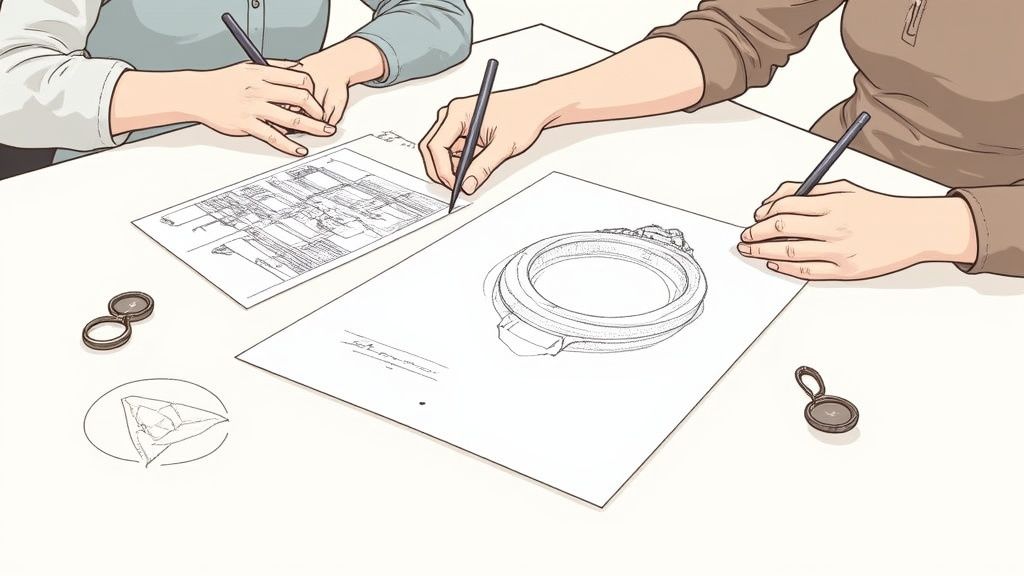
It nearly always starts with a pencil and paper. We’ll sit down and begin with rough sketches—nothing perfect, just quick, exploratory drawings that help turn your words into a visual. Think of it as a creative brainstorming session, a chance to see different ideas take shape and decide which elements you’re drawn to most.
Don't hold back. If a curve looks too sharp or a setting seems too high, this is the moment to say it. This back-and-forth sketching ensures we’re both on the exact same page before we get into the more technical stuff.
A great jeweller listens more than they talk. Their job is to interpret your story and taste, then apply their technical skill to create something that’s not only beautiful but structurally sound and built to last a lifetime.
Visualising Perfection with CAD Models
With a clear direction, we move the design onto the screen using Computer-Aided Design (CAD). This is a game-changer. It allows us to build a photorealistic, 3D model of your ring, letting you see it from every possible angle in perfect detail.
You can see how light will catch the facets of your chosen diamond, check the exact thickness of the band, and admire the tiny details of the setting up close. We’ll usually send over several rendered images, showing the ring in different lighting or even on a digital hand to give you a true feel for its scale. It takes nearly all the guesswork out of the equation.
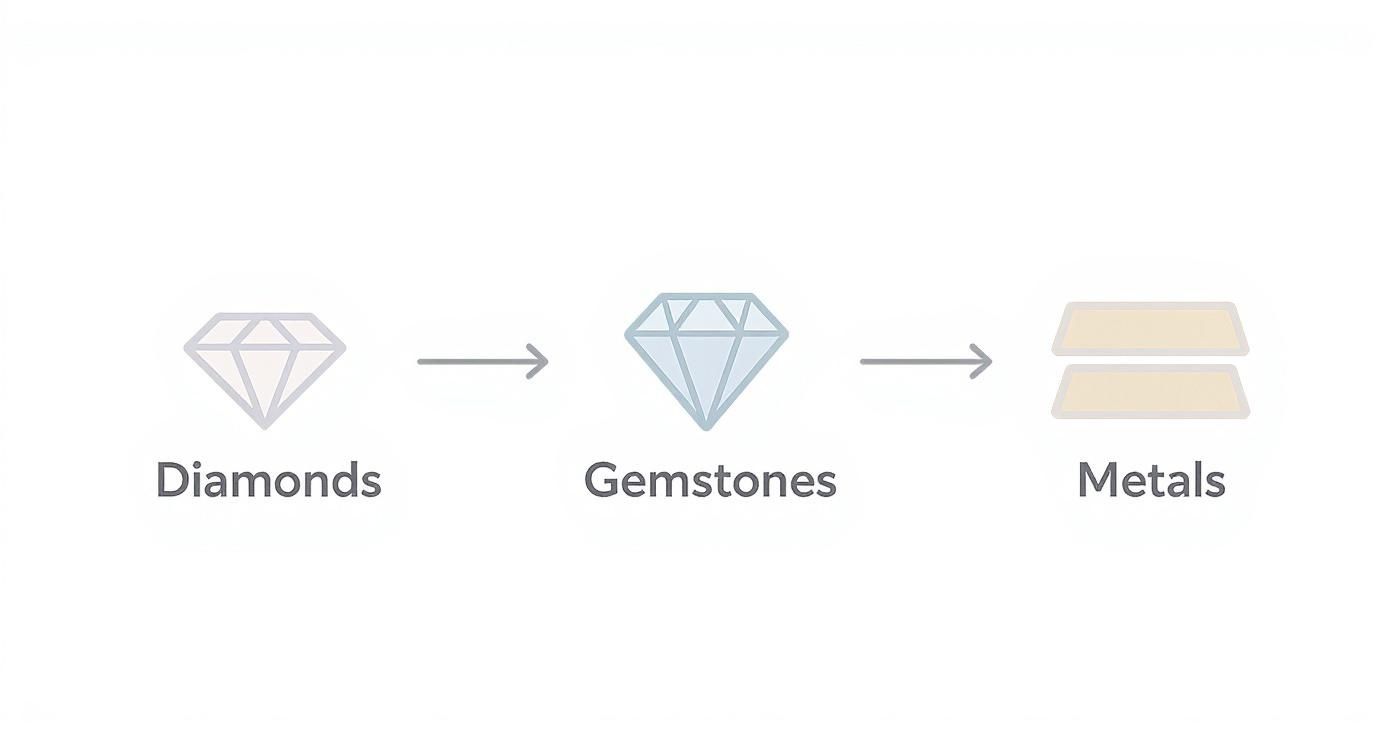
As the image below shows, this is the point where your chosen materials—the diamonds, gemstones, and precious metals—come together digitally to form the final aesthetic.
Holding the Future with Wax Models
For many people, this is the most reassuring part of the whole process. While CAD renders are fantastic, nothing beats holding a physical model in your hands. We’ll 3D-print a wax or resin prototype for you to try on.
This physical prototype lets you:
Check the Fit and Feel: You can confirm the ring size is spot-on and see how comfortable the band feels on your finger.
Assess the Proportions: Is the stone the right size for your hand? Does the setting sit at a height you like? You'll know for sure.
Confirm the Details: Get a close look at all the fine details, ensuring everything is exactly as you imagined it before we even think about casting in precious metal.
This journey—from sketch to digital model to physical prototype—is all about refinement and giving you total confidence. It ensures the final piece isn't just a ring we made for you, but the ring you helped create.
The Art of Crafting and Finishing Your Ring
Once you’ve signed off on the CAD renders and wax model, the real magic begins. This is where your vision leaves the screen and starts its journey into a tangible, precious object in the hands of a master goldsmith.
This stage of an engagement rings custom design isn't rushed. It typically takes several weeks, depending on how complex your design is. It's a precise, multi-step process where patience and an unwavering eye for detail are everything.
From Molten Metal to Solid Form
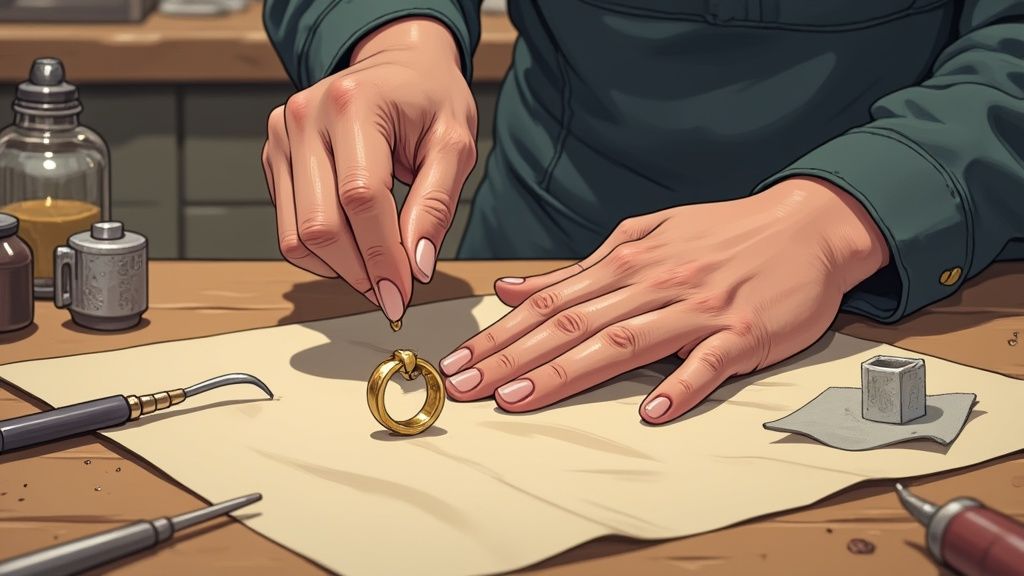
The first physical step is casting. We use your approved 3D-printed wax model to create a perfect mould. Molten metal—whether it's platinum, gold, or another alloy—is then poured in. Once it cools, the wax is carefully burned away, leaving the raw, foundational shape of your ring.
This initial casting is far from the finished product. It's a rough, unpolished piece that needs a skilled hand to refine. Our jewellers will file, sand, and meticulously shape the metal, cleaning up any tiny imperfections from the casting process and preparing it for the stones.
The Delicate Art of Stone Setting
Setting the diamonds or gemstones is probably the most critical and nerve-wracking stage of the whole process. This is where a jeweller's experience truly shines, as they have to secure each stone perfectly without causing any damage. The technique all depends on the setting style you’ve chosen, be it prong, bezel, or pavé.
A pavé band, for example, is incredibly intricate. The setter drills tiny holes into the metal and meticulously places each small stone, raising minuscule beads of metal to hold them securely. It’s a job that demands immense precision and can take many hours to get just right.
A master stone setter doesn’t just secure the gems; they position each one to maximise its brilliance. The goal is to create a seamless flow of light and sparkle, ensuring the stones are not only safe but showcased to their absolute full potential.
Adding the Finishing Touches
With the stones locked in place, the ring moves on to the final stages of finishing. This is where the piece truly comes alive, getting its signature lustre and polish. These final details are what separate a good ring from an exceptional one.
The finishing process includes several key steps:
Final Polish: The entire ring is meticulously polished using a series of compounds and wheels. This removes any tiny scratches left from the crafting process and brings the metal to a brilliant, mirror-like shine.
Hand Engraving: If your design includes custom engravings, a specialist engraver will carve these details by hand. This adds a unique, personal touch that machines simply can't replicate.
Rhodium Plating: For white gold rings, we apply a final layer of rhodium. This hard, silvery-white metal gives the ring its bright, dazzling finish and adds a layer of protection against scratches.
Before we call you, the ring goes through one last, rigorous quality check. The jeweller examines every single aspect under magnification—checking the security of the settings, the perfection of the polish, and the overall structural integrity. Only when it meets our highest standards is it finally ready for you.
Your Custom Engagement Ring Questions, Answered
Stepping into the world of bespoke engagement rings is a fantastic experience, but it’s completely normal to have a few questions. To give you total peace of mind, here are the straightforward answers to the queries we hear most often in our Hatton Garden workshop.
How Long Does a Custom Ring Take to Make?
From our first chat to the final polish, a bespoke engagement ring typically takes between 6 to 10 weeks. This gives us the right amount of time for careful design, precision craftsmanship, and for you to give feedback at every key stage.
A few things can influence this timeline:
Design Complexity: A simple, classic solitaire will naturally be quicker to perfect than a highly detailed, intricate design.
Sourcing Your Stone: If you have your heart set on a very specific or rare gemstone, it might take a little longer for us to track down the perfect one for you.
Your Approval Speed: The process moves smoothest when we get your thoughts on sketches and CAD models promptly. It's always a good idea to start the process well ahead of when you plan to propose.
Is a Custom-Made Ring More Expensive?
Not always. In fact, going bespoke often means you can get more value by tailoring the ring to your exact budget. You're in complete control of every element, from the metal to the stone's characteristics.
This control lets you decide what's most important. You could choose a slightly smaller diamond with a higher clarity grade, for instance, or opt for 18k gold instead of platinum to put more of your budget towards the craftsmanship itself. Working directly with a workshop like ours often proves more cost-effective than buying from a big retail brand with high overheads.
Can I Use My Own Heirloom Stone in the Design?
Absolutely. We love giving family heirlooms a new lease of life. Incorporating a stone with personal history into a modern design is a beautiful way to honour your past while creating a ring that’s entirely your own.
Before we start the design, our gemmologists will give your stone a thorough assessment to make sure it's secure and in good condition for resetting. From there, we’ll build a design that not only protects it for the future but also shows off its unique character.
Using an heirloom stone doesn't limit your creativity; it enriches it. We see it as the heart of the new story you're telling, and we build the design around its legacy.
What if I Don’t Like the CAD Model?
This is exactly what the CAD and wax model stages are for. They are your chance to make changes, and we fully expect and encourage you to give honest feedback. If something in the 3D render doesn’t feel quite right, just tell us.
It’s standard practice to include a set number of revisions. The whole point is to get it perfect before we cast any precious metal, so please don't be shy. Speaking up ensures the ring we make is the one you’ve been picturing all along.
Ready to create something truly personal? The skilled artisans at Opulence Jewellery Services are here in the heart of Hatton Garden to bring your vision to life. Explore our custom design services today.
Explore our curated list of 7 inspirational custom engagement ring designs. Find expert insights and actionable tips to create your perfect bespoke ring.
Shop Fine Jewellery Online
Engagement rings, wedding bands, earrings, necklaces & birthday gifts — beautifully crafted and delivered to your door.