Create Your Own Ring: A Complete Bespoke Design Guide
31 December 2025 16 min read Hatton Garden, London
Discover how to create your own ring with a concise guide to design, materials, and the bespoke process from expert Hatton Garden jewellers.
This is where the journey really begins—turning those daydreams and abstract ideas into a solid plan. It's about pulling inspiration from the world around you, whether it's the curve of an architectural arch or the intricate pattern on a leaf, and figuring out how to translate that into a piece of jewellery. A good project always starts with a clear blueprint that you and your jeweller can follow.
Translating Your Vision into a Tangible Ring Design
Before a single sketch is drawn or any metal is chosen, the first and most important step is to gather your thoughts. Making your own ring is an intensely personal process, and the final piece needs to be a true reflection of your style, your story, and your day-to-day life.
Think of this initial phase less about technical specs and more about inspiration and clear communication. You're building the foundation for the entire project. The clearer you can be about your vision, the smoother the whole thing will run.
Building Your Mood Board and Design Brief
Your first real task is to put together a mood board. This is more than just a collage of nice pictures; it’s a crucial tool to help your jeweller see what’s inside your head. It’s amazing how a few images can explain what words struggle to.
Use something like Pinterest or even just a folder on your desktop to save images that you're drawn to. And don't just limit yourself to photos of other rings. Your mood board could include:
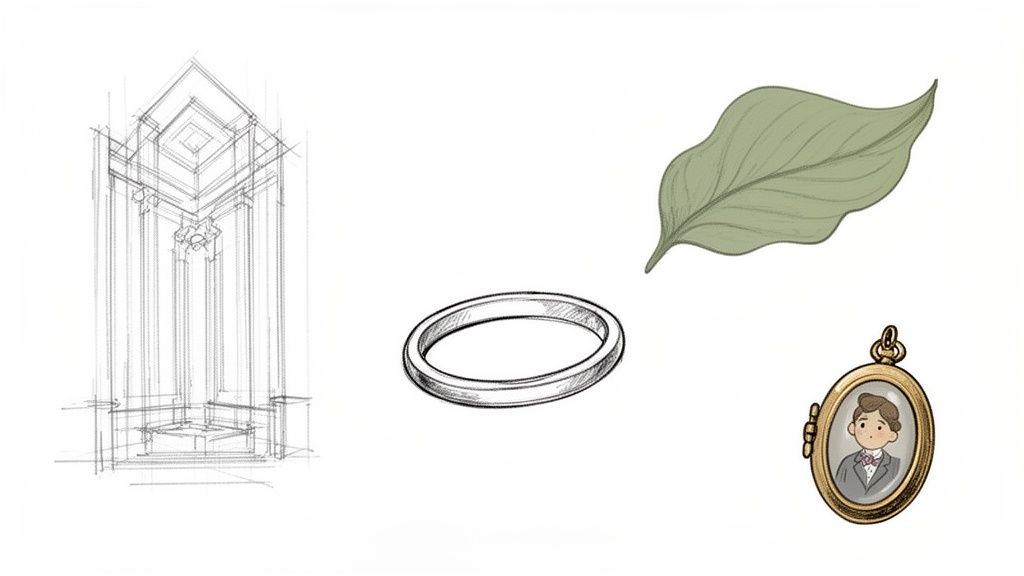
Architectural Details: The clean, sharp lines of a modern building or the intricate scrollwork on old iron gates.
Natural Elements: The organic shape of a seashell, the rough texture of tree bark, or the colours of a sunset.
Art and Heirlooms: A favourite painting, the engraving on a family locket, or a pattern from a vintage piece of fabric.
Existing Jewellery: Pieces you already own and love. Point out specific things, like the width of a band or the style of a setting.
Alongside the mood board, it helps to write a simple design brief. Just a few sentences to summarise the core idea. For example: "I’m looking for an Art Deco-inspired engagement ring, but it needs a low-profile setting because I have a very active lifestyle." This gives your jeweller a solid starting point. If you want to get truly hands-on, a ring making workshop in London can give you invaluable insight into the craft itself.
Your mood board and design brief act as a compass for the project. They make sure you and your jeweller are heading in the same direction, preventing any misunderstandings and setting clear expectations from day one.
Establishing a Realistic Budget
Setting a budget is a practical, non-negotiable step. It will influence every decision that follows, from your choice of metal to the stones you select. Being honest about your budget isn't a limitation; it's a framework that helps your jeweller find the best possible solutions for you.
When working out your numbers, remember to factor in all the potential costs:
Materials: The price of precious metals like platinum and gold changes daily, and the cost of gemstones can vary massively.
Labour and Craftsmanship: The more complex your design, the more time and skill it demands from the jeweller.
Contingency: It’s always smart to keep 10-15% of your budget aside. This little cushion covers any unexpected tweaks or small upgrades you might decide on along the way.
Choosing Your Metals and Gemstones
Now for the best part. With a design taking shape, it's time to choose the materials that will bring it to life. This is where personal taste, budget, and even your lifestyle all come into play. The right metal and stone combination won't just look incredible—it'll be made to last.
The metal you choose really sets the tone for the entire piece. While classic yellow gold is always a beautiful choice, it's just the starting point. You'll want to think about how the metal’s colour works with your skin tone and how it will complement or contrast with your chosen gemstone.
Selecting the Perfect Precious Metal
The metal is the foundation of your ring, so it needs to be beautiful but also tough enough for day-to-day life. If you have an active lifestyle or a hands-on job, durability is key.
Platinum, for example, is incredibly strong and naturally hypoallergenic, making it a brilliant choice for a ring that's going to see a lot of wear. Over time, it develops a soft, satin-like patina rather than losing its silvery-white lustre.
Yellow gold has that traditional warmth and looks stunning against warmer skin tones, especially when paired with gems like emeralds and rubies. Rose gold offers a more modern, romantic feel that's a perfect match for stones like morganite or champagne diamonds. Gold is still the number one material for custom jewellery here in the UK, making up 49% of the market share for bespoke rings. This preference for seeing materials in person is especially strong in London, driving demand for specialist workshops where you can actually feel the weight and see the colour up close. You can read more about the latest trends in the UK jewellery market.
If you love the look of platinum but are working with a different budget, white gold is an excellent alternative. It gets its silvery colour by being alloyed with white metals and is usually plated with rhodium for extra shine and protection. For a detailed breakdown, check out our guide on the difference between white gold and platinum.
Finding Your Ideal Gemstone
The gemstone is usually the star of the show, but your options go far beyond the classic diamond. While the famous "four Cs" (cut, colour, clarity, and carat) are vital for judging a diamond's quality, there's a whole world of incredible coloured gemstones out there.
Think about the colours you naturally love to wear.
Sapphires: Famous for their deep blue, but they actually come in a whole rainbow of colours. They’re also incredibly hard, second only to diamonds.
Emeralds: You can't mistake that lush green, but they are a softer stone, so they need a well-designed, protective setting.
Rubies: Symbolising passion, these bold red stones are extremely durable and always make a statement.
Don't dismiss modern, ethical options like lab-grown diamonds. They are physically and chemically identical to natural diamonds but offer a sustainable and often more accessible route, meaning you might be able to get a larger or higher-quality stone within your budget.
Ultimately, the right stone is the one that you connect with. A good jeweller won't just sell you a gem; they'll help you source a high-quality stone, advise on the best cut to show off its brilliance, and design a setting that protects it for a lifetime.
From Digital Design to Finished Piece: The Bespoke Journey
This is where the magic really starts. Your ideas, sketches, and inspiration begin their transformation from a concept into a wearable piece of art. The professional process to create your own ring is a careful blend of modern technology and age-old craftsmanship, ensuring the final piece is exactly what you envisioned—with no surprises.
It all kicks off in the digital world. Using your design brief and mood board, your jeweller creates a detailed Computer-Aided Design (CAD) model. Think of this as a precise, photorealistic 3D blueprint of your ring.
Visualising Your Ring with CAD
The CAD rendering lets you see your ring from every conceivable angle. You can examine the height of the setting, the width of the band, and exactly how the gemstones will sit. This is a critical checkpoint. To get a feel for this part of the process, it can be helpful to explore some 3D design visualization tools yourself.
This digital precision gets rid of all the guesswork. It’s far easier to request a tiny adjustment—like making the band 0.5mm thinner—at this stage than it is once the ring is cast in precious metal. It's a truly collaborative process, giving you complete control before committing to production. For a deeper dive into this crucial phase, our guide on how to design an engagement ring covers it in detail.
From Digital to Physical: The Wax Prototype
Once you’ve given your final approval on the CAD design, the next step is to bring it into the physical world. A high-resolution 3D printer creates an exact replica of your ring using a specialised wax or resin.
This prototype is a genuine game-changer. You can actually hold it, try it on, and get a true sense of its scale and proportions on your hand.
This tangible model is your final opportunity to confirm the fit and feel. It’s the moment you can say with 100% confidence, "Yes, this is perfect." It guarantees the comfort and ergonomics of the design live up to its aesthetic appeal.
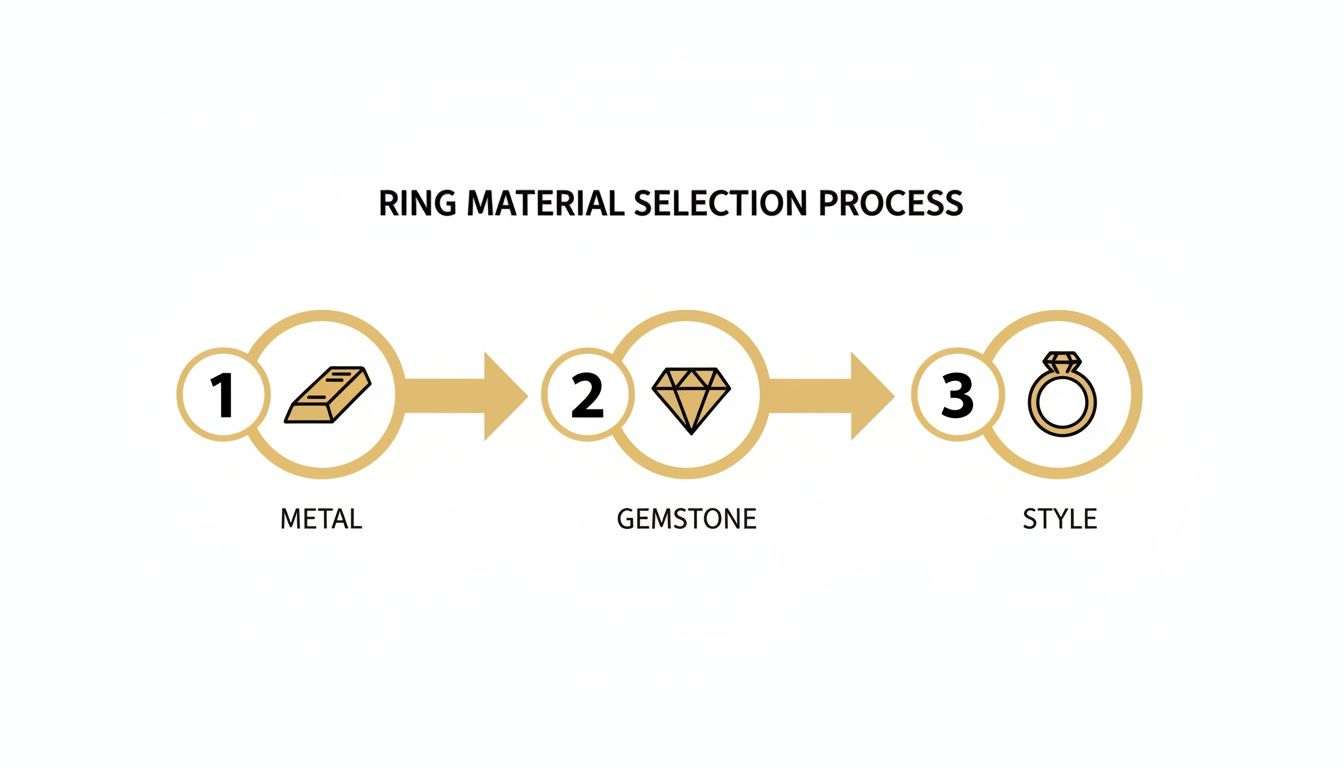
The visual below shows how the key material decisions you make lead right up to this production stage.
As you can see, foundational choices in metal and gemstones directly inform the final style that gets modelled in CAD.
The Final Stages: Casting and Finishing
With your sign-off on the wax model, the creation process moves into the hands of skilled artisans in our workshop.
Casting: Your wax model is used to create a mould, into which molten precious metal—be it gold or platinum—is poured. This technique, known as lost-wax casting, flawlessly captures every minute detail from your approved design.
Finishing and Setting: The raw casting is then meticulously cleaned, filed, and polished by hand. The jeweller skilfully sets your chosen gemstones, securing them in place and ensuring they capture the maximum amount of light.
Final Touches: This is when any engravings are added and, if you've chosen white gold, it receives its final bright rhodium plating. The ring undergoes a last polish and a rigorous quality check before it’s ready for you.
To give you a clearer picture of how long this all takes, here's a typical timeline for creating a bespoke ring from scratch.
Typical Bespoke Ring Creation Timeline
Stage
Typical Duration
Key Milestones
Initial Consultation & Design
1-2 weeks
Design brief finalised, sketches approved, stone selection confirmed.
CAD Modelling & Revisions
1-2 weeks
Receive 3D renders, provide feedback, approve final CAD design.
Wax Prototype & Approval
1 week
Receive and approve the 3D-printed wax model for fit and feel.
Casting & Initial Finishing
1-2 weeks
Ring is cast in precious metal, cleaned, and prepared for stone setting.
Stone Setting & Final Polish
1 week
Gemstones are set, final polishing, engraving, and plating completed.
Quality Control & Collection
2-3 days
Final checks are performed, and the finished ring is ready for you.
Keep in mind these are estimates; complex designs or sourcing rare gemstones can sometimes extend the process. But on average, you can expect the journey from concept to finished ring to take around 6 to 8 weeks.
Finding the Right Hatton Garden Jeweller
Choosing who will bring your ring to life is probably the biggest decision you'll make in this whole process. A great craftsman in London’s iconic Hatton Garden does more than just bend metal and set stones; they're your guide, your translator, and your creative partner. Find someone you click with, and the entire experience goes from daunting to genuinely exciting.
Your first step? Dive into their portfolio. Look past the initial sparkle and get a feel for their signature style. Do their pieces have that intricate, vintage character you love, or are they masters of clean, modern lines? Their previous work is the single best clue to their aesthetic and skill, so make sure it lines up with what you’re picturing.
What to Look for During a Consultation
The initial chat is where you find out if you've got the right fit. A good workshop won't be about the hard sell; they’ll be more interested in understanding your ideas. They should be asking you smart questions about your lifestyle, where your inspiration comes from, and what kind of budget you’re working with.
Remember, this is a two-way street. Come prepared with a few questions of your own:
Can you show me a few rings you’ve made that are similar to my idea?
How do you keep clients in the loop during the making process?
What happens if I want to make changes after I see the CAD model?
Can you walk me through your pricing so I understand exactly what I’m paying for?
Honest communication and clear pricing are non-negotiable. A jeweller you can trust will give you a detailed quote and a realistic timeline right from the start. No hidden costs, no nasty surprises. That collaborative spirit is what really separates a decent workshop from a truly great one.
Understanding the Jeweller's Role in a Growing Market
The desire for jewellery that’s truly personal has never been stronger. In fact, rings are the biggest part of the entire jewellery market, and that’s largely driven by their emotional weight and the boom in customisation. When you decide to create a bespoke ring, you’re part of a major shift towards pieces that mean something. You can find more on the UK's jewellery industry trends here.
A proper Hatton Garden jeweller gets this. They know they aren’t just making another ring; they’re crafting a future heirloom that tells a story—your story.
The right jeweller is a collaborator, not just a vendor. They should be as invested in bringing your vision to life as you are, offering expert guidance while always respecting your ideas and budget. This partnership is the foundation of a truly successful bespoke experience.
Aftercare: Keeping Your Bespoke Ring Like New
The journey doesn't end when you slip the ring on your finger. Now the focus shifts to preserving its beauty for a lifetime. Proper aftercare is more than just a quick clean; it’s about protecting your investment and the sentiment behind it. With a little regular attention, your bespoke piece will stay as stunning as the day it was made.
Daily life can take its toll. Lotions, soaps, and natural skin oils build up over time, creating a film that dulls the sparkle of both the metal and the gemstones. The good news is you don't need harsh chemicals to bring back the brilliance.
Simple At-Home Cleaning
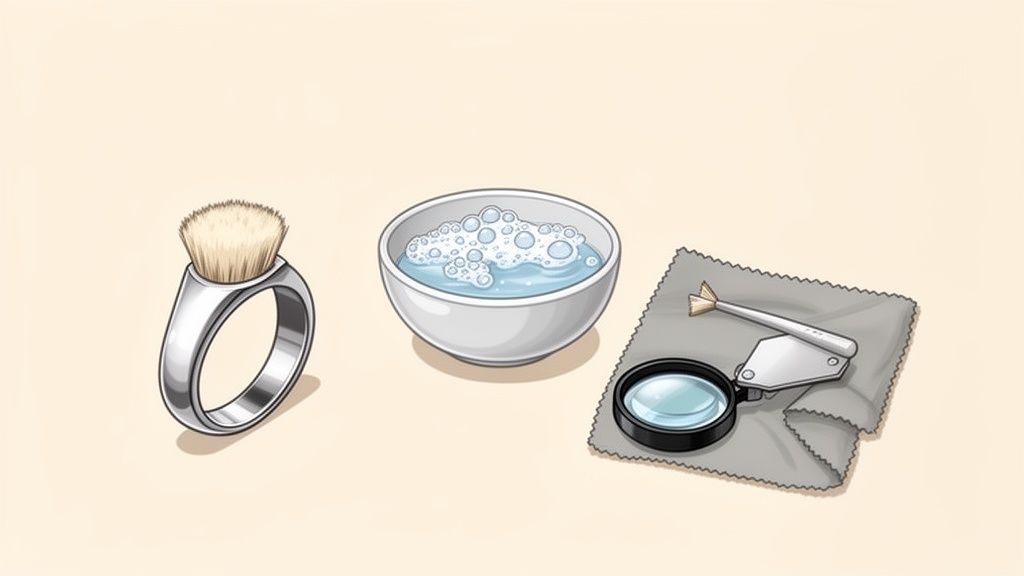
One of the safest ways to clean most rings is right in your own kitchen. All you need is a bowl of warm water and a few drops of gentle washing-up liquid.
Let the ring soak for 20-30 minutes to loosen any dirt and grime. Then, take a very soft-bristled toothbrush—a baby toothbrush is perfect for this—and gently scrub around the setting and underneath the stones. This is where build-up loves to hide.
Once you’re done, rinse the ring thoroughly under warm running water and pat it dry with a soft, lint-free cloth. A quick tip: avoid paper towels, as their fibres can leave tiny scratches on softer metals.
A weekly gentle clean is one of the best habits you can adopt. It stops significant build-up in its tracks, which means professional cleaning is quicker and more effective. More importantly, it keeps your gemstones catching the light day after day.
The Importance of Professional Maintenance
While home cleaning is great for keeping that surface-level sparkle, an annual professional check-up is absolutely crucial for your ring's long-term health. Think of it as an MOT for your most precious possession. A jeweller won't just clean it; they'll perform a deep, ultrasonic clean and inspect every detail under magnification.
This professional assessment includes checking:
Prongs and Settings: Are they tight and secure? This prevents any risk of losing a stone.
Metal Integrity: We look for signs of wear and tear, especially on the shank (the bottom of the band).
Overall Condition: A final polish will remove minor surface scratches and restore that original high-shine finish.
Custom rings are a huge part of the UK jewellery market, which is seeing its fastest growth in this area. With a clear preference among millennials for unique elements like lab-grown diamonds, the personal value invested in these pieces is higher than ever, making their preservation even more important. You can find out more about the growth of the UK jewellery market here.
Special Care for White Gold
If you chose white gold, your ring has almost certainly been plated with rhodium. This is a bright, silvery-white metal from the platinum family that gives it that brilliant, crisp shine.
This plating naturally wears away over time, which can reveal the slightly warmer, creamier tone of the white gold alloy underneath. It's completely normal.
Depending on your lifestyle and how often you wear it, you might need to have it re-plated every 12 to 24 months to maintain its lustre. This is a straightforward process that we can handle in the workshop, often as part of an annual maintenance check, leaving your ring looking brand new again.
A Few Common Questions About Custom Rings
Taking the first step into the world of bespoke jewellery naturally brings up a few questions. It’s a big decision, and it’s smart to get a feel for the process before you dive in. To give you a bit of clarity, here are some of the most common queries we handle every day in our Hatton Garden workshop.
How Much Does It Actually Cost?
This is usually the first thing people ask, and the honest answer is: it varies hugely. A simple, elegant 9ct gold band might land in the few hundreds of pounds. On the other end of the scale, an intricate platinum design set with a top-quality diamond can easily run into the thousands.
This is exactly why settling on a budget upfront is so important. It gives your jeweller clear parameters to work within, helping them guide you to the right metals, stones, and design complexity for what you’re comfortable spending. You’ll always get a transparent quote after your initial chat, so there are no surprises down the line.
What’s a Realistic Timeframe?
Another big one is the timeline. From your first sketch to the finished ring, the entire journey typically takes between 4 and 12 weeks. This pace allows for a thoughtful, unhurried process where every last detail gets the attention it deserves.
The process usually breaks down like this:
Design & CAD: This is the creative stage, including the 3D modelling and any tweaks you want to make. It usually takes 1-2 weeks.
Production: Once you’ve given the final green light, the physical crafting—casting, setting, and finishing—takes another 3-8 weeks.
Can I Use My Own Gold or Gemstones?
Absolutely, yes. We get asked this all the time. Remodelling an heirloom piece is a wonderful way to give sentimental jewellery a new lease on life. We can carefully remove stones to place in a new setting and often melt down and incorporate the original precious metal into your new design, blending a piece of your history into something fresh and modern.
The most important thing to remember is that you are in the driver's seat the entire time. We build in key approval stages—like signing off on the 3D CAD renders and the physical wax prototype—to make sure you are 100% happy before a single piece of metal is cast.
This collaborative approach is designed to make creating your own ring just as rewarding as wearing it. Every question is a valid one on the path to making something that is truly, uniquely yours.
Ready to start your own bespoke journey? The expert jewellers at Opulence Jewellery Services are here to guide you through every step, from initial design to the final polish. Visit us in Hatton Garden to discuss your ideas.
Thinking about how to design your own ring? This practical guide walks you through every step, from finding your style to choosing the perfect materials.
Shop Fine Jewellery Online
Engagement rings, wedding bands, earrings, necklaces & birthday gifts — beautifully crafted and delivered to your door.