design an engagement ring: UK guide to crafting your ring
14 November 2025 17 min read Hatton Garden, London
design an engagement ring: explore inspiration, budgeting, diamonds, and the CAD process in the UK.
Going bespoke for an engagement ring is a completely different experience from picking one out of a display case. It’s a personal journey where you get to create something that tells a unique story—your story. The whole process is a collaboration, turning your ideas and feelings into a real, tangible symbol of your relationship.
Why Go for a Bespoke Engagement Ring?
Choosing to design an engagement ring from scratch means you're not just buying jewellery; you're creating a future heirloom. You're in the designer's seat, making sure every single detail, from the curve of the band to the choice of stone, is a perfect reflection of your partner.
It’s an idea that’s really taken off. In fact, around 30% of UK consumers now choose a custom-made engagement ring over an off-the-shelf one. People want a ring with genuine personal meaning, and you can find out more about the bespoke ring market to see why so many couples are taking this path.
Taking Your Idea from a Sketch to a Masterpiece
The custom design journey is a clear, structured collaboration between you and a skilled jeweller. You don't need to be a design expert—your job is to bring the inspiration. The jeweller’s job is to translate that into a beautiful, wearable piece of art.
It generally unfolds like this:
Sharing Your Vision: It all starts with a conversation. We’ll talk about initial ideas, styles you love, and the story you want the ring to tell.
Expert Guidance: From there, we work together to refine the concept, helping you select the perfect materials and gemstones that fit your budget and vision.
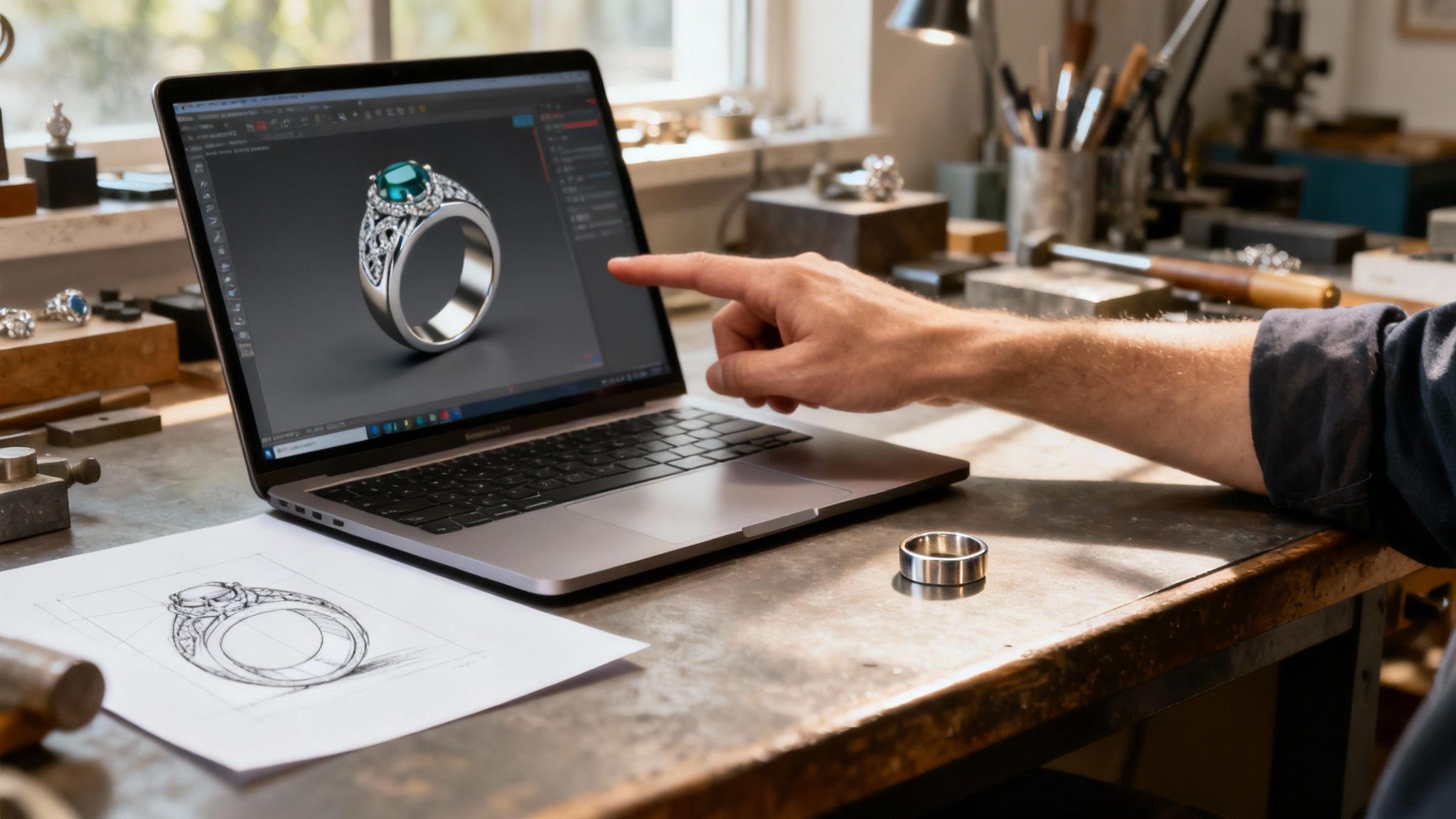
Digital Modelling: You get to see exactly how the ring will look with a 3D digital model (a CAD render). This is where you can make tweaks and give the final go-ahead before it’s made.
Artisan Craftsmanship: Once approved, our skilled craftspeople bring the ring to life—casting the metal, setting the stones, and polishing it all by hand.
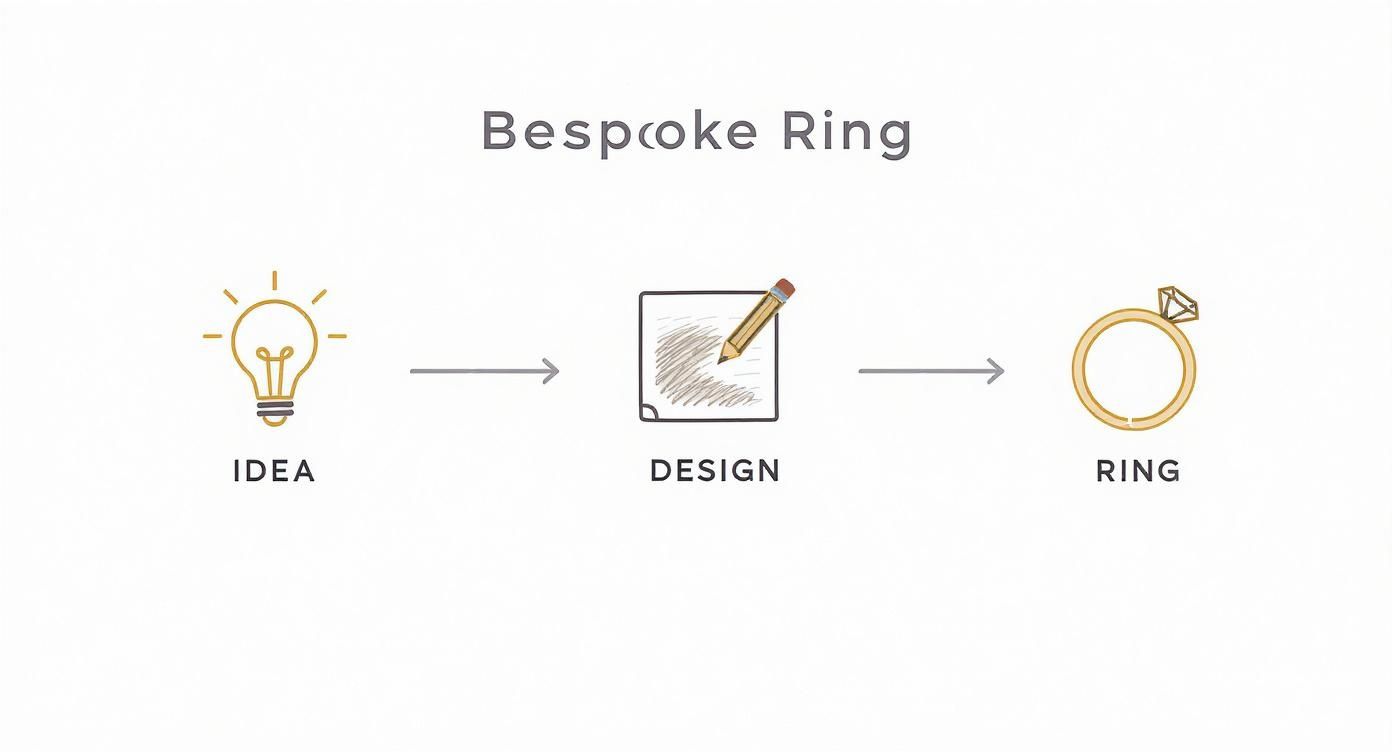
This infographic gives you a simple overview of how a rough idea transforms into a finished, polished ring.
As you can see, it's a seamless flow from that first spark of inspiration right through to the final, cherished piece.
Finding Inspiration and Setting Your Budget
Before a single sketch is drawn, the journey to a custom engagement ring starts with two things: what you love and what you want to spend. This is the fun part, the creative spark where you gather ideas that tell a story about you as a couple. It’s about building a blueprint that’s both meaningful and financially comfortable.
Inspiration can come from anywhere. You might spot an elegant curve on a vintage piece, admire the clean lines of modern architecture, or want to capture a shared memory in a design.
A private Pinterest board is a brilliant place to start, letting you quietly gather images of styles that catch your eye. Don't just look at rings, either. Textures, colours, and shapes from art or nature can all ignite incredible ideas.
Here in the UK, many of our clients gravitate towards classic, timeless designs that have proven their appeal for generations. The simple, elegant solitaire engagement ring, for example, remains a firm favourite, reflecting a national preference for understated beauty over fleeting trends.
Defining Your Budget
Setting a clear, realistic budget is probably the most important step you’ll take. Forget the old "three months' salary" rule; your budget should be a figure you're genuinely comfortable with. A defined budget helps your jeweller show you the very best options within your price range, avoiding any disappointment down the line.
To set your number, you need to think about what matters most. Is it the size and quality of the main stone? The precious metal? Or the intricacy of the design itself?
Prioritising is key. Deciding whether the diamond's carat weight or the complexity of the setting is more important will guide every single choice you make and help you allocate your funds effectively.
For instance, if a large, high-quality diamond is the top priority, you might opt for a simpler, classic solitaire setting in 18ct gold to put more of your budget towards the stone. On the other hand, if you’ve always dreamed of a unique, detailed band with intricate metalwork, you could choose a slightly smaller centre stone or a beautiful lab-grown alternative to make it happen.
To get a better sense of how different budgets can achieve stunning, unique results, you can explore our gallery of custom engagement ring designs. This honest self-assessment ensures your vision and finances are perfectly aligned from day one.
Custom Engagement Ring Budget Allocation
Here's a typical breakdown of how a custom ring budget is allocated, helping you prioritise where to spend your money.
Component
Typical Budget Allocation
Key Considerations
Centre Stone
50%–70%
The main driver of cost. A bigger budget here allows for higher carat, colour, or clarity.
Setting & Metal
15%–30%
Platinum costs more than gold. Intricate settings with pavé diamonds increase this share.
Side Stones/Accents
5%–15%
Small diamonds or gemstones that add sparkle to the band or create a halo.
Labour/Design
10%–20%
Covers the CAD design, casting, setting, and finishing by skilled goldsmiths.
This table is just a guide, of course. The beauty of a custom ring is that you can adjust these percentages to reflect what's truly important to you.
Choosing Your Centre Stone and Metals
Now for the brilliant part. With a solid design direction and a budget in place, we can start exploring the raw materials that will bring your ring to life.
The centre stone is the undeniable heart of the ring, while the metal band is its essential foundation. These two choices define not just the ring’s personality, but its durability for a lifetime of wear.
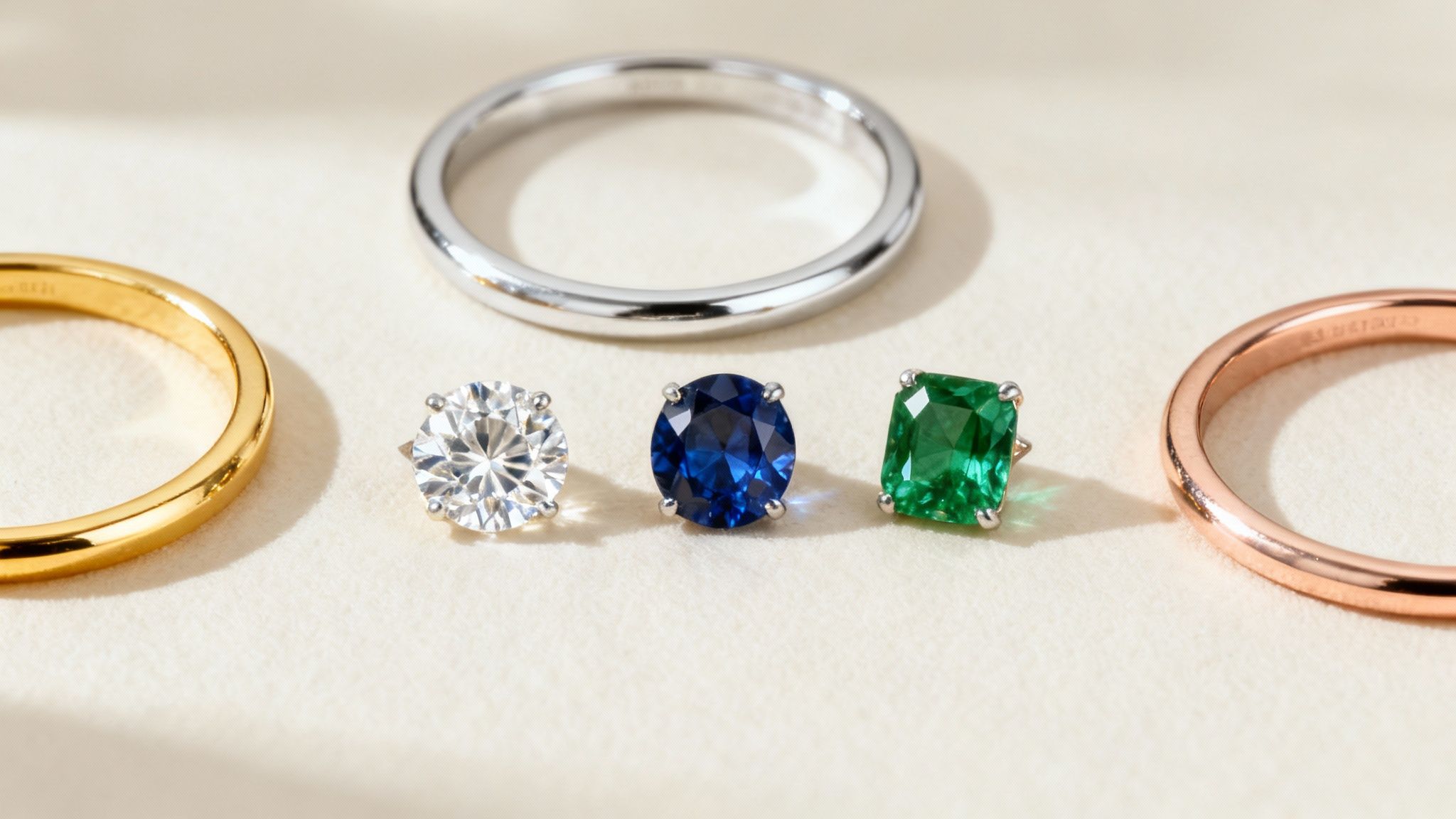
When you design an engagement ring, the conversation about the centre stone goes far beyond the classic 4Cs. While a traditional diamond is timeless, so many couples now choose gems that tell a more personal story.
Vibrant coloured gemstones like deep blue sapphires, rich green emeralds, or fiery rubies offer a stunning alternative. Each carries its own character and symbolism, turning the ring into a true expression of your partner’s style.
Exploring Diamond Alternatives
The world of diamonds has changed, too. Lab-grown diamonds are now a fantastic mainstream option, offering a stone that is chemically and visually identical to its mined counterpart.
The key benefit? They are often more affordable, which might mean you can opt for a larger or higher-quality stone within your budget. This, combined with their ethical and sustainable sourcing, makes them an incredibly compelling choice for modern couples.
If a diamond is what you have your heart set on, our complete guide on how to choose an engagement ring offers deeper insights to help you make the perfect selection.
Choosing a stone isn't just a technical decision; it's an emotional one. Think about your partner's favourite colour, their personal style, and even their birthstone. The right gem will feel like it was always meant for them.
Selecting the Perfect Metal
The metal you choose for the band does more than just hold the stone. It sets the entire tone for the piece and has to be right for your partner's lifestyle. In the UK, a few key choices stand out, each with its own distinct feel.
Platinum: Famous for its strength and naturally white sheen that will never fade or change colour. It’s hypoallergenic and incredibly durable, making it a brilliant choice for anyone with an active lifestyle. Keep in mind it’s the densest metal, and often the most expensive option.
Yellow Gold: A classic choice that gives off a warm, traditional glow. It works beautifully with vintage-inspired designs and is especially flattering on warmer skin tones. We usually recommend 18ct gold for its perfect balance of rich colour and strength.
White Gold: This is a very popular alternative to platinum. It’s an alloy of gold and white metals, coated with rhodium for a bright, white finish. It gives you a similar look to platinum at a more accessible price, but it will likely need re-plating every few years to maintain its lustre.
Rose Gold: With its romantic, pinkish hue from a copper alloy, rose gold has become a modern favourite. It's a stylish choice that complements all skin tones and brings a warm, contemporary feel to any design.
Think about how the metal’s colour will play off the centre stone. A D-F grade colourless diamond, for example, looks breathtaking in platinum or white gold, as the metal accentuates its icy brilliance. On the other hand, the warmth of yellow or rose gold can beautifully enhance a diamond with a slightly warmer tone or bring out the richness in a colourful gemstone like an emerald.
Your final choice is a balance of aesthetics, durability, and budget—the three pillars of a ring built to last a lifetime.
Bringing Your Vision to Life with CAD
This is where the magic really starts to happen. After our initial chat, where you’ve shared all your ideas and we’ve talked through materials, we move from sketches and concepts into the digital world. The next step is to build a Computer-Aided Design (CAD) model of your ring.
This isn’t just a simple drawing. Think of it as a precise, three-dimensional blueprint that gives you a photorealistic preview of the finished piece before a single gram of precious metal is touched.
The whole CAD process is a conversation between your vision and our expertise. It’s a crucial checkpoint that lets you see and fine-tune every single detail, so there are absolutely no surprises later on. You get complete confidence that the ring in your mind is the ring we’re about to create.
Understanding the CAD Renderings
Your CAD renderings are essentially a virtual photoshoot of your ring. We’ll send over a set of high-resolution images showing the design from every possible angle—top-down, from the side, even looking up from underneath.
The level of detail is incredible. You’ll be able to clearly see:
The proportions of the centre stone against the width of the band.
The exact placement of any smaller stones or delicate details like milgrain edging.
How high the setting sits off the finger, which is key for comfort and day-to-day wear.
The thickness and shape (or profile) of the band itself.
This kind of visual feedback is priceless. An idea that sounds perfect on paper can sometimes look or feel different once it’s rendered in 3D. Seeing it on screen empowers you to make small, informed adjustments with pinpoint accuracy.
This collaborative design stage is precisely why so many people in the UK choose a bespoke jeweller. The ability to see and approve a digital model before creation is a cornerstone of the custom experience, ensuring the final piece is exactly what you envisioned.
Even with the rise of online design tools, that in-person collaboration remains vital. It’s why offline sales still account for a huge 86.2% of the UK's jewellery market share, according to Grand View Research. People value that expert guidance and teamwork—you can read more on the importance of in-person jewellery expertise here.
Giving Clear and Constructive Feedback
Your role here is to be the final editor. When you get your renderings, the more specific you can be with your feedback, the better. Instead of saying "the band looks a bit thick," try something like, "could we see what it looks like if we reduce the band width by 0.5mm?"
Here are a few tips to make the process smooth:
Ask for Different Angles: If something doesn't feel quite right, ask us to render a new view for you.
Go Back to Your Inspiration: It often helps to refer back to your original mood board or photos to explain the look you're aiming for.
Trust Your Jeweller's Advice: If we suggest a change might compromise the ring's structural integrity, it’s worth listening. We understand the practical limits of a design and always want to create something that will last a lifetime.
After you provide feedback, we’ll make the tweaks and send a new set of images your way. This back-and-forth continues until you look at the design and say, "That's it. It's perfect." This careful process is just as important when you later decide to build your wedding ring to create a perfect matching set.
Once we have your final, enthusiastic approval, the digital file is sent to the workshop, ready to be brought to life.
The Final Touches and Approving Your Ring
Once you’ve given the final, enthusiastic nod on the CAD model, your ring makes the leap from screen to reality. This is where digital precision meets the hands-on expertise of a master goldsmith. Your design is cast in your chosen precious metal, followed by the meticulous work of setting the stones and bringing the whole piece to a flawless polish.
This is also the perfect moment to think about those deeply personal details that make a bespoke ring truly yours. While the main design is locked in, there's still a window to add subtle, meaningful elements that tell your unique story.
Thinking about these last flourishes is a key part of how you design an engagement ring that feels complete. It's about weaving in a layer of sentiment that only the two of you will share.
Adding Personal Engravings and Details
It’s often a tiny, hidden detail that transforms a beautiful ring into a personal heirloom. A secret message, a symbol of your journey together, tucked away just for you.
Consider incorporating one of these popular personal touches:
A Meaningful Engraving: A special date, a short, private phrase, or even the coordinates of where you first met can be inscribed inside the band.
A Hidden Gemstone: Setting a tiny birthstone on the inner surface of the band is a subtle, beautiful way to add a flash of colour and personal significance.
Milgrain or Filigree: For a touch more character, these delicate, vintage-inspired details can be added to the edges of the band or around the setting, adding texture and intricacy.
These final details are what elevate your ring from simply custom-made to deeply personal, ensuring it’s a true one-of-a-kind creation.
When the moment comes to see your finished ring for the first time, it’s completely normal to feel a rush of excitement and nerves. Take a deep breath and look closely—this is your chance to give the final sign-off with absolute confidence.
Your Final Approval Checklist
Your jeweller will have performed their own rigorous quality checks, but your eyes are the most important ones. This isn’t about hunting for flaws; it’s about confirming that every detail you so carefully planned has been brought to life exactly as you imagined.
Here’s a simple checklist to guide you during the final reveal:
Check the Stone Security: Gently touch the centre stone and any accent gems. They should feel completely secure in their settings, with no wobble or movement. All prongs should be smooth to the touch and evenly placed.
Inspect the Finish: Look at the metal from all angles under good, bright light. The polish should be consistent and flawless, with no visible scratches or marks. Check that the band’s profile is exactly as you designed it.
Verify the Engraving: If you added an inscription, double-check it for accuracy and clarity. Make sure the spelling, dates, and spacing are all perfect.
Confirm the Fit: Try the ring on. This is the moment of truth! Ensure the size is correct and it feels comfortable on the finger.
Seeing your vision brought to life in precious metal and gemstones is an unforgettable experience. Giving your final approval with this checklist in mind ensures the ring you take home is everything you dreamed it would be.
Your Custom Ring Questions, Answered
Stepping into the world of bespoke ring design is incredibly exciting, but it's only natural to have a few questions. From how long it all takes to the classic puzzle of finding your partner's ring size, getting the details straight from the start makes the whole process a pleasure. We’ve pulled together the most common queries we hear to give you complete confidence.
One of the first things people ask about is the timeline. You’ve likely got a proposal date in mind, and you need to know if your dream ring can be crafted in time. It’s a crucial question because true craftsmanship can’t be rushed.
Then there's the cost. Many people assume 'bespoke' is just another word for 'more expensive', but that’s not always the case. In fact, a custom design puts you firmly in control of the budget, letting you decide exactly where to invest.
How Long Does It Take to Design and Make a Custom Ring?
From our first chat to the moment you hold the finished ring, the process typically takes between 6 to 12 weeks here in the UK. This can shift a little depending on the complexity of your design or if we're sourcing a particularly rare or unusual gemstone for you.
Here’s a rough idea of the key stages:
Design & CAD Phase (2-4 weeks): This is where we talk, sketch, and create a precise 3D model of your ring. The timeline here really depends on how many tweaks we make to get it absolutely perfect.
Production Phase (4-8 weeks): Once you give the thumbs-up on the design, our goldsmiths get to work. This involves casting the metal, meticulously setting every stone by hand, and completing the final polishing and finishing touches that make it shine.
Our best advice? Try to start the process at least three or four months before you plan to propose. It just builds in a comfortable buffer and keeps everything relaxed and stress-free.
Is a Bespoke Ring More Expensive?
Not necessarily. While a very elaborate platinum ring with a huge, flawless diamond will of course have a premium price, a custom ring is ultimately built to your budget. You’re in the driver's seat.
You get to decide what truly matters. By working directly with a jeweller, you can put your money towards the things you value most—maybe it's the size of the centre stone, the feel of a certain metal, or the intricacy of the setting. Often, this means you get a ring with far more personal value for a similar price to an off-the-shelf piece from a high-street shop.
The real value of a bespoke ring is getting exactly what you want without paying for features you don’t. You control every single element, ensuring your investment is focused purely on the details that matter to you and your partner.
What if I Don’t Know My Partner’s Ring Size?
Ah, the classic challenge! The best and most accurate way is to secretly 'borrow' a ring they already wear on the correct finger (that's usually the third finger of the left hand) and get a jeweller to measure it. If that feels too risky, you could try pressing the ring into a bar of soap to create an impression or carefully tracing the inside circle onto paper.
If you absolutely have to guess, it is always safer to go slightly larger. Sizing a ring down is a much simpler job for a goldsmith than making it bigger, which can sometimes compromise the ring's structure. Most jewellers, including us, offer a complimentary resizing to make sure the fit is perfect after the big moment.
Can I Use an Heirloom Stone in a New Design?
Absolutely. Using a family gemstone is a beautiful way to honour your heritage and weave a bit of history into your own story. It’s something we love to do, and most bespoke jewellers are very experienced with it.
The first step is always a careful inspection. We’ll assess the stone's condition, checking for any tiny chips or wear that might affect its security in a new setting. From there, we design a new home for it that not only protects the cherished gem but shows it off beautifully, blending its legacy with your modern love story.
Ready to start your own bespoke journey? The expert team at Opulence Jewellery Services is here to guide you through every step of creating a beautiful, one-of-a-kind ring. Visit us to learn more about our custom design process.
Our expert guide to engagement ring resizing covers cost, process, and finding the perfect fit in the UK. Learn what to expect before you visit a jeweller.
Shop Fine Jewellery Online
Engagement rings, wedding bands, earrings, necklaces & birthday gifts — beautifully crafted and delivered to your door.