Resize Engagement Ring: UK Guide to Sizing, Costs, and Trusted Jewellers
19 December 2025 16 min read Hatton Garden, London
Need to resize engagement ring in the UK? This guide covers the process, costs, and how to find a trusted jeweller for a perfect, secure fit.
That sinking feeling when a new engagement ring doesn't quite fit is more common than you might think. But don't panic—in nearly all cases, you can resize an engagement ring. It's a routine, everyday job for any skilled goldsmith.
First thing's first: if the ring is too loose, stop wearing it immediately. The last thing you want is for it to slip off and get lost.
Your Engagement Ring Doesn't Fit—Now What?
Discovering your beautiful new ring isn't a perfect fit can feel a bit deflating, but it's an incredibly frequent issue. Whether it was a surprise proposal where the size was a loving guess, or just the natural way our fingers change with the seasons, many people need a small adjustment.
The journey to a perfect fit begins with figuring out if resizing is the right move for your specific ring.
Not all rings are created equal when it comes to alterations. A few key factors determine whether a jeweller can safely and seamlessly resize your piece.
Can My Engagement Ring Be Resized? A Quick Check
Use this table to get a quick idea of whether your ring is a good candidate for resizing.
Ring Characteristic
Good Candidate for Resizing
Challenging or Impossible to Resize
Metal Type
Gold, Platinum, Silver, Palladium
Tungsten, Titanium, Ceramic, Stainless Steel
Band Style
Plain band, Solitaire setting
Full eternity band (stones all around)
Stone Settings
Simple claw/prong setting
Tension setting, Channel-set stones
Band Detail
Smooth, unadorned band
Intricate engravings, Milgrain edges, Heavy patterns
Size Change
Up or down by 1-2 sizes
A change of more than 2 sizes
This gives you a solid starting point, but a professional assessment is always the final word.
Key Factors for Resizing Eligibility
The type of metal is the first hurdle. Precious metals like gold, silver, and platinum are what jewellers love to work with—they’re malleable and respond beautifully to resizing. On the other hand, some contemporary metals like tungsten and titanium are incredibly hard and can't be cut and soldered in the traditional way.
The ring's design also plays a huge part. A classic, plain-band solitaire? That’s about as straightforward as it gets. Things get trickier with more detailed designs.
Pavé or Channel Settings: Rings with a band full of tiny, closely-set diamonds are delicate. Changing the curve of the ring can loosen these stones, so it requires a very careful hand.
Eternity Bands: With an unbroken circle of diamonds, these are the most difficult. Often, resizing isn't possible without completely remaking the ring from scratch.
Intricate Engravings: Detailed patterns that wrap around the band can be disrupted where the jeweller makes the cut. A good goldsmith can often re-engrave the area, but it adds complexity and cost.
As a general rule of thumb, most engagement rings can be safely sized up or down by about two sizes. Pushing it further can start to compromise the ring's structure, especially the tension holding your main diamond in place.
Finally, the amount of resizing needed is critical. A small tweak of half a size up or down is usually a simple affair. If you need to jump several sizes, it becomes a much more involved job that a jeweller needs to assess carefully to ensure the integrity of the setting isn't put at risk.
How To Find Your Accurate Ring Size
Getting the measurement right is the single most important part of the whole resizing process. It sounds simple, but your finger size is a moving target—it can change with the weather, what you’ve eaten, and even the time of day. Just taking one measurement and running with it is a classic mistake that often leads to another trip to the jeweller.
So, what’s a perfect fit? A well-sized ring should slide over your knuckle with a bit of a push, then sit comfortably at the base of your finger without spinning around. If it’s a real struggle to get on or leaves a deep indent, it's too tight. On the other hand, if it slips off easily when your hands are cold or wet, it's dangerously loose.
Finding Your True Size
The best way forward is to measure your finger a few times to find a reliable average. It's completely normal for your fingers to swell a little in the heat and shrink when it's cold. They can also be a bit puffier in the morning or after a particularly salty dinner.
To get a reading you can trust, here are a few insider tips:
Measure at the end of the day. Your fingers are usually at their largest in the evening when your body temperature is stable.
Avoid measuring when you're cold or hot. Extreme temperatures will give you a false reading, one way or the other.
Measure three to four times. Taking a few measurements on different days and at different times helps you find a consistent size that works for you in most conditions.
This approach gives you a size that’s right for your actual, everyday life—not just for a single moment in a shop.
Your ideal ring size is one that feels right most of the time. It might feel a bit snug on a hot summer afternoon and a little looser on a chilly winter morning, and that’s perfectly normal. The aim is a secure, comfortable fit for the majority of the time.
Professional Sizing vs At-Home Methods
While you can find printable sizers and charts online, and they can be a decent starting point, nothing really beats getting it done professionally. A jeweller uses a proper set of calibrated metal rings (called a finger gauge) to find your exact fit with total precision.
Getting the fit right is the first hurdle. If you're looking for more advice on how to accurately measure for a ring size, that guide offers some excellent tips. Ultimately, visiting a professional takes out all the guesswork and gives you peace of mind that the job will be done right the first time.
How We Resize Your Ring: A Look Inside the Workshop
So, you've got the perfect size pinned down. But what actually happens behind the workshop door when you hand over your ring? Resizing an engagement ring isn't just a simple adjustment; it's a delicate craft, blending time-honoured goldsmithing skills with absolute precision. The path we take depends entirely on one thing: whether your ring needs to go up or down in size.
Knowing the techniques helps you understand the skill involved and chat more confidently with your jeweller. Let's break down the most common methods.
To Make a Ring Smaller: The Cut and Solder Method
When a ring is too loose, our go-to method is the cut and solder. Think of it as a small, precise surgical procedure for your jewellery.
A master goldsmith will carefully measure and mark the exact slice of metal to be removed from the bottom of the shank (that’s the part of the band under your finger). We choose this spot because it's out of sight and almost never has any design work on it.
Using a fine jeweller's saw, we cut out that tiny piece. The two fresh ends of the band are then filed and shaped to perfection, ensuring they’ll meet without a single gap. A torch is used to solder them back together, creating a bond that’s as strong as the original metal. The final, most crucial part is the finishing—meticulously cleaning, polishing, and buffing the entire ring, with extra attention on the join.
A job well done means the solder point is completely invisible. The ring should look as if it was never touched, restored to its perfect circle and flawless finish.
To Make a Ring Larger: Stretching vs. Adding Metal
If your ring feels a bit too snug, we have a couple of options. The right choice comes down to how much larger it needs to be and, of course, the ring’s design.
Stretching: For a tiny increase—usually no more than half a size—we can sometimes stretch the metal. This is done with a specialist tool called a ring stretcher that gently expands the band. The trade-off is that it thins the shank ever so slightly, so it’s only really suitable for plain bands. The pressure involved can put stress on stone settings, so we avoid it for those.
Adding Metal: This is the much safer and preferred method for bigger size adjustments or any ring with stones. Just like making a ring smaller, we cut the shank at the bottom. But instead of taking metal away, we insert a small, perfectly matched piece of gold or platinum to bridge the gap. We then solder it into place on both sides before polishing it back to a seamless, immaculate finish. This way, the ring's thickness and strength are completely preserved.
The Unique Challenge of Intricate Designs
Not every resize is a straightforward job. The style of your ring can throw a few curveballs. For instance, the huge popularity of certain styles has brought their resizing challenges to the forefront. Recent data shows oval engagement rings are a massive trend, but their elongated shape can sometimes complicate sizing after the proposal. You can see more on what’s popular and why in this analysis of popular engagement ring styles.
Rings with pavé or channel-set stones along the band are especially tricky. When you change the curve of the ring, even slightly, you risk loosening the tiny prongs or channels holding those diamonds in place. A skilled jeweller has to work with extreme care, and will almost always check and tighten every single stone after the resize is finished.
Then you have eternity bands, with their complete, unbroken circle of diamonds. These are the toughest of all. In most cases, they simply can't be resized using traditional methods because it would break the continuous setting. For these rings, the only real solution is often to remake the band entirely—a far more involved and costly process.
Engagement Ring Resizing Costs in the UK
Getting that perfect fit is everything, but it helps to know what to expect on the bill. The final cost to resize an engagement ring isn’t just one flat fee; it’s a mix of the metal, the complexity of the job, and the jeweller's time. Understanding these factors means no nasty surprises when you get the quote.
The biggest influence on price is the type of metal. Platinum is a prime example. It has a much higher melting point than gold, which means it needs specialist tools and a higher level of skill to work on. That extra effort and expertise mean resizing a platinum ring will pretty much always cost more than an identical one in yellow or white gold.
Breaking Down the Price Factors
Beyond the metal itself, the intricacy of your ring’s design is a massive factor. A simple, plain solitaire band? That’s about as straightforward as it gets.
But if your ring is covered in tiny diamonds in a pavé setting, the jeweller has to work with incredible care to make sure none of the stones come loose. That delicate process adds to the time and, naturally, the cost.
The amount of resizing needed also plays a part. Making a ring a full size larger by adding a new piece of gold is more involved and uses more material than making it just half a size smaller by taking a sliver out. Each detail adds up to create the final price.
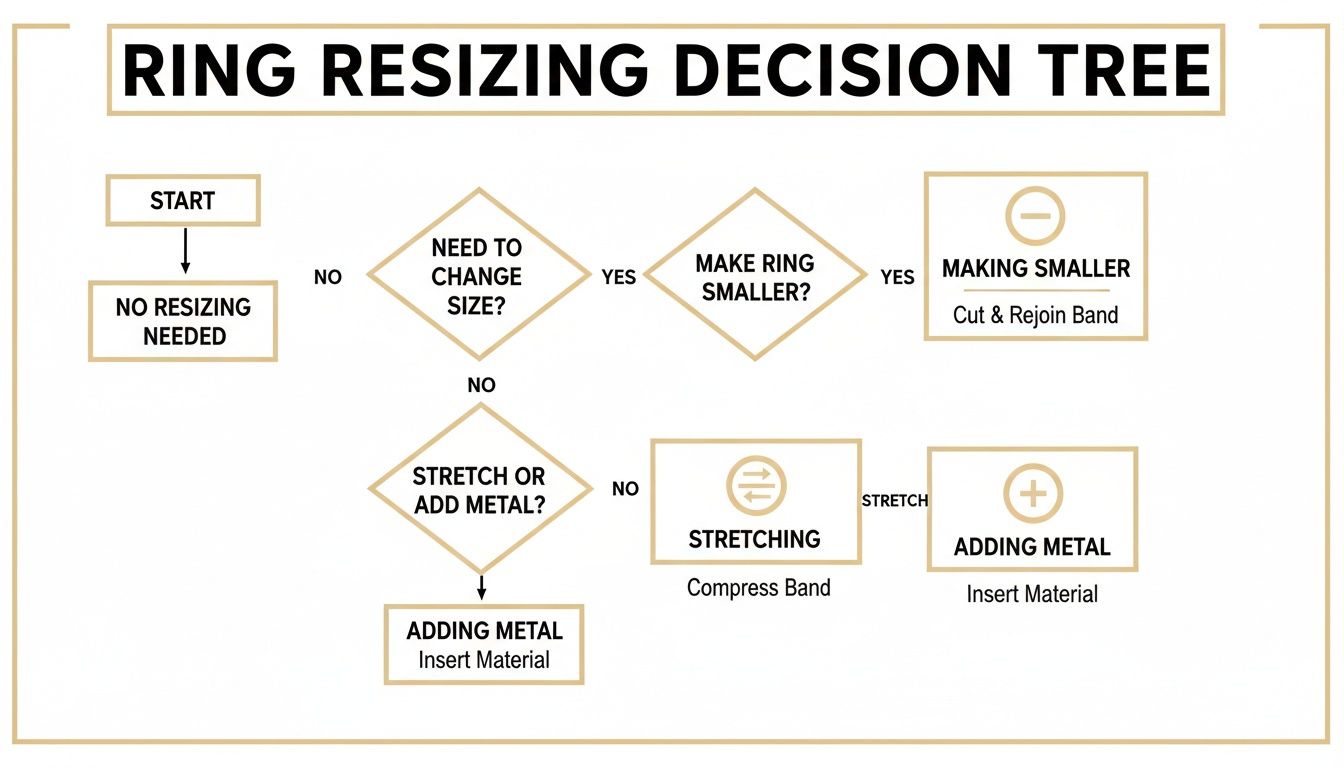
This decision tree gives you a simple look at the paths a jeweller might take, depending on whether the ring needs to go up or down in size.
As the flowchart shows, making a ring smaller usually means cutting and soldering the band back together. Making it larger can be done by either stretching the metal for tiny adjustments or, more commonly, adding a new piece in for a seamless result.
Typical Costs and Timelines
So, what should you actually budget? For a simple gold band, you’re often looking at a starting price of around £80. If you’re dealing with a complex design, especially in platinum, that cost can climb quickly.
While most ring resizing in the UK averages between £100-£300, it’s not uncommon for intricate work on high-value pieces to push towards £500. For a more detailed breakdown, have a look at our full guide on how much it costs to resize a ring.
Turnaround time is usually about one to two weeks. But if you're in a real hurry for a special occasion, many workshops—especially in places like London's Hatton Garden—offer an express or even a same-day service for an extra fee.
It's a popular service. We saw a 15% jump in resizing requests after the 2020 lockdowns, as people's lifestyles (and finger sizes) shifted. More recently, the rush of last-minute Christmas proposals always drives a huge demand for speedy resizing services just before the holidays.
How to Choose a Trusted Jeweller for Your Ring
Handing over your engagement ring for a resize can be a bit nerve-wracking. We get it. This isn't just any piece of jewellery; it’s loaded with memories and meaning, so finding a jeweller you trust is the most important step in the whole process.
Your first port of call should always be the original jeweller if possible. They’ll know the ring’s construction inside and out. But that’s not always practical.
If you’re looking for a new workshop, focus on established specialists with a solid local reputation and plenty of positive, genuine online reviews.
Vet Their Experience and Workshop
One of the first things you should ask is whether the work is done on-site. Many high-street shops actually send repairs to a separate workshop, which adds time, risk, and a layer of detachment from the person actually working on your ring.
A jeweller with an on-site workshop—like ours in Hatton Garden—gives you a direct line to the goldsmiths. It often means a much faster turnaround, too.
Don’t be afraid to get specific. Ask them directly: "Have you worked on platinum pavé rings like mine before?" Their answer should fill you with confidence, not hesitation. A good jeweller will understand the nuances of different settings and metals.
Don't be shy about asking to see examples of their previous resizing work. A reputable jeweller will be proud to show you the quality of their craftsmanship and the seamless finish they achieve.
Questions to Ask Before You Commit
Before you leave your ring with anyone, you need to feel 100% comfortable. Arm yourself with a few key questions to get the peace of mind you deserve. This is about more than just the price.
What’s your process? Get them to explain exactly how they’ll do it. Will they be cutting and soldering, stretching, or adding a piece of metal?
Is my ring insured here? You need to confirm your ring is fully covered by their insurance while it’s in their care. No exceptions.
Do you guarantee your work? A professional will always stand by their craftsmanship, guaranteeing the join will be invisible and your stones will be secure.
What’s the final cost and when can I collect? Always get a firm quote and an estimated completion date in writing.
Choosing the right expert is everything. For a bit more guidance, our article on where to have a ring resized offers some extra tips. A little research upfront makes all the difference, ensuring your cherished ring comes back looking flawless and fitting perfectly.
Caring for Your Newly Resized Ring
Your ring is back on your finger, fitting perfectly. But before you walk out of the jeweller's, there's one last crucial step: a final inspection to make sure the work is absolutely flawless. A professional resize should be completely invisible, leaving the ring looking exactly as it did before, only better fitting.
Take a moment to run your finger along the bottom of the band. You shouldn't feel any bumps, dips, or rough patches—just a perfectly smooth, polished surface. Look closely at the colour and finish. There should be no sign of a join or any discolouration at all.
Final Checks Before You Leave
It only takes a minute, but these checks are essential.
Check the Stones: Hold the ring close to your ear and give it a gentle tap. Can you hear a faint rattle? That could mean a stone has become loose during the heating process. If you hear anything, ask the jeweller to inspect and tighten the settings right there and then.
Check the Shape: Look at the ring head-on. Is it still a perfect circle? A rushed or poor resizing job can sometimes leave the band slightly oval.
Check the Finish: The entire ring should have a consistent, brilliant shine. No dull spots, no visible solder marks, just a seamless polish from top to bottom.
Your newly resized ring is an investment worth protecting. A resize can sometimes alter its valuation, so this is a great time to check in on your insurance policy and make sure your documentation is up to date.
To keep it looking its best, bring your ring back for a professional clean and inspection every six to twelve months. This will keep the stones secure, the metal bright, and ensure your ring stays as beautiful as the day you first wore it.
Your Ring Resizing Questions Answered
When it comes to something as sentimental as an engagement ring, it’s only natural to have questions. You want to feel confident before handing it over. Here are a few of the most common things clients ask us.
How Many Times Can My Ring Be Resized?
Most rings can handle being resized once or twice without any issues. Each time a jeweller heats and works the metal, it goes through a bit of stress, which can slowly affect the band's integrity—especially if it’s a particularly fine or delicate design.
Rings with very complex settings or those that have already been sized up or down by several sizes are a little more vulnerable. A good jeweller will always have a close look at your ring’s current condition first, to make sure another resize is a safe bet for your specific piece.
A professional resize should be completely invisible, leaving no trace. If a job is done poorly—leaving a visible seam, warping the setting, or distorting engravings—it doesn't just look bad; it can genuinely affect the ring's long-term value.
Should I Resize My Ring While I'm Pregnant?
Our strong advice is to wait. It’s always best to hold off until at least a few months after giving birth before you resize an engagement ring. During pregnancy and the postpartum period, finger size can fluctuate quite a bit due to natural swelling and water retention.
If you resize your ring during this time, you’re almost guaranteed to end up with the wrong size later on. The simplest and safest thing to do is wear your ring on a necklace or keep it somewhere secure until your finger size has settled down. A little patience now means you only have to do the job once and get a perfect, lasting fit.
Restore your ring's brilliance with our expert guide on cleaning diamond rings. Learn safe, effective home methods and know when to see a professional.
Thinking about resizing a wedding ring? Our guide covers UK costs, jewellers, and the process for gold, platinum, and rings with stones. Get a perfect fit.