15 November 2025 15 min read Hatton Garden, London
Discover how much to get a ring resized. This guide covers UK costs for gold and platinum, key price factors, and how to find a trusted jeweller.
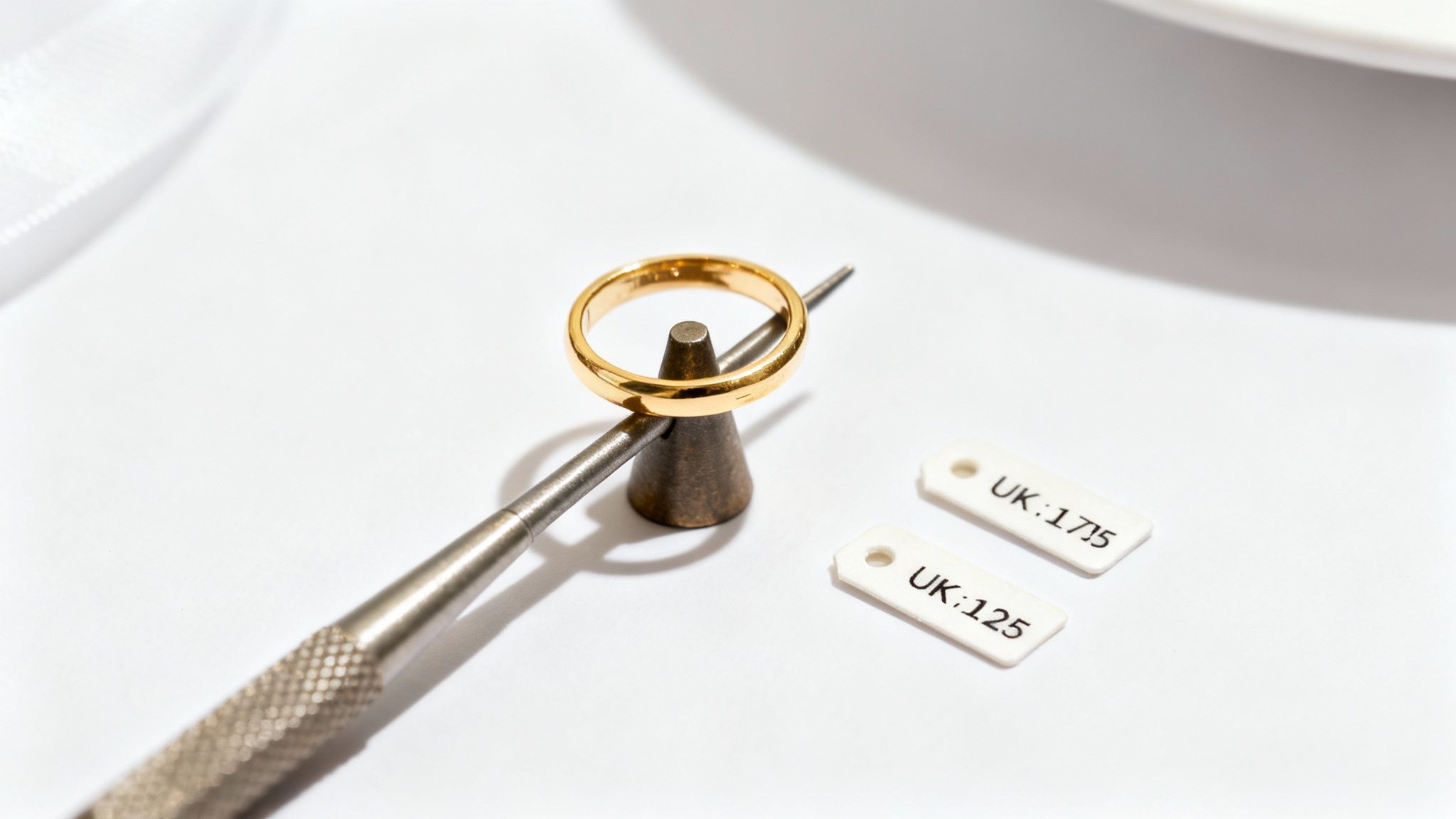
So, you need a ring resized. The big question is always, "How much is this going to cost?"
For a straightforward job on a simple silver or gold band in the UK, you’re typically looking at a starting price between £25 to £80. But if you're working with a tougher metal like platinum or a more complex design, that figure can easily climb past £120, especially if the ring needs to be made larger.
Your Quick Guide to Ring Resizing Costs
Understanding how much it costs to get a ring resized is a bit like getting a quote for a car repair. A simple fix is one price, but a major overhaul is another. Shrinking a plain silver band is the quick, simple job. Making a platinum engagement ring bigger? That's a different story.
This section is all about giving you a clear, upfront idea of what to expect. Think of it as a ballpark figure before we get into the nitty-gritty of what makes the final price tick.
A jeweller’s work is a delicate balance of art and science. When resizing a ring, they aren't just changing its size; they are preserving its integrity, design, and sentimental value.
Remember, making a ring larger almost always costs more than making it smaller. Sizing up means a jeweller has to add new metal and blend it in seamlessly, a process that takes more time, material, and skill.
For a more comprehensive look at what different repairs might set you back, our full UK jewellery repair price list has all the details.
Estimated UK Ring Resizing Costs by Metal Type
To give you a clearer picture, this table breaks down the typical starting prices for resizing the most common ring metals by one or two sizes.
Metal Type
Average Cost to Make Smaller
Average Cost to Make Larger
Silver
£25 – £45
£35 – £55
9ct Gold
£40 – £60
£50 – £80+
18ct Gold
£50 – £70
£65 – £100+
Platinum
£70 – £90
£90 – £150+
These prices are a solid starting point. Your final quote will depend on the other factors we'll explore next, like the ring's design and how many sizes it needs to change.
What Actually Drives Ring Resizing Prices?
Ever wondered why there isn’t a flat fee for resizing a ring? The price a jeweller quotes you isn't just pulled out of thin air. It’s a careful calculation, a bit like tailoring a bespoke suit—a simple tweak is one thing, but altering a complex, detailed garment takes far more skill, time, and material.
The biggest factor influencing how much you’ll pay to get a ring resized is the metal itself. Different metals have completely different personalities. They demand specific tools, techniques, and levels of expertise. Platinum, for instance, has an incredibly high melting point, meaning it needs a specialised torch and more time to work with compared to gold or silver.
This single difference—the metal—directly affects both labour and material costs, forming the foundation of your quote.
The Direction of the Size Change
A huge piece of the pricing puzzle is whether we're making the ring larger or smaller.
Making a ring smaller is generally the more straightforward job. A jeweller will snip out a small piece of the band, solder the ends back together, and then meticulously re-round and polish it until the join is completely invisible.
Sizing up, on the other hand, is a bit more involved because it requires adding new metal. We cut the band and carefully insert a new piece of the exact same metal, soldering it seamlessly into place. This doesn’t just mean you’re paying for the extra material; it also takes more labour to make sure the new section blends perfectly in colour, shape, and finish.
The sign of a professional resizing is that it’s undetectable. An expert goldsmith leaves zero trace of their work, ensuring the ring’s structural integrity and look are perfectly preserved.
Thickness and Design Complexity
Beyond the metal and the direction of the change, the ring's own character plays a massive role. A thick, chunky band will naturally need more work (and potentially more metal) than a thin, delicate one. Think about the difference between cutting a thin wire and a thick pipe—the same logic applies here.
The ring’s design also adds layers of complexity. A simple, plain wedding band is the easiest to resize. But what if your ring has:
Intricate engravings or patterns? The jeweller has to cut and rejoin the band without disrupting the flow of the design. This takes immense precision.
Gemstones set near the back? Any stones near the area we need to cut often have to be removed and then reset after the soldering is done. This protects them from the intense heat of the torch and adds significant labour time.
A unique shape or profile? Bands that aren't perfectly circular or have detailed metalwork require more time to reshape perfectly after being altered.
Each of these details adds time and skill to the process, and that’s what's reflected in the final cost. When you understand these factors, you can see your quote not just as a price, but as a fair reflection of the craftsmanship needed to tailor your treasured piece perfectly.
Comparing Resizing Costs For Different Metals
The metal your ring is crafted from is one of the biggest factors in what you'll pay to get it resized. Think of it like a chef working with different ingredients; a simple silver ring is like a familiar, easy-to-handle vegetable. A dense platinum band? That’s more like tackling a prime cut of meat that demands special tools and techniques.
Every metal has its own personality—its density, melting point, and how easily it can be shaped. These properties dictate the tools, time, and skill a jeweller needs to resize it perfectly. It's exactly why a quote for a platinum ring will always look very different from one for a silver piece.
Silver and Gold Resizing Averages
Silver is almost always the most affordable metal to resize. It's relatively soft and has a low melting point, so it’s quicker and less demanding for a jeweller to work with. For a simple resizing job, a silver ring will sit at the lower end of the price spectrum.
Gold is, of course, the most common metal for rings, and its resizing cost is tied to its purity, or karat.
9ct Gold: This alloy contains more other metals, which makes it a little harder but still straightforward to resize. Costs here are moderate.
18ct Gold: With a higher gold content, it’s softer and prized for its rich colour. Naturally, the cost of adding metal is higher than for 9ct.
White gold needs an extra step. After resizing, it requires a fresh coat of rhodium plating to bring back that bright, silvery-white finish, which adds a bit to the final cost.
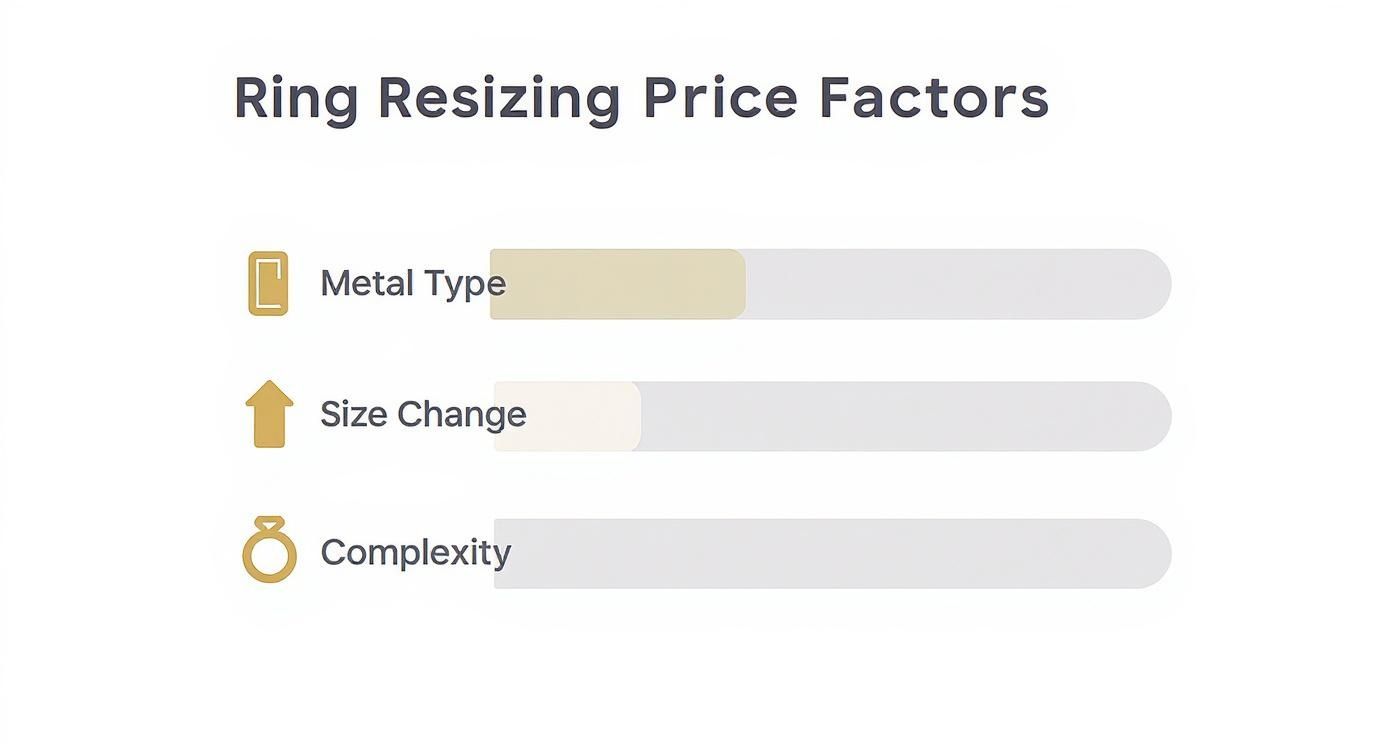
The infographic below shows how the metal type, along with other key elements, sets the baseline for the final price.
As you can see, the metal is really the starting point for any resizing quote.
The Premium Price of Platinum
Platinum consistently sits at the top of the resizing price scale, and for very good reason. It’s an incredibly dense and durable metal with an extremely high melting point of around 1,768°C—that's a world away from gold’s 1,064°C.
This isn't just a number; it means a jeweller needs a special, hotter torch and protective eyewear just to work on it. The metal is also tougher to manipulate, demanding more time and effort to cut, shape, and polish. Because it’s so dense, any platinum added to size a ring up is also more expensive. These specialised requirements mean that only highly skilled jewellers are equipped to handle the job correctly. You can discover more about what makes this metal so unique in our detailed article on the platinum engagement ring.
Jewellers often call working with platinum a "different discipline." Its unique properties demand patience, precision, and a flawless, invisible join that only an expert can achieve.
How Ring Design Complicates the Process
While the metal your ring is made of sets a baseline for the cost, it's the design that really dials up the complexity. A simple, plain gold band is a fairly straightforward job for any experienced goldsmith. But the moment you introduce patterns, engravings, or stones, the task gets a whole lot trickier.
Think of it like the difference between hemming a plain pair of trousers and tailoring a pinstripe suit. With the suit, every single stripe has to line up perfectly, or the alteration will stick out like a sore thumb. The same meticulous care is needed for detailed jewellery, where every cut and join has to be completely invisible to preserve the ring’s beauty.
Some designs, however, are so challenging that resizing them is either incredibly difficult, very expensive, or in some cases, simply not possible without a major overhaul.
Why Some Rings Are So Difficult to Resize
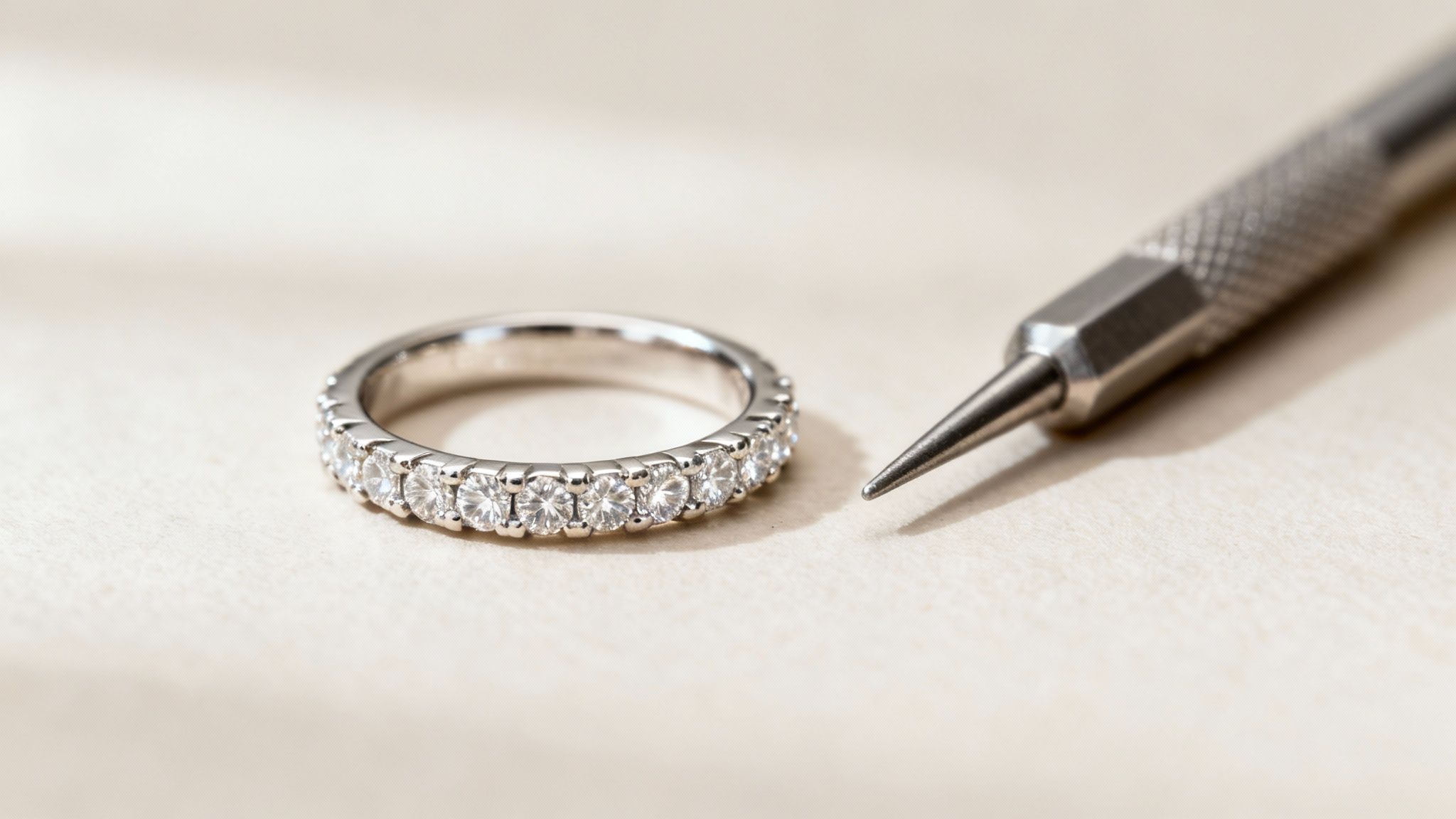
The most famous example? The eternity ring. With a continuous, unbroken circle of gemstones, there’s often no bare metal for a jeweller to safely make a cut. Trying to size an eternity band risks cracking stones, damaging the settings, and compromising the entire structure of the ring. Resizing one often means a complete rebuild, which is a far more involved and costly job.
Other design features that add layers of complexity include:
Intricate Patterns or Engravings: If a pattern wraps all the way around the band, the jeweller has to perform delicate surgery. They need to cut and rejoin the ring so perfectly that you can’t see where the work was done.
Mixed Metals: Rings that blend different metals, like a band of yellow and white gold twisted together, require specialised soldering techniques. This ensures both metals bond correctly without leaving any discolouration at the join.
Tension Settings: These are rings where the gemstone is held in place purely by the pressure of the band itself. They are extremely sensitive to any change in size and, more often than not, simply cannot be altered.
The Impact of Gemstones on Cost
The placement of gemstones is another make-or-break factor. If stones are set along the sides of the band, right where a jeweller needs to cut, they absolutely must be removed before any heat is applied. The intense temperature from a soldering torch can easily damage, discolour, or even shatter many precious gems.
A professional jeweller will always prioritise the safety of your gemstones. Removing and then securely resetting stones is a time-consuming but essential step that protects your investment and ensures a flawless finish.
This process of carefully unsetting each stone and then meticulously resetting it adds significant labour time to the job. Every single stone has to be placed back into its setting, with the claws or prongs tightened and checked to make sure it’s completely secure.
This painstaking work is directly reflected in the final answer to how much it will cost to get your ring resized, turning what seems like a simple job into a far more detailed restoration project.
Uncovering Hidden Costs and Extra Services
The first quote you get for a ring resize is usually just for the core job. But like any skilled craft, there are often a few extra steps needed for a flawless, professional finish, and these can add to the final bill.
Think of it like getting a room painted. You’re paying for the paint and the labour, sure, but you also need primer, filler for any cracks, and dust sheets. These aren't just "upsells"—they're what separate a quick job from a perfect one. It’s the same in jewellery. These extra steps make sure your ring comes back looking pristine and, just as importantly, structurally sound.
One of the most common additions is rhodium plating, especially for white gold rings. This isn't optional; it's a must-do final step.
The Essential Rhodium Plating for White Gold
Here’s something many people don’t realise: white gold isn't naturally a bright, silvery-white. It's an alloy, made by mixing pure yellow gold with white metals, which leaves it with a slightly warm, off-white hue. To get that signature brilliant shine, it's coated in a micro-thin layer of rhodium, a precious metal from the platinum family.
When a jeweller resizes a white gold ring, the heat from soldering burns this delicate plating away around the join. Re-plating the entire ring is the only way to restore its uniform, brilliant white colour. This service typically adds £20 to £50 to the cost.
Other Potential Service Add-Ons
Beyond plating, a few other services might be needed, depending on your ring's design and condition. These are all about returning the piece in absolutely perfect shape.
Professional Polishing: The resizing process involves tools that can leave tiny scuffs or marks on the band. A final professional polish buffs every imperfection away, restoring the ring's original lustre.
Stone Checking and Tightening: Heat and pressure from resizing can sometimes loosen the settings of nearby gemstones. A good jeweller will meticulously check every prong and tighten them to ensure your stones are completely secure.
Gemstone Resetting: As we've covered, if stones need to be removed to protect them from heat, the careful work of resetting them afterwards will be an additional charge.
A 2022 survey backs this up, showing that 28% of UK customers who had a ring resized paid extra for services like stone resetting or rhodium plating. You can dig into the findings from the National Association of Jewellers. If you’re in a hurry, it’s worth asking about options to get your ring resized while you wait, as this can be a great way to clarify all the costs upfront.
Finding a Jeweller You Can Trust
Knowing the numbers is only half the battle. The other, arguably more important part, is finding the right pair of hands to entrust with your ring. A resize isn't just a simple adjustment; it's a delicate operation. Get it wrong, and you risk damaging the piece you love. The goal is to find a true craftsperson whose work is so good, it's completely invisible.
So, where do you start? Reputation and credentials are key. Look for jewellers who are members of respected trade bodies like the National Association of Jewellers (NAJ). This isn't just a badge; it's a sign they’re committed to high standards and ethical work. But don't just take their word for it—dig into independent online reviews to see what real customers have to say.
Asking the Right Questions
Once you’ve got a shortlist, it's time to have a conversation. A good, trustworthy professional will be more than happy to walk you through their process and even show you examples of their work.
Here’s what you should be asking:
Can you give me an itemised quote? This needs to break down the cost of labour, any extra metal needed, and add-ons like rhodium plating.
How will you resize this specific ring? They should be able to explain their exact approach, especially if your ring has intricate details or stones.
What’s the turnaround time? A clear timeline manages everyone's expectations.
Is my ring insured while it’s with you? This is a deal-breaker. Any professional workshop must have full insurance to cover your property.
A transparent quote is the hallmark of an honest jeweller. If they're vague on pricing or reluctant to detail the work, that’s a major red flag.
Always, always get a clear, written quote before agreeing to anything. This simple step prevents any nasty surprises and ensures you know the full cost before the work begins. The document should lay out every part of the job, from the basic resizing to any polishing or stone checks needed. Taking these steps means you can leave your ring with complete confidence, knowing it’s in skilled, reliable hands.
A Few Common Ring Resizing Questions
When you're looking into getting a ring resized, the cost is just the start. You'll naturally have questions about how long it takes, what's even possible, and whether the process might affect your piece in the long run. We get asked these all the time, so here are some straight answers.
Think of this as a quick guide to get you up to speed before you even step into a workshop. Knowing the ins and outs means no surprises, just a perfectly fitting ring.
How Long Does Ring Resizing Take?
The honest answer? It depends entirely on the ring. For a simple job, like sizing a plain gold or silver band up or down a size or two, many jewellers can get it done in one to three days. Some workshops, including ours, even offer a same-day or "while-you-wait" service for these straightforward tasks.
But complex work needs more time. If your ring is platinum, has detailed engravings, or is set with stones that have to be removed and reset, the process could easily take one to two weeks. Always ask for a time estimate when you get your quote.
A good jeweller prioritises craftsmanship over speed. While getting it back quickly is great, giving them the time they need for a complex job ensures a flawless, durable result that protects your ring for years to come.
Can Every Single Ring Be Resized?
Sadly, no. Some rings, because of their design or material, are either impossible to resize or would have to be completely remade—a much bigger and more expensive job.
Eternity Rings: With an unbroken circle of gemstones, there’s no clear metal shank to cut into and work with.
Tension-Set Rings: These unique rings hold the main stone in place using the band's pressure. Changing that band's size would compromise the very thing keeping your stone secure.
Alternative Metals: Materials like tungsten, titanium, and ceramic are incredibly hard and brittle, so they can't be cut and soldered in the traditional way.
Does Resizing Weaken a Ring?
When it's done right by a skilled professional, resizing should not weaken your ring at all. An expert jeweller creates a seamless solder join that’s just as strong as the rest of the band, polished so you’ll never even know it was there.
A poor job, however, can create a weak spot that might break under stress later on. It’s also worth remembering that a ring can only be resized so many times before its structure could be compromised. This is exactly why choosing a reputable, experienced jeweller is crucial—it's the best way to protect your ring's strength and beauty.
At Opulence Jewellery Services, our master jewellers in Hatton Garden bring decades of experience to every job, ensuring each resize is perfect. We handle everything from simple bands to complex engagement rings, often with a same-day service. Visit us to restore your treasured jewellery with confidence.
Thinking about resizing a wedding ring? Our guide covers UK costs, jewellers, and the process for gold, platinum, and rings with stones. Get a perfect fit.
Our expert guide to engagement ring resizing covers cost, process, and finding the perfect fit in the UK. Learn what to expect before you visit a jeweller.
Searching for wedding ring resizing near me? This UK guide covers finding a trusted jeweller, resizing costs, timelines, and what to expect for a perfect fit.
Searching for ring resizing near me? Our UK guide helps you find a trusted local jeweller, understand costs, and get a perfect, lasting fit for your ring.
Shop Fine Jewellery Online
Engagement rings, wedding bands, earrings, necklaces & birthday gifts — beautifully crafted and delivered to your door.