Rings Design Your Own A Guide to Custom Jewellery
Want to rings design your own? This guide walks you through the entire process, from inspiration to the finished piece, with expert tips and real-world advice.

Designing your own ring is a creative journey that ends with a piece of jewellery that is entirely you. It turns what can feel like an overwhelming task into an exciting, hands-on process, putting you in control of everything from the first sketch to the final, sparkling masterpiece.
Your Bespoke Ring Journey Starts Here
Creating a bespoke ring isn’t just a purchase; it's a collaboration between you and a skilled jeweller. The whole experience is built around your story, style, and vision, making sure the final piece is a perfect reflection of who you are. Forget settling for off-the-shelf options that are almost right. When you design your own ring, every single detail—from the choice of metal to the cut of the gemstone—is chosen by you, for you.
This guide breaks down the custom design process into clear, manageable steps. We'll walk you through:
- Gathering inspiration and pinning down your personal style.
- Choosing the right precious metals and gemstones that fit your lifestyle.
- Understanding how Computer-Aided Design (CAD) brings your ideas to life.
- Navigating the production timeline from digital model to finished ring.
The demand for custom jewellery has soared, becoming a major focus within the UK's vibrant market. As a result, design-your-own ring services have grown right alongside the UK jewellery industry, which was valued at around £4.4 billion in 2023. Further research shows the UK ring segment held the largest market share at roughly 36.3% of revenue in 2024, proving that rings are the biggest single focus for both retailers and custom workshops. You can find out more about the UK jewellery market on promocode.me.uk.
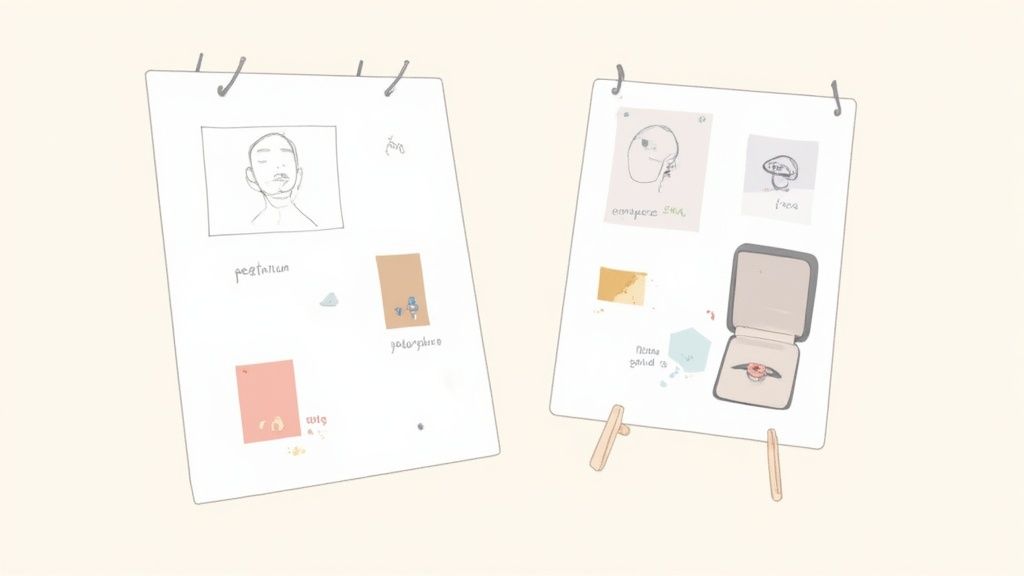
This simple visual shows the journey from an idea in your head to a finished, custom-made ring on your finger.

As you can see, the process flows logically from creative brainstorming to precise digital modelling before any metal is cast. This ensures you’re completely happy and confident in the design every step of the way.
Finding Your Inspiration and Making Core Choices
Every bespoke ring starts not in the workshop, but with an idea. The first, most exciting step in designing your own ring is translating your personal style into a tangible concept. This isn't about having a perfect sketch from day one; it's about gathering fragments of inspiration that really resonate with you.
Start by looking at the world around you. Inspiration can pop up in the most unexpected places—the clean lines of modern architecture, the intricate patterns in a vintage lace fabric, or even the organic shapes found in nature.
I always recommend starting a digital mood board on Pinterest or simply saving images to a folder. Don't just look at other jewellery; collect colours, textures, and forms that you love.
Another brilliant source of inspiration is right there in your own jewellery box. Take out your favourite pieces. What do you gravitate towards? Are they bold, statement designs or delicate, minimalist bands? Do you prefer the warm tones of yellow gold or the cool lustre of platinum? Spotting these patterns is a huge leap towards defining the core elements of your new ring.
Defining Your Ring's Foundation
Once you have a clearer sense of your style, we can move on to two foundational choices that will define your ring's entire character: the precious metal and the main gemstone. These decisions influence not just the look but also the ring's durability and how it feels to wear every day.
The metal is the canvas for your design. While yellow gold offers a classic warmth and rose gold provides a modern, romantic feel, platinum and white gold deliver a sleek, contemporary look. Your lifestyle plays a big part here, too. Platinum, for example, is incredibly dense and durable, making it an excellent choice for a ring you'll wear constantly. Different carats of gold also offer varying levels of hardness and colour intensity.
For a deeper look into this, our guide on custom engagement ring designs offers some extra insights.
To help you visualise the options, here's a quick comparison of the most popular choices.
Comparing Popular Precious Metals for Your Ring
| Metal | Colour | Durability (Hardness) | Maintenance | Best For |
|---|---|---|---|---|
| Platinum | Silvery-white | Very high (extremely dense) | Scratches create a patina; needs occasional professional polishing. Naturally hypoallergenic. | Lifelong wear, especially for active individuals. Securely holds stones. |
| Yellow Gold | Classic warm yellow | Good (hardness varies with carat, e.g., 18k is softer than 9k) | Prone to scratching over time; requires regular polishing to maintain its lustre. | Traditional, timeless designs that complement warmer skin tones. |
| White Gold | Silvery-white | High (often alloyed with stronger metals and rhodium plated) | Rhodium plating wears off over time and needs re-plating every 1-3 years to stay bright white. | A contemporary, platinum-like look at a more accessible price point. |
| Rose Gold | Warm, pinkish hue | High (copper alloy adds strength and colour) | Very durable and doesn't require plating. The colour can deepen slightly over time. | Modern, romantic styles that suit a wide range of skin tones. |
Each metal has its own personality, and the right one depends entirely on your personal taste and how you plan to wear your ring.
Choosing Your Centrepiece
Picking a gemstone is a deeply personal choice that goes way beyond the traditional diamond. While diamonds are a classic for a reason, today’s market is filled with incredible alternatives like vibrant sapphires, deep green emeralds, and unique salt-and-pepper diamonds.
There's also been a huge shift in what people value when making these choices. Ethical sourcing and sustainability are now central to the conversation. We see this every day in the workshop, with recent trends showing that over 70% of younger UK buyers now prefer lab-grown or ethically sourced stones.
This extends to style preferences, too. The popularity of the classic round brilliant cut is making way for more unique shapes like ovals, which have seen a massive rise in demand. You can discover more insights about engagement ring trends on queensmith.co.uk.
A thoughtfully chosen gemstone does more than just sparkle; it tells a story. Whether it's a lab-grown diamond that aligns with your environmental values or an heirloom stone you're giving new life, this choice makes the ring uniquely yours.
Ultimately, these first decisions about metal and stone set the stage for the entire design process. They give us the essential framework to build upon, ensuring your final piece is a true and lasting reflection of you.
Bringing Your Vision to Life with Digital Design
Once you’ve gathered your inspiration and decided on the metal and stones, the real fun begins: turning those ideas into a tangible design. This is where we work closely together, translating sketches and conversations into a precise digital blueprint for your ring. It’s the moment your custom piece starts to feel real.
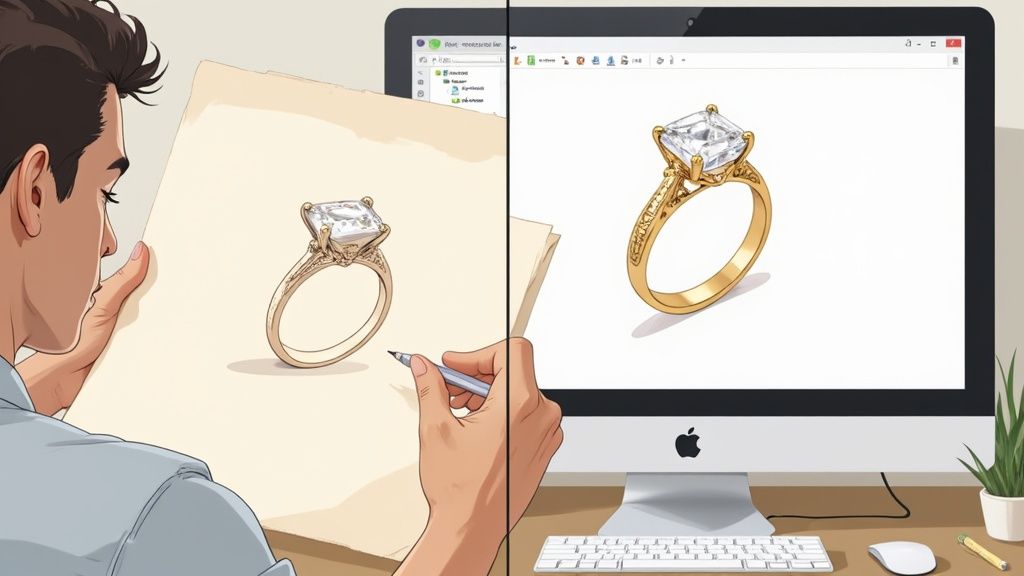
The journey from a hand-drawn sketch to a detailed Computer-Aided Design (CAD) model is a game-changer. A sketch captures the soul and style of your idea, but a CAD model provides the technical accuracy we need for a flawless result. It lets you see your ring from every possible angle, in perfect proportion, before we even touch a piece of precious metal.
This digital preview removes all the guesswork when you want to rings design your own piece. Suddenly, you can see exactly how high the centre stone will sit or how the light will play across the pavé diamonds on the band.
Reviewing Your CAD Model Like a Pro
When we send over the CAD renders, it’s your chance to fine-tune every last detail. This is the most important feedback stage, so don't be shy! Pay close attention to the small things that make a massive difference in how your ring looks and feels.
Here’s what to focus on:
- Prong Placement and Style: Are the claws holding the stone rounded, pointed, or flat? Do they complement the gem's shape without overwhelming it?
- Setting Height (Profile View): How high does the main setting sit off your finger? A dramatic, high setting looks stunning but might be more likely to catch on things day-to-day.
- Band Thickness and Width: A delicate band is elegant, but it needs enough substance to last a lifetime. For structural integrity, we typically recommend an engagement ring band is at least 1.8mm to 2.0mm thick.
To get an even clearer picture, 3D rendering creates photorealistic images of your design. You can learn more about rendering with specialized software like Rhino to see how these incredibly lifelike visuals are made. These models are crucial, and our guide on how to design an engagement ring offers more tips on what to look for during your review at https://opulencejewelleryservices.co.uk/articles/design-an-engagement-ring.
Getting the Sizing Spot On
Perfecting the digital design is only half the battle; getting an accurate ring size is absolutely essential. A ring that’s too tight is uncomfortable, and one that’s too loose is a constant source of worry. Forget online charts or using a piece of string—the only reliable way is to be professionally sized.
The perfect fit is a cornerstone of custom design. Your finger size can fluctuate with temperature and time of day, so it’s best to be measured when your hands are at a normal temperature, ideally in the afternoon.
Remember, the width of the band makes a big difference to the fit. A wider band (over 5mm) will feel much snugger than a narrow one of the same size, often meaning you’ll need to go up a quarter or half size. Let us know if you prefer a snug or slightly looser fit, and we’ll make sure the final piece feels like it was made just for you. This meticulous attention to detail is what makes a bespoke ring perfect.
How Your Custom Ring Is Actually Made
Once you’ve signed off on the final CAD model, the real magic begins: turning a digital file into a piece of jewellery you can actually wear. This is where modern tech meets traditional craftsmanship, and it’s a fascinating process to see unfold.
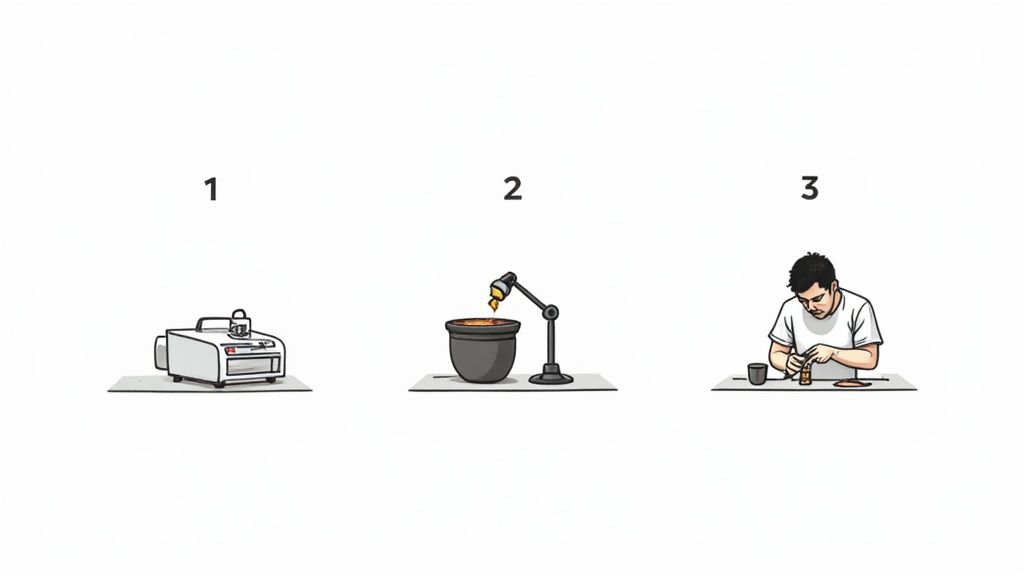
The first step is to bring your design into the physical world. We use a high-precision 3D printer to create a wax or resin model directly from the approved CAD file. This isn't just a rough approximation; it's an exact, touchable replica of your ring, capturing every tiny detail from the prongs to the gallery work.
From Wax Model to Precious Metal
Next, we move to a technique that’s been used for thousands of years: lost-wax casting. Your perfect wax model gets encased in a plaster-like material called an 'investment'. This is then fired in a kiln.
The heat makes the wax melt and burn away completely, leaving behind a perfectly hollow mould in the exact shape of your ring. Molten precious metal—be it gold, platinum, or another alloy—is then poured into this mould.
After it cools and solidifies, the investment is carefully broken away, revealing the raw casting of your ring. From here, it’s passed over to our master jewellers for the hands-on work.
At this stage, your ring is still rough and unpolished. It requires meticulous hand-finishing, including filing, sanding, and polishing, to bring out the metal's natural lustre and ensure every surface is flawless.
This skilled finishing is what transforms a rough casting into fine jewellery. It’s a huge part of the craft when you rings design your own piece.
Setting Timelines and Final Touches
The full production phase typically takes between four to six weeks. This timeline gives us the necessary time for casting, cleaning, polishing, and—most importantly—the precise work of setting any stones.
If your design involves something special like hand-engraving or sourcing a particularly rare gemstone, this can extend the timeline. Don't worry, though; we always give you a clear schedule right from the start.
The UK's jewellery manufacturing industry, set to generate around £1.0 billion in revenue in 2025, is built on this very blend of new technology and old-world skill. This strong local infrastructure is what allows us to create beautiful bespoke rings efficiently, right here in our workshop. You can read more about the UK's jewellery manufacturing industry on ibisworld.com.
The final step is always the best one: collecting your finished ring. At this appointment, we'll check that the fit is absolutely perfect and comfortable for everyday wear. This is the moment you finally get to see your unique idea brought to life—a beautiful, lasting symbol of your personal story.
Caring For Your One-of-a-Kind Creation
A bespoke ring is a piece you’ll treasure for a lifetime, so proper aftercare is vital to keep it looking as incredible as the day you first put it on. With the right maintenance, your one-of-a-kind creation will tell its story for generations.
Your first line of defence is gentle at-home cleaning. Daily life leaves a film of lotions, oils, and dust that can easily dull your ring's sparkle. A quick soak in warm water with a bit of mild washing-up liquid, followed by a gentle scrub with a soft toothbrush, is often all it takes to bring back the brilliance.
Of course, not all materials are the same. Porous stones like opals and pearls need a much lighter touch and shouldn't be submerged for long. For a more detailed walkthrough, our guide on using a professional engagement ring cleaner gives you the specifics for a flawless finish. And if you have a gold band, there are some great tips for polishing your gold ring that will keep its lustre perfect.
The Importance of Professional Check-Ups
While home cleaning keeps things looking great day-to-day, it can’t replace an expert’s eye. We always recommend an annual professional check-up for any bespoke piece, especially something you wear every day. Think of it as an MOT for your ring—it’s about much more than just a deep clean.
During this "health check," our goldsmiths will:
- Check every setting and prong to make sure they're tight, preventing any risk of losing a stone.
- Inspect the band for thinning or signs of wear, particularly at the base (the shank).
- Professionally polish the metal to buff away deeper scratches and restore that original, mirror-like shine.
- Re-plate white gold with rhodium if it’s started to look dull, bringing back its crisp, bright-white finish.
This is all about proactive care. Catching these tiny issues early on saves you from bigger, more expensive problems down the line and gives you total peace of mind.
Evolving Your Design Over Time
One of the best things about a custom piece is that its story doesn't end once it's made. Your style will evolve, and so can your ring. At Opulence Jewellery Services, we specialise in remodelling, breathing new life into existing jewellery.
Remodelling honours the past while celebrating the present. It’s a sustainable and sentimental way to update a piece, whether it’s adding new stones to mark an anniversary or completely reimagining an heirloom for a new generation.
Maybe you've inherited a ring with a stunning gemstone but a setting that just isn't you. We can carefully remove that stone and work with you to design a new, modern piece around it. This way, you keep all the sentimental value while creating something that feels completely your own.
When you rings design your own piece with us, you're not just making a ring for today; you're creating a foundation that can be loved, worn, and even transformed for years to come.
Common Questions About Designing Your Own Ring
Stepping into the world of bespoke jewellery is exciting, but it’s completely normal to have a few questions before you start. To help you feel confident as you begin to design your own ring, we’ve put together straightforward answers to the questions we hear most often.
Getting clear on the practical side of things—cost, timing, and how the design process actually works—is the key to a smooth, enjoyable experience from that first idea to the finished piece.
How Much Does It Cost to Design Your Own Ring?
The cost of a bespoke ring is entirely flexible and comes down to the materials and complexity you choose. A simple, elegant band in 9ct gold might start from a few hundred pounds, while an intricate platinum engagement ring with a high-grade diamond could be many thousands.
The real beauty of the bespoke process is that you are in complete control of the budget. We start by discussing your ideal price point. From there, we guide you towards the metals, gemstones, and design details that fit comfortably within it. There are no hidden surprises; we work with you to create something stunning that respects your budget.
How Long Does the Bespoke Ring Process Take?
It’s best to plan for a timeframe of between six to ten weeks to create a custom ring. This schedule gives us the time needed for the meticulous, hands-on work that fine jewellery deserves.
Here’s a typical breakdown of the journey:
- Initial Design & Consultation (1-2 weeks): This is where we talk through your ideas, sketch out initial concepts, and lock in the core elements like your choice of metal and stones.
- CAD Modelling & Approval (1-2 weeks): Our designers build a detailed 3D model of your ring for you to review. We’ll make any revisions you want during this stage.
- Production & Finishing (4-6 weeks): Now for the hands-on part. We cast the ring in your chosen metal, set the stones, and complete all the hand-finishing, polishing, and quality checks.
If your design is especially complex or requires us to source a particularly rare gemstone, the timeline might extend a little. We'll always give you a clear and transparent schedule before any work begins.
Can I Use My Own Heirloom Gemstones or Gold?
Yes, absolutely! Remodelling is a wonderful, sustainable way to breathe new life into sentimental jewellery. Using an heirloom gemstone is one of our most popular requests—it allows us to build a fresh, modern design around a stone that holds real personal meaning.
When it comes to using old gold, the process is slightly different. To guarantee the structural integrity and quality of your new piece, we don’t melt down old items directly into the new one. Instead, we professionally assess the scrap value of your old gold and offer you that amount as a credit towards your new bespoke ring. We then use freshly alloyed, pristine metal for the creation itself, ensuring a flawless and durable finish. It's the perfect way to honour the past while creating something new.
The CAD approval stage is your safeguard. It is a critical checkpoint designed to ensure you are 100% happy with every detail before we move into production. We encourage honest and thorough feedback.
What if I Dislike the CAD Model?
This is a common worry, but our process is specifically designed to prevent this exact problem. The 3D digital model is your chance to see the ring from every angle and request any changes, no matter how small they seem.
It’s far easier, faster, and cheaper to tweak a digital file than it is to alter a finished piece of metal. Our design process includes revisions, and we won't move an inch further until you’ve signed off on the final design and are completely thrilled with how it looks.
At Opulence Jewellery Services, we bring your vision to life. From same-day consultations in our on-site Hatton Garden workshop to ensuring the final, perfect fit, we’re here to guide you every step of the way. Start your bespoke journey with us today and create a ring that is truly yours. Visit us at https://www.opulencejewelleryservices.co.uk.