30 November 2025 16 min read Hatton Garden, London
Learn diamond replacement in ring: costs, sourcing, setting, and how to choose a trusted jeweller for your repair.
That heart-sinking moment you look down and see an empty setting where a diamond used to be is something we see all the time. But don't panic. Replacing a lost stone is a routine and often straightforward job for an expert jeweller. It’s all about a precise process: assessing the setting, sourcing a perfect new stone, and setting it securely so your ring looks exactly as it should.
The Diamond Replacement Process: A Quick Guide
Whether it’s a treasured family heirloom or your own engagement ring, the thought of a repair can be daunting. We want to demystify the whole thing for you. This guide will walk you through exactly how a skilled jeweller brings your ring back to its former glory, from the first look under a loupe to the final polish.
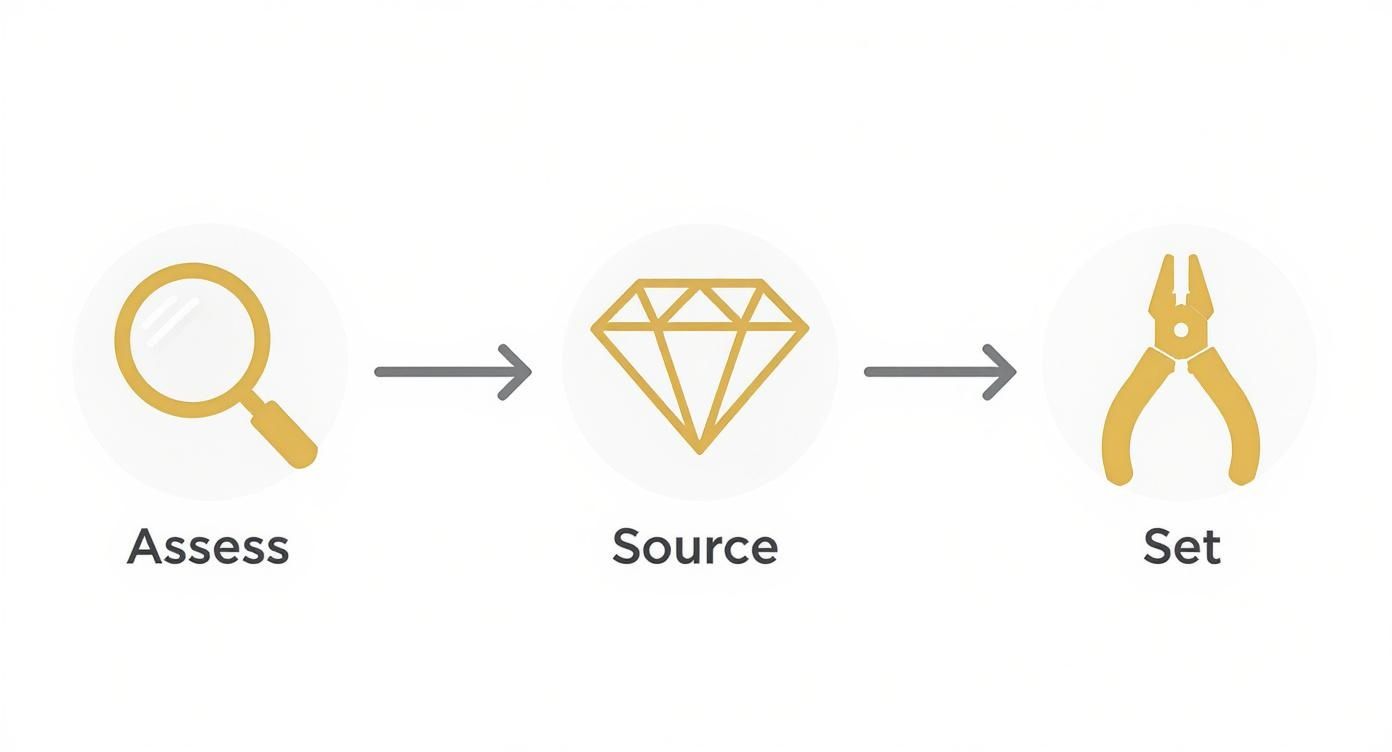
The entire journey is one of pure precision and artistry. It really comes down to three core stages.
We first need to assess the ring’s condition, then source the perfect diamond, and finally, set it with expert care.
What to Expect
The goal isn't just to pop a new stone in; it’s to make the repair invisible and the new setting even more secure than it was before.
Here’s what you can expect when you bring your ring to us:
A Full Damage Assessment: The first question we ask is why the stone fell out. We’ll carefully inspect the setting for worn-down prongs, a damaged bezel, or any other structural issues that need addressing. Fixing the root cause is key to preventing it from happening again.
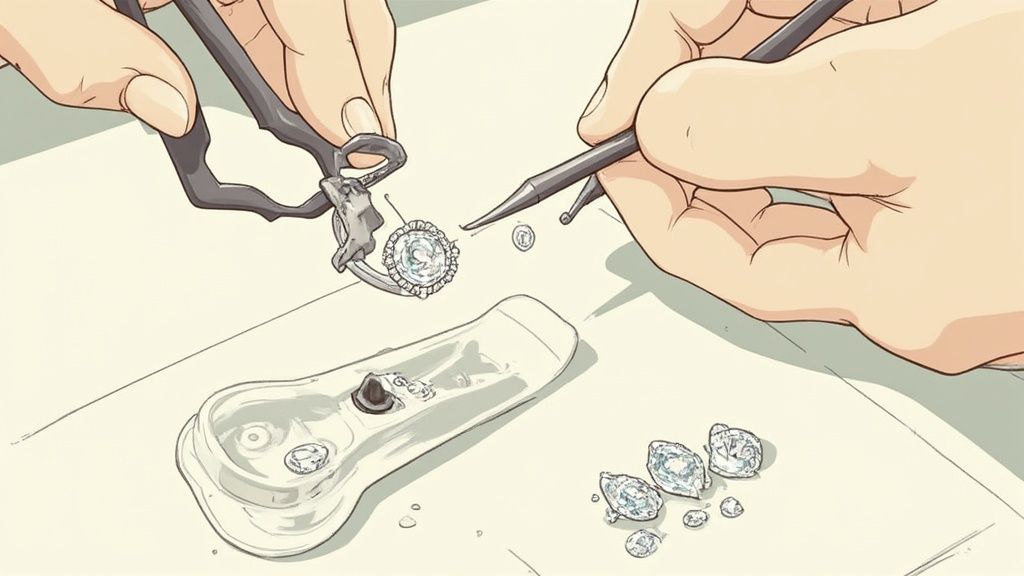
Expert Stone Matching: This is where the real artistry comes in. We find a new diamond that’s an identical match to any others in your ring, looking at its cut, colour, clarity, and carat weight. For a solitaire, we match it to the original specifications. It has to be perfect.
Secure and Precise Setting: We use a range of techniques to place the new stone. This might involve re-tipping the prongs to build them back up or, for more delicate work, using our advanced laser soldering machine to work right beside other gems without transferring heat.
Clear Costs and Timelines: We’ll give you a transparent look at what affects the price and how long the job will take. Many smaller diamond replacements can even be done while you wait at our Hatton Garden workshop.
Knowing these steps helps you feel confident that your ring is in safe hands. We're not just replacing a stone; we’re restoring the ring’s integrity and ensuring you can wear it without worry for many more years.
Diamond Replacement At A Glance
To give you a quick overview, here are the key factors involved in any diamond replacement job.
Factor
Typical Expectation
Why It Matters
Assessment
10–15 minutes
A proper inspection finds the root cause (e.g., worn prongs) to prevent future loss.
Stone Sourcing
Same day to a few days
Finding an exact match in colour, cut, and clarity is crucial for an invisible repair.
Setting & Repair
Same day to 48 hours
The method depends on the ring's design. Laser welding is used for heat-sensitive gems.
Cost
Varies widely
Based on diamond size/quality, metal type, and labour complexity (e.g., prong re-tipping).
Turnaround
While-you-wait to 3 days
Simple jobs can be done quickly; complex settings or rare stones may take a bit longer.
Ultimately, the process is designed to be as seamless and stress-free as possible, returning your piece to you in pristine condition.
First Look: Diagnosing the Setting & Sourcing a Match
The moment your ring arrives at our workshop, its journey back to perfect begins. The first thing we do isn't just look at the empty space; it's a proper diagnosis to figure out why the diamond came out in the first place. A true jeweller acts like a detective, getting the loupe out for a meticulous inspection of the setting.
We’re not just looking for the obvious. We’re hunting for subtle clues—a single claw that’s worn thinner than the others, a microscopic crack in the metal, or a bezel wall that’s lost its shape. Just dropping a new diamond into a faulty setting is asking for the same thing to happen again. This initial assessment dictates the entire scope of the repair.
Checking the Health of the Setting
Once we've examined every angle, we’ll know exactly what’s needed to make the setting secure again. It usually involves one of a few key procedures.
Prong Re-tipping: This is essential when the little claws holding the stone have worn down over time, becoming flat and fragile. We skilfully add new metal to rebuild them, restoring their strength and shape.
Bezel Repair: With bezel settings, the metal wall wrapping around the stone can get knocked or bent. It has to be perfectly reshaped to grip the new diamond tightly.
Structural Repairs: Sometimes the damage is more significant, and the whole setting is compromised. In these cases, we might need more advanced techniques. You can learn more about how we use precision tools for complex jobs in our guide on laser welding jewellery—it’s a fantastic method that protects nearby stones from heat.
A proper assessment ensures the repair isn't a quick fix, but a lasting solution. Our goal is to hand your ring back to you in a condition that’s even stronger and more secure than it was before.
The Art of Finding the Perfect Match
With a solid plan for the setting, the focus shifts to finding the replacement diamond. This part is a delicate mix of science and artistry. For a single-stone engagement ring, it’s about sourcing a diamond that matches the original’s specs, which are often found on an appraisal or certificate.
The real challenge, though, is with multi-stone rings—think trilogy rings or pavé bands. Here, the new diamond has to be an absolutely flawless match for its neighbours. A jeweller will meticulously compare potential replacements against the existing stones, making sure the '4 Cs' align perfectly.
Cut: The faceting has to be identical so the light bounces back in the same way.
Colour: Even a single colour grade difference is noticeable up close, so an exact match is crucial for a seamless look.
Clarity: The new stone needs a similar level of inclusions to blend in naturally.
Carat (and size): We measure the new diamond to the hundredth of a millimetre to ensure it sits perfectly in the setting.
This obsessive matching process is what makes the final repair totally invisible, restoring your ring’s original, harmonious beauty.
Choosing Your Stone: Lab-Grown vs. Natural Diamonds
When a diamond goes missing from your ring, you’re faced with a choice that simply didn't exist a generation ago: should you replace it with a natural diamond or a lab-grown one? It’s a modern question, and the answer can impact everything from the cost of your repair to the final look of your ring.
Natural diamonds have that incredible mystique—formed over billions of years, deep in the earth. That ancient allure is powerful, but it comes at a premium. On the other hand, lab-grown diamonds are a brilliant alternative. They are physically, chemically, and optically identical to their natural counterparts but created in a controlled lab environment. This makes them a much more accessible and ethically transparent option.
The Financial and Ethical Considerations
For most people, the decision comes down to cost. A lab-grown diamond can be 30-50% less expensive than a natural stone of the exact same quality. This price difference doesn't just make the repair more affordable; it opens up a genuine opportunity. You could use the budget for a like-for-like natural stone replacement to instead select a larger or higher-clarity lab-grown diamond, effectively upgrading your ring in the process.
Beyond the price tag, traceability is a huge factor for many of our clients. While the industry has made great strides with schemes like the Kimberley Process, concerns about environmental impact and conflict sourcing haven't entirely disappeared. Lab-grown diamonds offer a clear, documented origin, giving you complete peace of mind.
This isn't just a niche trend. The UK jewellery market has seen a massive shift. We now see lab-grown diamonds making up a huge portion of engagement ring sales, proving just how widely accepted and popular they've become.
Real-World Scenarios: What It Means for Your Ring
Let’s put that into practice. Imagine you've lost a 0.50-carat natural diamond from your engagement ring. A like-for-like natural replacement might run you around £1,200. For that same budget, you could potentially get a 0.75-carat lab-grown diamond with excellent colour and clarity. Suddenly, the choice isn't just about repair—it's about enhancement.
This reflects a huge change in how people buy jewellery here in the UK. Over the last few years, the market has completely evolved. Industry reports now show that lab-grown stones account for approximately 70% of engagement ring sales, a world away from the total dominance natural diamonds once held. You can see more on these engagement ring trends and how dramatically preferences have shifted.
This flexibility is one of the best things about a modern diamond replacement. It lets you make a choice that aligns perfectly with your budget, your values, and what you want your finished ring to look like. Whether you stick with tradition or embrace innovation, we’ll make sure the final result is a stunning, secure diamond that you'll love for years to come.
The Art of Setting Your New Diamond Securely
Once we’ve sourced the perfect replacement diamond, the real craft begins. Setting a new stone isn’t just a matter of dropping it into place; it’s a delicate operation that demands absolute precision to make sure it stays there for a lifetime. Before we even think about the new diamond, our first job is to prepare its foundation—the setting itself.
We always start by addressing the original reason the stone was lost. More often than not, this means carefully repairing and strengthening the existing metalwork.
Rebuilding the Foundations of Your Ring
One of the most common jobs we do is prong re-tipping. Over years of wear and tear, the tiny metal claws holding a diamond in place can wear down, becoming thin, weak, and snagging on clothing. We meticulously add new metal—usually gold or platinum—to rebuild each prong, restoring its original strength, shape, and security.
For more intricate repairs, particularly on delicate rings or those with many small stones, we often turn to our laser welder. This incredible tool lets us perform microscopic welds with pinpoint accuracy. Better yet, it generates very little heat, meaning we can work right next to other gemstones without any risk of damaging them. It's a game-changer for complex designs.
"A replacement is only as secure as its setting. We spend just as much time perfecting the metalwork as we do setting the stone. It’s the only way to guarantee a lasting repair."
Techniques for Different Setting Styles
The method a jeweller uses for a diamond replacement in a ring is dictated entirely by its design. Each style presents unique challenges and requires a specialised approach to get it just right.
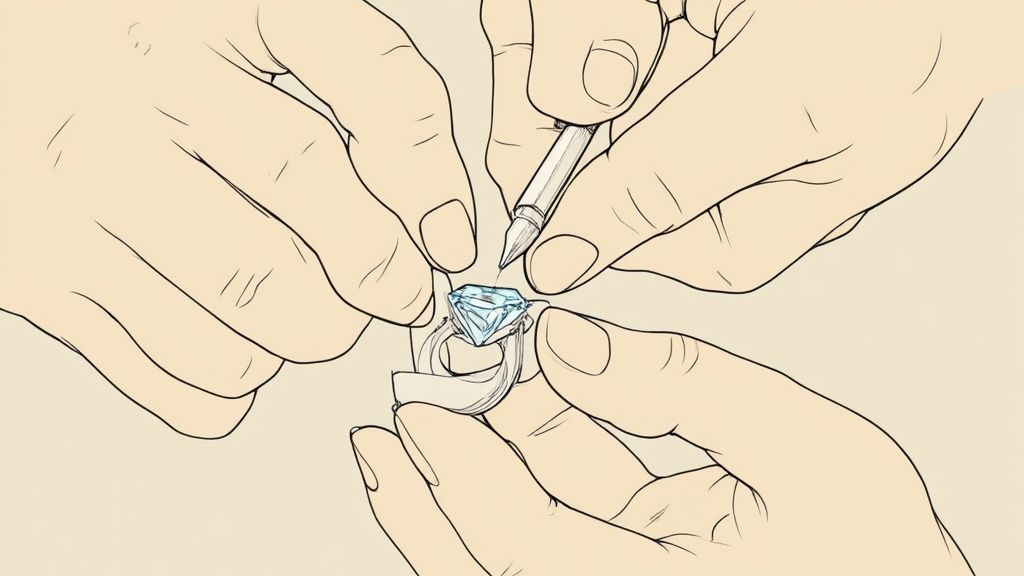
Prong Settings: After making sure the prongs are strong and properly shaped, the new diamond is placed in its seat. Using specialised pliers, the jeweller gently but firmly bends each prong over the diamond’s edge, creating a secure grip that holds it tight.
Bezel Settings: This style wraps the diamond in a thin metal rim. The key here is ensuring the diamond sits perfectly level before a burnishing tool is used to push the metal collar snugly against the stone’s entire circumference, leaving absolutely no gaps.
Pavé Settings: For these tiny, close-set diamonds, the work is microscopic. The jeweller carves a precise seat for the new stone and then raises miniscule beads of metal from the surrounding surface to hold it securely. It’s all about precision, ensuring the new stone blends seamlessly with its neighbours.
If you want to get into the finer details, our guide on diamond jewellery setting explores these techniques and more.
The Final Polish and Finish
With the diamond securely in place, the final stage is all about making the repair completely invisible. The entire ring is professionally polished to remove any tiny tool marks and bring the metal to a brilliant, uniform shine.
For white gold rings, this includes one last essential step: rhodium plating. This process adds a bright, white, mirror-like finish that gives white gold its signature lustre. When we're done, the ring looks brand new, with no trace of the work ever having been done. It's this meticulous attention to detail that elevates a simple repair into a true restoration.
Costs, Timelines, and Insurance Explained
When a diamond is lost or damaged, the practical questions are usually the first to come to mind. How much will it cost? How long will I be without my ring? What about the insurance? Let’s get straight to the answers so you know exactly what to expect.
The total bill for a diamond replacement in a ring comes down to two things: the cost of the new diamond and the labour needed to set it perfectly.
Breaking Down The Costs
The new stone is almost always the biggest part of the final price. A diamond's value is all about its '4 Cs'—Cut, Colour, Clarity, and Carat weight. Naturally, a bigger, clearer, more colourless diamond will have a higher price tag. This is where choosing a lab-grown diamond can make a real difference, often cutting the stone's cost by 30-50% compared to a natural one with the same specs.
The complexity of the job also matters. Re-tipping a few prongs on a simple solitaire is a fairly quick task for a skilled goldsmith. On the other hand, rebuilding a delicate pavé section or a full channel setting takes far more expertise and time, which is reflected in the labour fee. For a good idea of what different jobs involve, our jewellery repair price list offers a clear breakdown.
It's interesting to see how trends are shifting across the UK. The average cost of an engagement ring now sits between £1,800 and £3,200, partly because lab-grown diamonds let people get a more impressive look without breaking the bank.
Turnaround Times: From Hours to Weeks
How long you'll have to part with your ring really depends on the job. Here at Opulence Jewellery Services in Hatton Garden, we can handle many straightforward replacements with our same-day, while-you-wait service. If it’s a common diamond size and cut, we likely have the perfect match in stock and can get it done for you in a few hours.
If your ring needs a rare or uniquely cut stone, sourcing it from our network of suppliers can take anywhere from a few days to a couple of weeks. More complex setting repairs also extend the timeline. We’ll always give you a realistic and transparent timeframe before starting any work.
Our Advice: Always ask for a quote that separates the cost of the diamond from the labour. This transparency means you know exactly what you’re paying for and avoids any hidden surprises.
Navigating Jewellery Insurance
If your ring is insured, your first step is to contact your provider and start a claim. Most insurers will require a professional assessment and a detailed quote from a jeweller, which we are happy to provide. They might have their own network of preferred repairers or let you choose your own specialist.
It's absolutely vital to get an updated valuation once the repair is complete. A new, high-quality diamond can change your ring's replacement value, and your insurance policy needs to be updated to reflect that. This ensures you’re fully covered going forward. Insuring pieces with lab-grown diamonds is just as simple as with natural stones—and the premiums are often lower, too.
Your Diamond Replacement Questions, Answered
A lost diamond feels like a disaster, but the fix is usually straightforward. Still, it's a process that brings up a lot of questions. Here are the clear, no-nonsense answers we give customers every day in our Hatton Garden workshop.
Can You Perfectly Match My Lost Diamond?
Yes, a skilled goldsmith can source a replacement stone that's a perfect visual match to the others in your ring. While no two diamonds are ever identical under a microscope, our goal is to create a seamless look that's indistinguishable to the naked eye.
We use any remaining stones in the ring, or the original certification if you have it, as our blueprint. We then meticulously source a new diamond, focusing on the crucial ‘4 Cs’—carat, cut, colour, and clarity.
For pavé or channel-set rings, the real art is in creating a uniform surface where the new stone just blends in. The finished result should restore the ring's original, balanced design without drawing any attention to the new diamond.
Is It Worth Replacing a Tiny Diamond?
Absolutely. This is one of the most important small repairs you can do, especially for a sentimental piece. The cost to replace a tiny melee diamond (the small accent stones) is often quite low, but doing so protects the entire ring.
Leaving an empty socket isn't just a cosmetic problem. It weakens the surrounding setting, making it much more likely that adjacent stones will loosen and fall out over time.
Think of it as preventative maintenance. Replacing a small stone is a minor investment that protects the structural integrity of your ring and safeguards the more valuable diamonds for years to come.
This quick fix restores the complete look of your ring and ensures it’s strong enough for daily wear. It’s a simple step that buys you lasting peace of mind.
How Can I Stop This from Happening Again?
Prevention is always better than a cure, and it all comes down to proactive care. Regular professional maintenance is the single best thing you can do to avoid the stress of losing another stone.
We can't say it enough: have your precious rings professionally inspected and cleaned at least once a year. A trained jeweller will spot problems you can't see.
Professional Checks: We look for loose stones and check every single prong for wear and tear. Catching a worn prong early means we can perform a simple re-tipping repair, securing the diamond long before it has a chance to escape.
Mindful Wear: It’s smart to take your rings off during strenuous activities. Things like working out, gardening, or lifting heavy objects can easily bend a prong or cause a direct knock that dislodges a stone.
At-Home Cleaning: Gently cleaning your ring at home with a soft brush and mild soap doesn't just keep it sparkling. It’s also a great way to notice if a stone feels a bit loose. If anything feels off, bring it straight to a professional.
Building these simple habits can dramatically reduce the risk of needing another diamond replacement, keeping your cherished ring right where it belongs.
At Opulence Jewellery Services, our expert jewellers are ready to answer all your questions and restore your ring with precision and care, often while you wait. Visit our Hatton Garden workshop for a complimentary assessment. Learn more at https://www.opulencejewelleryservices.co.uk.
Discover how to design a custom wedding ring in London. Our guide walks you through finding inspiration, choosing materials, and the bespoke creation process.