Difference Between Engagement and Wedding Rings: A Practical Guide
08 January 2026 15 min read Hatton Garden, London
Explore the difference between engagement and wedding rings: meanings, designs, costs, and wearing tips, your quick UK guide.
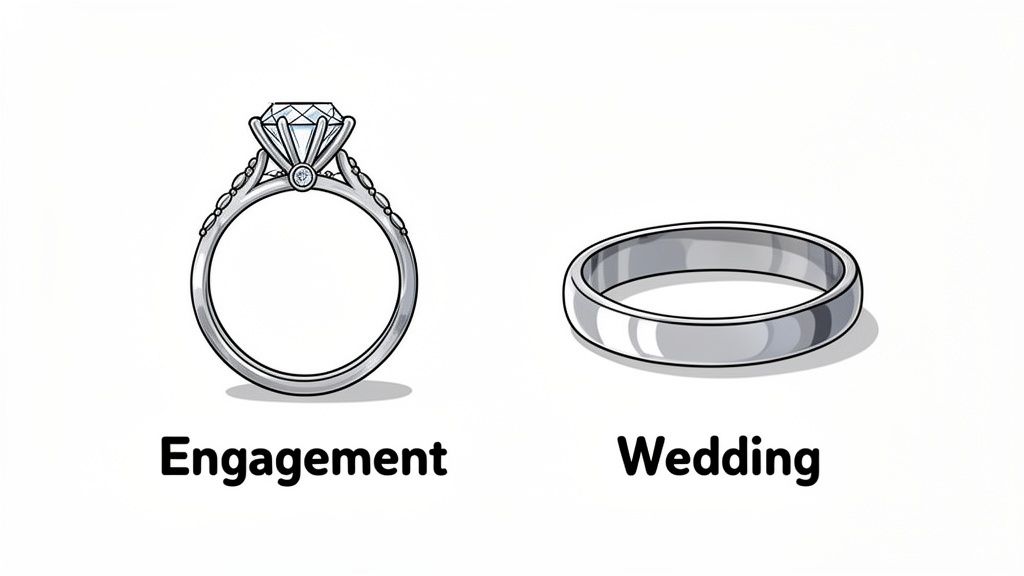
At their heart, the difference between engagement and wedding rings boils down to timing and purpose. Think of an engagement ring as the beautiful promise of marriage, given during a proposal. The wedding ring, on the other hand, is exchanged during the ceremony itself, sealing that promise and signifying the official union. This core distinction shapes everything else, from how they look to how they're worn.
Engagement Rings vs Wedding Rings: A Quick Comparison
To get straight to the point, one is a question, and the other is the lifelong answer. The engagement ring represents the promise to marry and is presented at the proposal, while the wedding ring formalises that promise and is exchanged on the wedding day. Every other difference—from the design to the cost—stems from this.
For a simple, at-a-glance overview, the comparison table below breaks down these key distinctions. It covers the symbolism, typical design, average cost, and how each ring is worn, giving you a clear foundation before we dive into the finer details.
Engagement Ring vs Wedding Ring at a Glance
Feature
Engagement Ring
Wedding Ring
Purpose & Symbolism
A promise to marry; a symbol of intent and commitment before marriage.
The official bond of marriage; a symbol of an eternal, binding union.
Timing
Given during the proposal, worn from the moment of "yes" onwards.
Exchanged during the wedding ceremony, worn from the wedding day forward.
Typical Design
Often elaborate and features a prominent centre stone (e.g., diamond).
Typically a simpler band of metal, which may include smaller stones or engravings.
Cost
Generally more expensive due to the centre stone and intricate setting.
Usually less expensive, with cost determined by metal, width, and any accents.
How It's Worn
Worn on the ring finger of the left hand throughout the engagement.
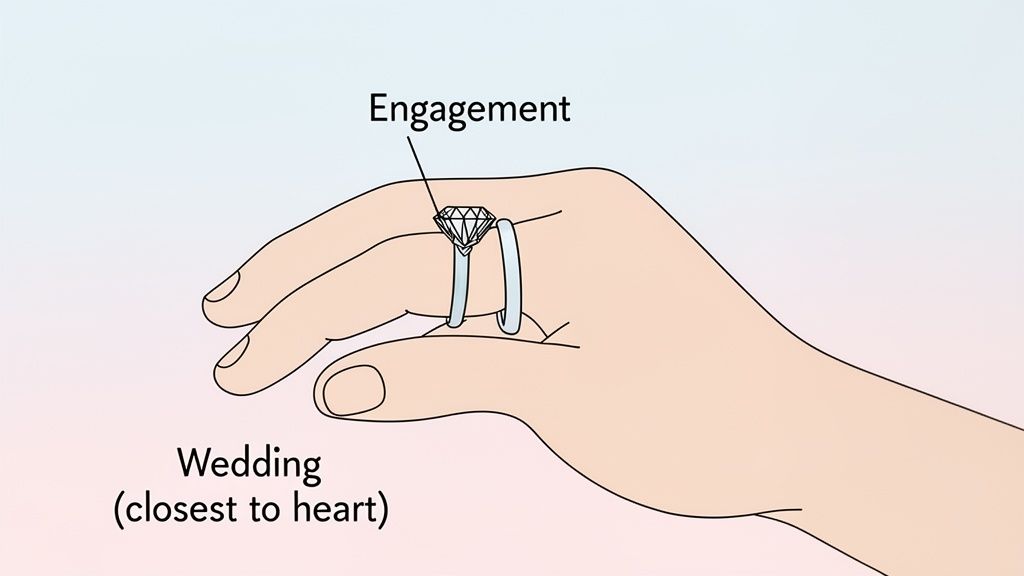
Worn on the ring finger of the left hand, traditionally closest to the heart.
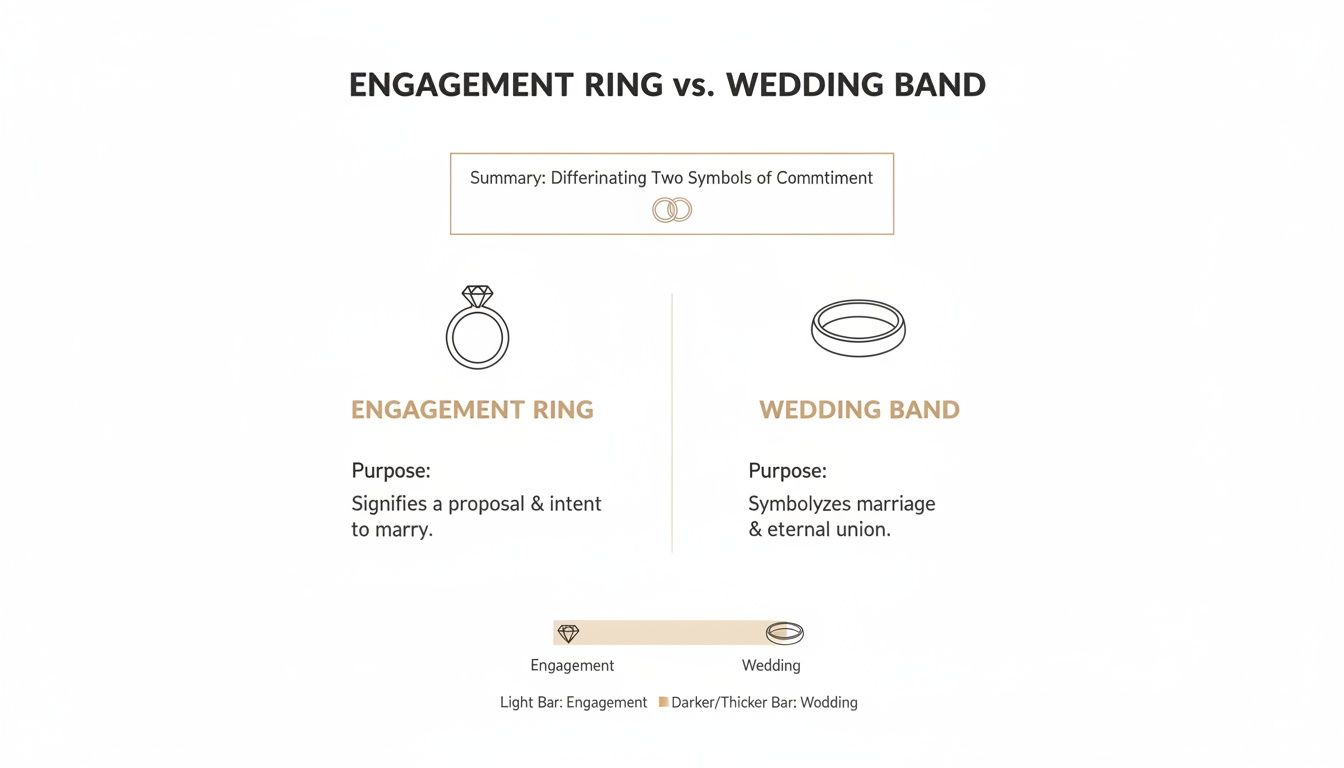
The infographic below offers a great visual summary of each ring's role, highlighting the proposal moment for the engagement ring versus the marriage itself for the wedding ring.
As you can see, the engagement ring is often the grand, sparkling gesture, while the wedding band is the quiet, powerful symbol of an enduring partnership.
The Meaning and Tradition Behind Each Ring
While they sit side-by-side on your finger, the engagement ring and wedding ring come from very different places historically. Understanding their distinct stories helps explain why one is a promise and the other is a lifelong declaration. These cultural roots are what shape everything from the typical designs to how they’re worn today.
The engagement ring started life as more of a token of betrothal, a public signal that a woman was spoken for and an agreement was in place between families. Over time, it evolved into the grand symbol of commitment we see now, capturing the spectacle and excitement of the proposal itself.
In contrast, the wedding ring’s meaning is all in its shape—a perfect, unbroken circle with no beginning and no end. This represents the eternal, legally binding union of marriage. It’s a quiet, constant reminder of the vows you exchange, designed for enduring strength.
The Spectacle Versus The Bond
An engagement ring is built to capture the buzz of the proposal. It’s often elaborate, designed around a central gemstone that draws the eye and tells a story of aspiration and commitment. This is exactly why styles like solitaires and halos are so timeless; their entire purpose is to showcase a beautiful stone.
The wedding ring, on the other hand, reflects the settled strength of a partnership. Its simpler, more durable design is meant to be worn every single day for a lifetime, symbolising the reality of a shared life. It doesn't need to be loud; its power lies in its constant, steady presence.
This symbolic split—the engagement ring as the grand gesture and the wedding band as the enduring bond—explains why they are treated so differently, from their design focus right down to their maintenance needs.
You can see this cultural focus reflected in what people search for and buy. A 2025 trends review showed that oval engagement rings pulled in around 7,000 Google UK searches a month, while classic solitaire designs still make up about 40.3% of sales. In contrast, simpler wedding bands are a major part of the 36.3% revenue share that rings hold in the wider UK jewellery market, proving their role as a daily-wear staple.
Beyond their looks, both rings carry a rich history. To understand more about the customs and symbolism behind these pieces, it's worth exploring topics like the enduring tradition of wearing wedding rings on the left hand. This tradition reinforces the idea of the wedding ring being physically and symbolically closer to the heart.
Comparing Design Aesthetics and Popular Styles
Beyond the symbolism, the most obvious difference between engagement and wedding rings comes down to their design philosophy. One is crafted to be a showstopper, the other a symbol of quiet, enduring comfort. Getting these aesthetic distinctions right is the key to choosing a pair that will sit together in perfect harmony for a lifetime.
An engagement ring is, at its heart, an exercise in presentation. Its entire job is to showcase a central gemstone, making it the undeniable star of the show. The whole structure, from the setting to the band itself, is engineered to lift that main stone up and squeeze every last drop of brilliance from it. It's why certain styles have remained classics for decades.
Engagement Ring Styles: Taking Centre Stage
The most iconic engagement ring designs are all about the main event—that diamond or coloured gemstone. Their entire construction is a deliberate strategy to draw the eye.
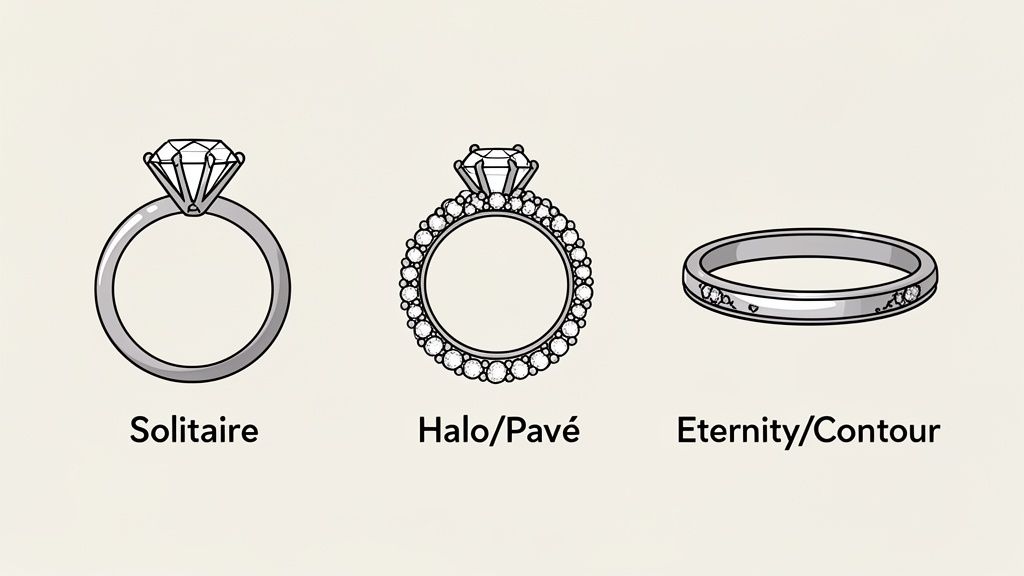
Solitaire: The quintessential classic. A solitaire setting uses the absolute minimum of metal (often just four or six tiny claws) to hold a single stone aloft. This lets the maximum amount of light flood into the diamond, seriously boosting its sparkle.
Halo: Here, the main stone is completely encircled by a ring of smaller pavé diamonds. It’s a clever trick that creates the illusion of a much larger centre stone while adding a dramatic, almost blinding, layer of brilliance.
Three-Stone: Representing the past, present, and future, this style flanks the central stone with two smaller side stones. It creates a much wider, more elaborate look that spreads across the finger.
For those wanting to dig deeper into these styles, our detailed guide covers the different kinds of engagement rings and what makes each one so unique.
Wedding Ring Styles: The Perfect Partner
A wedding ring, by contrast, is designed for constant, everyday wear and to complement, not compete with, the engagement ring. Its look is all about comfort, durability, and subtlety. While engagement rings are built up, wedding bands are typically designed to sit low and flush against the skin.
The core design principle is simple: the engagement ring makes the statement, and the wedding ring provides the seamless, supportive foundation.
This leads to popular styles that focus on creating a clean, elegant line:
Plain Band: A simple, polished band of precious metal. Its timelessness means it will never fall out of fashion, and it won’t distract from the main ring.
Pavé/Eternity Band: These feature a continuous or partial line of tiny diamonds set directly into the band. They add a beautiful sparkle without the height or prominence of a large centre stone.
Contoured/Chevron Band: A fast-growing trend in the UK, these bands are shaped with a distinct curve or 'V' to fit snugly against an unusually shaped engagement ring, like one with a pear or oval cut. This creates a cohesive, gap-free look, turning two individual rings into a single, unified bridal set.
Navigating the Budget for Each Ring
Let’s talk money. Getting a clear handle on the financial difference between an engagement ring and a wedding ring is a vital part of planning. The two carry vastly different price tags, and for good reason.
The engagement ring is usually the single biggest jewellery investment a couple will make. Its cost is almost entirely driven by the centre stone—its carat, cut, colour, and clarity are what shape the final price. Intricate metalwork, like a delicate pavé or a halo setting, will add to the expense, too.
In contrast, wedding bands have a much more approachable and flexible price range. Their cost comes down to the precious metal you choose (platinum costs more than gold, for instance), the width of the band, and whether you decide to add any small accent diamonds.
Understanding the Cost Breakdown
The financial gap between these two rings is pretty striking here in the UK. Engagement rings are a major, one-off purchase, with recent survey data suggesting the average UK spend is between £1,900–£2,200. In London, specialists often see that figure closer to £2,000–£4,000, depending on the diamond and setting.
Wedding bands, on the other hand, are a different story. They’re part of a much larger market sustained by sheer volume, with the UK wedding rings market valued at around USD 3.587 billion. This really highlights a key difference: one is a high-value, singular purchase, while the other is an almost universal staple, typically bought in pairs. While you’re thinking about ring budgets, it’s worth keeping other big wedding expenses in mind, like finding the perfect custom wedding suits.
Allocating Your Budget Wisely
For most couples, it makes perfect sense to put a larger slice of the jewellery budget towards the engagement ring. It’s the showstopper, the piece that symbolises the proposal, and its value is concentrated in that beautiful gemstone. Once you have a clear idea of what you want to spend there, planning for the wedding bands becomes much easier.
Key Takeaway: Think of the engagement ring as your main, stone-focused investment. Treat the wedding bands as complementary pieces where the metal choice and comfort are the biggest factors driving the cost.
A simple, elegant wedding band doesn't need to break the bank to be deeply meaningful. Often, the best strategy is just to focus on a durable metal that pairs beautifully with your engagement ring. If you’re looking for ideas on creating something special without overspending, our expert guide on how to build your wedding ring can help you match your style and budget perfectly.
How to Wear Engagement and Wedding Rings Together
Once you have both rings, the question shifts to how you'll wear them together. Getting the pairing right is about creating a look that’s comfortable, meaningful, and visually beautiful. The way you stack your rings is a personal choice, balancing tradition with the practicalities of everyday life.
The most time-honoured custom here in the UK is to wear the wedding ring first, placing it closest to your heart. This tradition comes from the ancient belief in the vena amoris, or "vein of love," which was thought to run directly from the fourth finger to the heart.
Following this custom, the engagement ring is stacked right on top of the wedding band. On the wedding day itself, many brides will temporarily move their engagement ring to their right hand. This leaves the left ring finger clear for the wedding band during the ceremony. Afterwards, the engagement ring is simply moved back to the left hand, sitting on the outside.
Modern Ways to Wear Your Rings
While tradition is lovely, more and more couples are finding creative and practical ways to wear their rings that just make more sense for their lifestyles. At the end of the day, the perfect arrangement is the one that feels right for you.
Here are a few popular alternatives we see all the time:
Soldering the Rings: For a perfectly seamless look and total convenience, some people choose to have their rings professionally soldered together. This creates a single, unified piece, which stops the rings from spinning or rubbing against each other and reduces long-term wear.
Wearing on Separate Hands: Another popular option is wearing the wedding band on the left hand and the engagement ring on the right. This works really well if the rings don’t sit flush together or if you simply prefer a less cluttered feel for daily wear.
Choosing a Bridal Set: A bridal set is an engagement ring and wedding band designed and made to fit together perfectly from the start. Opting for a set removes all the guesswork and guarantees a harmonious, integrated look.
Your lifestyle is the most important factor. If you work with your hands a lot, soldering your rings or wearing them on separate hands can prevent damage and keep them secure.
Ultimately, you want to create a pairing that feels authentic to you. Think about comfort, the shape of your engagement ring, and how the two metals look side-by-side. Whether you follow tradition to the letter or forge your own path, how you wear your rings is just another chapter in your unique story.
Ensuring a Lifetime of Care for Your Rings
Once your rings are on your finger, the journey isn't over—it’s just beginning. Keeping them beautiful means understanding that each ring has its own distinct maintenance needs. The difference between an engagement and a wedding ring is never clearer than in how they handle daily life and the care they require over the years.
An engagement ring, with its prominent centre stone and detailed setting, is naturally more vulnerable. Its claws can catch on clothes or get knocked during daily tasks, which can gradually weaken their grip. This makes regular professional checks essential to prevent the heartbreaking loss of a stone.
A wedding band, on the other hand, is built for endurance but it isn't indestructible. Because it's worn constantly, it takes the brunt of daily friction, which can lead to scratches, dullness, or the wearing away of the rhodium plating on white gold.
Distinct Maintenance Needs for Each Ring
The way each ring lives on your finger dictates its upkeep. After leaving the jeweller’s, they behave very differently, creating unique demands for repair services across the UK. With rings making up a massive 36.3% of the UK’s multi-billion-pound jewellery market, their ongoing care is a serious consideration.
Due to their exposed settings, engagement rings are far more likely to suffer from claw wear, especially for those commuting in busy cities like London.
This leads to specific care routines:
Engagement Rings: Need their prongs and settings checked at least twice a year. Professional cleaning is also vital to keep the main stone sparkling.
Wedding Bands: Usually need more frequent polishing to buff out surface scratches. White gold bands will also require rhodium re-plating every so often to restore their bright white finish.
The golden rule of ring care is proactive maintenance. It's always better to retip a worn prong or re-plate a fading band than to deal with a lost diamond or a permanently discoloured ring.
Why Professional Upkeep Is Non-Negotiable
While cleaning your rings at home is great for day-to-day sparkle, it’s no substitute for a professional jeweller’s eye. A skilled artisan can spot issues you can’t see, like tiny fractures in the band or a subtle weakness in the setting. For a better understanding of how to care for your rings, check out our guide on cleaning wedding rings at home and professionally.
At our Hatton Garden workshop, Opulence Jewellery Services is set up to handle these exact needs. We offer while-you-wait services like secure prong retipping to safeguard your engagement stone and same-day resizing for a wedding band that no longer fits. Professional care isn't a luxury; it's a crucial part of honouring what these precious symbols represent and ensuring they last a lifetime.
Common Questions About Engagement and Wedding Rings
Even with the differences laid out, lots of practical questions come up when you're choosing the rings. Getting clear answers builds confidence, making sure you pick something that feels right for your partnership, your style, and your budget. Here are the queries we hear most often in our workshop.
Do You Really Need Both Rings?
While it’s a long-standing tradition in the UK, having both is absolutely a personal choice, not a rule. Some people prefer a single, more substantial wedding ring that does the job of both. Others feel their engagement ring is the only symbol they need. Your decision should come down to what you love to wear and what feels most meaningful to you.
Which Ring Do I Buy First?
The engagement ring always comes first, as it’s presented during the proposal. Wedding rings are usually chosen together as a couple once you're engaged, but well ahead of the ceremony. This gives you plenty of time for any resizing or customisations needed.
Remember, these traditions are just guidelines. The most important thing is that the rings you choose are a true reflection of your unique partnership and the promises you’re making.
Can Any Ring Be Resized?
Most rings made from precious metals like gold and platinum can be resized by a skilled jeweller. However, some styles are tricky. Full eternity bands, with stones set all the way around, usually can't be resized without damaging the structure. Rings made from alternative metals like titanium are also extremely difficult to alter. It's always best to get a professional assessment first.
How Do You Match Your Wedding Band to the Engagement Ring?
The simplest way to get a perfect match is to buy a bridal set, where the rings are designed to sit together. If you're buying them separately, focus on matching the metal type, colour, and the profile of the band (its shape). For an engagement ring with a unique curve or shape, a custom-contoured wedding band is a fantastic option to get that seamless, gap-free fit.
Whether you need a same-day resizing, a stone securely replaced, or advice on creating a custom wedding band that fits perfectly, Opulence Jewellery Services is here to help. Visit our Hatton Garden workshop or explore our expert services at https://www.opulencejewelleryservices.co.uk.
Discover how to design a custom wedding ring in London. Our guide walks you through finding inspiration, choosing materials, and the bespoke creation process.
Thinking about resizing a wedding ring? Our guide covers UK costs, jewellers, and the process for gold, platinum, and rings with stones. Get a perfect fit.