Gold Plating Service London: Your Guide to a Perfect Finish
28 December 2025 17 min read Hatton Garden, London
Discover gold plating service london: learn how the process works, typical costs, and why Hatton Garden jewellers deliver a flawless finish.
When a cherished piece of jewellery starts to fade, it can feel like you've lost more than just its shine. For those seeking a premier gold plating service in London, our Hatton Garden workshop is where expert artisans bring your most loved items back to life.
Whether it’s a necklace that’s lost its lustre or a ring showing its age, professional plating offers a brilliant, durable finish, restoring the sentimental value held in every piece.
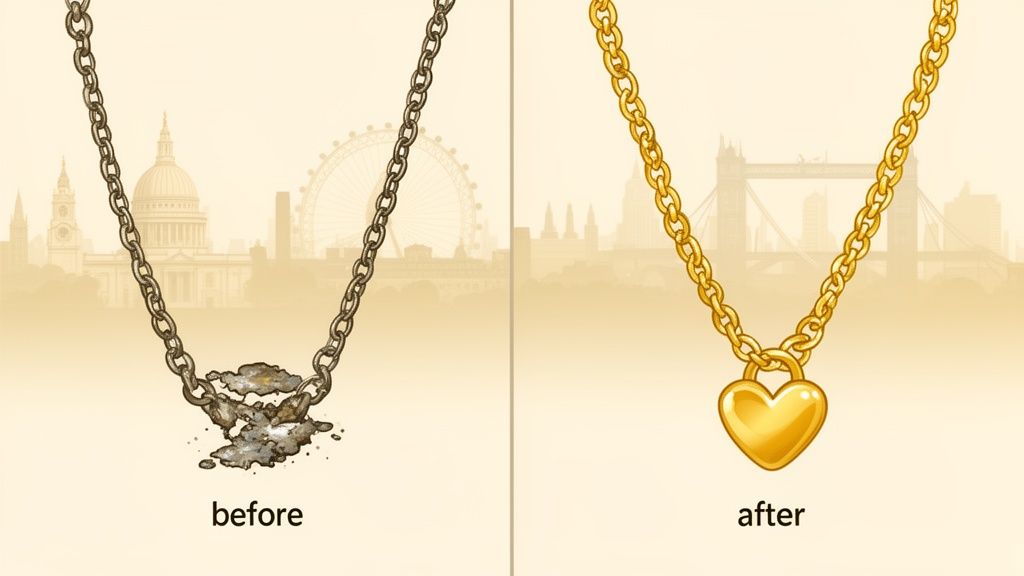
Giving Your Jewellery a Second Life in London
We’ve all been there. That favourite necklace now looks a little tired, or a treasured ring has seen better days. Before you consign them to the back of a drawer, imagine restoring their original, radiant glow. A professional gold plating service is the key to breathing new life into your jewellery, safeguarding the memories they represent.
This guide will walk you through how the expert process works, what you can expect from London’s top specialists, and how you can restore the beauty of your favourite pieces. It’s not just a repair; it's a way to ensure the stories and sentiments they hold can be worn and cherished for many more years.
More Than Just a Shine
Restoring jewellery is about so much more than surface looks—it’s about honouring its legacy. Many of the pieces we own carry deep personal meaning. They might be a gift from someone special, an heirloom passed down through generations, or a souvenir from a milestone moment. When these pieces fade, it can feel like a part of that story is lost with it.
Gold plating provides a practical and beautiful solution. It lets you:
Revive Sentimental Heirlooms Bring back the warm glow of a grandparent’s locket or a parent’s wedding band.
Update Fashion Jewellery Give a modern, luxurious finish to a costume piece you love but rarely wear because it looks worn.
Protect and Preserve Add a durable layer of real gold that shields the base metal from tarnish and everyday wear.
Once your pieces have been given a new lease on life, you might want to capture their restored beauty. To truly highlight their stunning transformation for an insurance valuation, online shop, or just for your own records, consider investing in professional jewelry product photography.
How Does Gold Plating Actually Work?
Gold plating isn't just a fancy coat of paint. It’s a meticulous scientific process called electroplating, where we use a controlled electric current to chemically bond a thin layer of real gold onto your jewellery.
Think of it like giving a piece of fine furniture a perfect, durable varnish, but on a microscopic scale. The result is a stunning finish that's molecularly bonded to the base metal, offering impressive durability for its thickness. It’s a precise art that completely transforms the surface of your treasured items.
The Science of a Flawless Finish
So, what happens in our workshop? The process starts by submerging two key items into a specialised electrolytic solution: your piece of jewellery (which acts as the cathode, or the negative electrode) and a piece of solid gold (the anode, or positive electrode).
When we introduce a gentle electric current, it acts like a magnet. The current causes microscopic gold particles to dissolve from the anode, travel through the solution, and deposit evenly onto the surface of your jewellery.
This controlled transfer ensures a uniform, consistent coating that adheres perfectly to every curve and detail. It’s this precision that separates a professional gold plating service in London from a DIY kit.
The quality of every material used is paramount. For a flawless finish, surfaces must be exceptionally clean. It's why professional workshops understand how ultrapure water is used in various industries, including jewellery plating, to prevent any imperfections during the critical cleaning and rinsing stages.
Key Stages in Our Plating Process
To achieve that showroom-quality result, our technicians follow a strict, multi-stage workflow. Every single step is crucial for ensuring the new gold layer is beautiful, strong, and long-lasting.
Meticulous Surface Preparation: First, the item is thoroughly cleaned and polished to remove any trace of oils, dirt, or tarnish. This is the most critical step—an impure surface will stop the gold from bonding correctly.
The Electrolytic Bath: Your jewellery and the solid gold anode are carefully placed in the plating solution. We precisely manage the type and temperature of this solution to achieve the exact colour and finish you want.
Controlled Current Application: Our experts apply a low-voltage direct current for a specific duration. This timing is what determines the thickness of the gold layer, which we measure in microns.
Finishing and Inspection: After plating, the piece is rinsed, dried, and given a final polish to bring out its brilliant lustre. It then undergoes a rigorous quality check before we hand it back to you.
The demand for high-quality materials to support this process is growing. Industry analysis shows a steady UK market, projecting a 4.1% annual growth rate in the gold plating chemicals sector, driven by both jewellery and electronics. This reflects the rising need for the specialist solutions used by UK platers every day.
Understanding the detail behind the process helps explain why professional expertise is so important. If you're curious about how this service can work for your items, our guide on finding a gold plating service near you offers more local insights.
Gold Plating, Vermeil, and Gold-Filled Explained
When you look at gold jewellery, what you see isn't always solid gold through and through. Terms like "plating," "vermeil," and "gold-filled" get thrown around a lot, but they describe very different ways of creating that beautiful golden finish.
Understanding what sets them apart is the key to choosing the right piece and, more importantly, knowing how to care for it or get it restored. The main differences really boil down to two things: what metal is underneath, and how thick the layer of gold on top actually is.
Think of it like this: a quick coat of paint is fine for a garden shed, but for a piece of fine furniture, you'd want multiple, thicker layers applied over a high-quality wood. It’s the same principle with your jewellery.
Comparing Gold Jewellery Finishes
To make it simple, here’s a direct comparison of the three most common gold finishing methods. This table helps you see exactly what you're getting in terms of durability, composition, and what each is best used for.
Attribute
Gold Plating (Electroplating)
Gold Vermeil
Gold-Filled
Base Metal
Usually brass, copper, or nickel. Can be any conductive metal.
Sterling Silver (92.5% pure silver) is required by UK law.
Typically jeweller's brass; a durable, affordable alloy.
Gold Thickness
Varies, but typically 0.5 to 1.0 microns. Very thin layer.
A minimum of 2.5 microns is legally required in the UK.
A thick sheet of gold, must be at least 5% of the item's total weight.
Bonding Process
Electro-chemical process using an electric current.
Same electroplating process as standard plating, just thicker.
Intense heat and pressure are used to permanently bond the gold layer.
Durability
Good for fashion/costume jewellery; can wear off with heavy use.
More durable than standard plating due to the thicker gold layer.
The most durable option. Resists tarnish and wear for many years.
Best For
Trendy pieces, costume jewellery, and items not worn daily.
Everyday pieces where quality and a precious metal base matter.
Chains, bracelets, and rings you want to wear daily without worry.
Each method has its place, offering a different balance of quality, longevity, and price. Knowing which one you have is the first step to giving it the expert care it deserves.
Standard Gold Plating: The Versatile Classic
Standard gold plating, also known as electroplating, is the most common method you’ll find. It’s a clever process where we use an electric current to bond a thin layer of gold onto a base metal like brass, copper, or silver.
Because the gold layer is measured in microns—a micron is just one-thousandth of a millimetre—it’s a fantastic, affordable way to get that luxury gold look. It's the perfect choice for giving a trendy fashion piece a new lease of life or restoring an item that isn't made from a precious metal. A professional gold plating service in London can control the process precisely, ensuring a beautiful, even finish.
Gold Vermeil: A Step Above
Gold vermeil (you say it 'ver-may') is a protected term for a reason—it’s a premium, regulated type of plating. For a piece to be legally sold as "vermeil" in the UK, it has to meet some strict rules that set it far apart from standard plating.
Base Metal Requirement: The piece must be made from sterling silver (that’s 92.5% pure silver). No exceptions.
Gold Purity: The gold used for the plating has to be at least 10 carats.
Thickness Standard: The gold layer must be a minimum of 2.5 microns thick, which is a big jump from most standard plating.
This combination of a precious metal base and a much thicker gold layer makes vermeil more durable and valuable. It hits that sweet spot between the quality of fine jewellery and a more accessible price.
Gold-Filled: The Durability Champion
If you want something that lasts, gold-filled is your answer. It’s the most durable and long-lasting option you can get outside of buying solid gold. Here, we’re not talking about a thin plated layer. Instead, a much thicker sheet of solid gold is permanently bonded to a base metal core (usually jeweller's brass) using serious heat and pressure.
The real difference is the sheer amount of gold involved. For a piece to be called gold-filled, the gold layer must make up at least 5% (or 1/20th) of the item's total weight. This means the gold layer is often 50 to 100 times thicker than what you'd find on a standard plated piece.
This robust construction makes gold-filled jewellery incredibly resistant to tarnishing and wear. It’s the ideal choice for pieces you live in, like chains and bracelets. While it costs a bit more upfront, its longevity makes it incredible value for money over time.
What Happens When We Plate Your Jewellery?
We believe in complete transparency, so let’s walk you through exactly what happens when you bring a piece to our Hatton Garden workshop. It’s a process we’ve refined over the years—a careful blend of traditional craft and modern precision that delivers a flawless, lasting finish every time.
First, everything starts with a conversation. One of our experienced jewellers will sit down with you to assess your item, discuss the finish you have in mind, and explain the best way to achieve it. We listen carefully, whether you want to match the original colour perfectly or give a beloved piece a completely new look.
The Critical Preparation Stage
Next comes the most important step: preparation. You can’t build a strong house on a weak foundation, and gold won’t bond properly to a surface that isn’t pristine. We painstakingly clean and polish your jewellery, removing every last trace of dirt, oil, and tarnish that could get in the way.
This stage is all about creating the perfect surface for the new gold layer to form a strong molecular bond with the base metal. It’s this attention to detail that sets a professional gold plating service in London apart and guarantees a durable, even coating.
The Plating Bath and Final Polish
Once your item is perfectly prepared, it’s submerged in our electroplating bath. This is where the magic happens. Our technicians expertly control the electric current and timing within this specialised solution, a skill that directly determines the thickness and consistency of the new gold layer. This precision ensures every curve and detail of your piece receives a beautiful, uniform coating.
After it emerges from the bath, we carefully rinse and dry the item before giving it a final, gentle polish to bring out a brilliant lustre. We then put it through a rigorous quality check, inspecting every detail to make sure it meets our high standards. Only then is your piece ready to leave our workshop, looking as good as new.
The diagram below shows the key differences between standard plating, vermeil, and gold-filled items.
As you can see, the thickness of the gold layer and the type of base metal really define the quality and durability of the final piece. To see how we apply these methods, you can explore the details of our professional gold plating services. It’s this combination of methodical steps and expert control that allows us to restore your jewellery with absolute confidence.
Finding the Right Plating Experts in Hatton Garden
Choosing the right artisan for your jewellery isn’t just about the technical process. It’s about trust. It's about knowing your treasured piece is in the hands of a true craftsperson. This is where location and experience really matter, and when you’re looking for a gold plating service in London, you want the assurance that comes from a workshop right in the city’s historic jewellery quarter.
Our workshop is situated in Hatton Garden, the traditional heart of London's jewellery trade. We’re not just technicians; we’re skilled artisans with over 15 years of dedicated experience, and we understand the sentimental value attached to every single item we handle.
The Opulence Jewellery Services Difference
We’ve built our service around what our London clients value most: traditional skill combined with modern convenience. Our commitment is to deliver a service that’s both reliable and perfectly suited to what you need.
Here’s what sets us apart:
Same-Day 'While-You-Wait' Service: Your time is valuable. For many plating jobs, we offer an immediate turnaround, so you can have your piece restored and back in your hands without a long wait.
Expert Colour and Clarity Matching: Whether we're restoring an old piece or repairing a small section, a flawless blend is everything. Our experts have a keen eye for matching gold colours and tones precisely, ensuring a seamless, invisible finish.
Decades of Combined Experience: Our team's deep knowledge means we can handle a huge range of items and challenges, from delicate antique heirlooms to contemporary fashion jewellery.
We believe exceptional craftsmanship should be accessible. That’s why our service is built on direct communication, clear expectations, and results that speak for themselves. You’re not just another customer; you're a partner in preserving something you love.
Transparent Pricing in the Heart of London
Clear, upfront pricing is key to building trust. While costs for jewellery restoration in the UK can vary, we make sure you know exactly what to expect from the very start.
As a benchmark, basic replating services in London often start from around £15–£30 for small touch-ups. More extensive work, like plating entire items or applying thicker deposits, will naturally cost more based on the materials and time needed. We always provide a clear, detailed quote before any work begins, so there are absolutely no surprises. You can discover more insights about gold plating market trends on globalinsightservices.com.
Our goal is simple: to be the most dependable and convenient choice for Londoners who demand guaranteed quality from local experts they can meet and trust.
How to Care for Your Gold-Plated Jewellery
You’ve given your favourite piece a new lease on life. Now, with a little bit of care, you can keep that brilliant gold finish looking its best for years. The golden rule? Treat it gently.
Think of that fresh layer of gold as a beautiful, protective coat that needs shielding from the rough and tumble of daily life. The key is protecting it from abrasion and harsh chemicals. A few simple habits will make all the difference, preserving its warm, luxurious shine.
Everyday Habits for a Lasting Shine
Honestly, the best way to care for your plated jewellery is to be mindful of when you wear it. A good habit is to make it the last thing you put on before you leave the house and the first thing you take off when you get home.
Just follow these simple rules to avoid damage:
Avoid Moisture: Always take your jewellery off before showering, swimming, or working out. Chlorine, salty water, and even your own sweat can speed up tarnishing and wear down that gold layer.
Keep Chemicals Away: Make sure to apply any lotions, perfumes, or hairsprays before putting on your jewellery. The chemicals can react with the gold, causing it to lose its lustre.
Remove During Chores: It's best to take off your rings and bracelets before cleaning, washing up, or gardening. This helps you avoid contact with harsh detergents and prevents accidental knocks and scratches.
Remember, the longevity of your gold plating is directly linked to how you wear it. By minimising its exposure to chemicals and moisture, you are actively preserving its finish.
Safe Cleaning and Storage
When it comes time for a clean, a gentle approach is vital. Never, ever use abrasive polishers or harsh chemical dips—they can easily strip away the thin layer of gold.
Instead, a simple wipe with a soft, lint-free cloth after each wear is usually enough to remove smudges and dirt. For a slightly deeper clean, you can use a bit of lukewarm water with a single drop of mild, soap-free washing-up liquid. We've got more detailed instructions in our guide on the best way to clean gold jewellery.
Proper storage is just as important as cleaning. To stop pieces scratching against each other, keep each plated item in its own soft pouch or a lined jewellery box. This simple step prevents tangles and friction, which are the main culprits for wearing down the finish. Following this advice ensures your cherished items, restored by our gold plating service in London, stay beautiful.
Your Gold Plating Questions Answered
We get a lot of questions about gold plating here in our London workshop. To help you feel confident about the process, we’ve put together clear, straight-to-the-point answers to the ones we hear most often.
How Long Does Gold Plating Last?
This really comes down to three things: the thickness of the gold layer, what the item is, and how you wear it. A thicker plate, measured in microns, will always have more staying power.
Think about it this way: a pair of earrings doesn't see much action, so its plating will last a long time. A ring on your dominant hand, however, is constantly in contact with surfaces. With a little care and avoiding harsh chemicals, a professionally plated piece can look fantastic for several years.
What Does It Cost To Plate a Ring in London?
For a standard gold plating service in London, you can generally expect a price between £40 and £80 for a typical ring. The final cost depends on the piece's size, how thick you want the gold layer to be, and the condition of the metal underneath.
Larger or more detailed items will cost a bit more, but we are always upfront about pricing. You'll get a clear, no-obligation quote from us before any work starts.
Gold plating and refinishing are a cornerstone of the UK’s vibrant jewellery industry. Valued at roughly USD 778.19 million, the market is set to grow, fuelling demand for the expert craftsmanship found right here in Hatton Garden. You can read more about the UK jewellery market's impressive growth on sphericalinsights.com.
Can You Gold Plate Any Metal?
Almost! The key is that the metal needs to conduct electricity for the electroplating process to work. Most base metals used in jewellery—like brass, copper, nickel, and sterling silver—are perfect candidates.
Some metals like titanium or stainless steel need a bit of special preparation first, but our experienced technicians can often plate them successfully. We'll always assess your piece first to make sure it's suitable.
How Does a Same-Day Service Work?
Our 'while-you-wait' service is all about convenience. For most straightforward plating jobs, you can bring your jewellery into our Hatton Garden workshop, and our artisans will get it done the same day, sometimes in just a couple of hours. It’s the perfect way to see your piece transformed and walk out with it looking brand new, no waiting required.
Ready to bring back your jewellery’s original shine? Visit Opulence Jewellery Services in Hatton Garden for a free chat and see how our expert plating can restore your treasured pieces. https://www.opulencejewelleryservices.co.uk
Discover the timeless elegance of the engagement ring emerald cut. Our guide covers choosing the perfect diamond, setting, and provides expert care tips.
Discover how to get the perfect fit for your big day. Our expert guide covers sizing wedding rings, resizing costs, and finding the right jeweller in London.
Shop Fine Jewellery Online
Engagement rings, wedding bands, earrings, necklaces & birthday gifts — beautifully crafted and delivered to your door.