Discover the timeless elegance of the engagement ring emerald cut. Our guide covers choosing the perfect diamond, setting, and provides expert care tips.
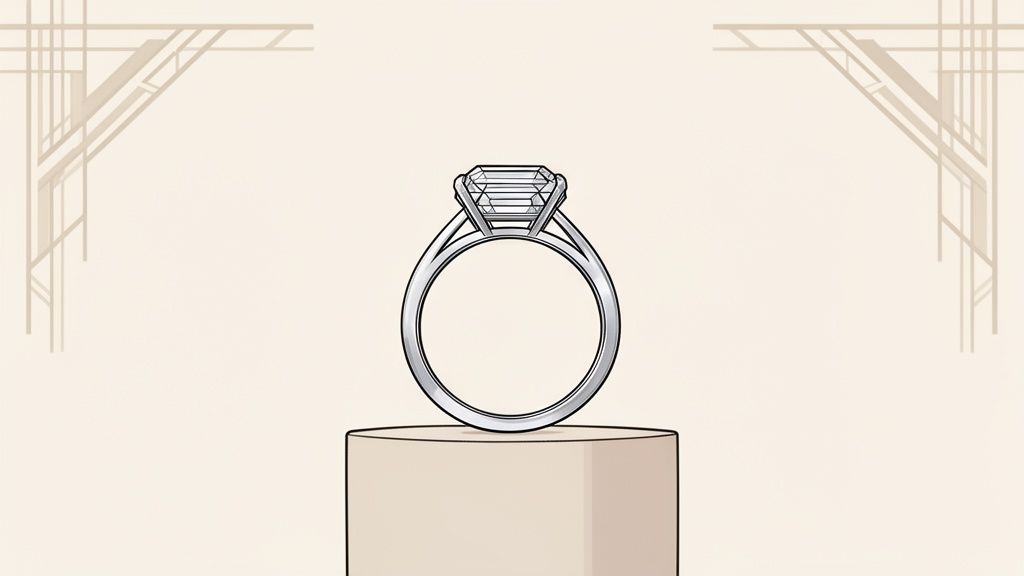
An engagement ring emerald cut is the very definition of sophisticated elegance. It’s known for its iconic rectangular shape and long, stepped facets that create a hypnotic 'hall of mirrors' effect. This unique cut gives a subtle, glamorous flash of light rather than the fiery sparkle you see in other diamond shapes, making it a timeless choice for those who love understated glamour.
The Timeless Allure of the Emerald Cut
Step into the world of the emerald cut engagement ring—a style that effortlessly blends vintage charm with modern grace. With roots deep in the Art Deco period, this cut is celebrated for its clean lines, architectural feel, and the completely unique way it plays with light.
Unlike brilliant cuts designed for maximum sparkle, the emerald cut was created to showcase a stone’s exceptional clarity and lustre. The long, linear facets act like mirrors, reflecting bold flashes of white light back to your eye.
This creates a more subdued, elegant glow. It's a visual signature that appeals to those who appreciate precision and quiet confidence in their jewellery. It’s a style that feels both classic and contemporary, making it a consistently popular choice.
A Modern Resurgence in Popularity
While always a classic, the emerald cut has seen a remarkable surge in recent years. Couples are increasingly drawn to its distinct character and flattering silhouette, which elegantly elongates the finger. This isn't just a feeling; market data shows a clear shift in what people are buying.
The emerald cut's appeal lies in its sophisticated geometry. It doesn't shout for attention with sparkle; instead, it captivates with its depth and clarity, revealing the true character of the diamond.
Recent figures from the UK market highlight this growing demand. In the UK engagement ring market of 2025, the emerald cut diamond has captured 7% of all diamond shapes sold, a notable increase from 6% in 2024.
This rise positions emerald cuts as the fourth most favoured shape, just behind the ever-popular round, oval, and cushion cuts. You can explore more on this trend by reviewing the comprehensive Engagement Rings Trends Report from Queensmith.
This guide is your complete resource for understanding everything about an emerald cut engagement ring. From demystifying the 4 Cs as they apply to this specific shape to choosing the perfect setting and learning about lifelong care, our Hatton Garden experts are here to give you the insights you need.
Why Choose an Emerald Cut Diamond?
So, what is it that really sets an emerald cut engagement ring apart from all the others? While most diamond cuts are engineered for that classic, fiery brilliance, the emerald cut offers something else entirely: a mesmerising depth and a sophisticated, understated glamour. Its unique signature is less about frantic sparkle and more about elegant, dramatic flashes of light.
Think of it like gazing into a perfectly clear, still lake versus a bubbling stream. A brilliant cut diamond is the stream, with light bouncing off in countless directions to create that familiar shimmer. An emerald cut, however, is the lake. Its large, open table—the flat top facet—acts as a crystal-clear window, drawing your eye deep into the stone’s heart.
This clarity-first nature is what defines an emerald cut. The long, stepped facets lining its sides don't break up light into tiny sparkles. Instead, they act like a hall of mirrors, creating broad, clean flashes of white and coloured light that glide across the surface as the ring moves. It’s a confident, architectural beauty that showcases the diamond’s quality above all else.
The Unique Advantages of This Cut
Opting for an emerald cut diamond comes with a distinct set of benefits that appeal to anyone with a refined aesthetic. One of its most celebrated qualities is its flattering shape. The elongated, rectangular form has a remarkable ability to gracefully lengthen the appearance of the finger, creating a slender and elegant silhouette.
Another significant advantage is its potential for better value. Shaping an emerald cut from a rough stone is a highly efficient process, often preserving more of the original carat weight compared to other cuts. This can mean you get a visually larger stone for your budget. A 1.5-carat emerald cut, for example, often appears bigger than a 1.5-carat round brilliant because of its greater surface area.
Finally, there's that undeniable air of sophistication. An emerald cut engagement ring is a statement of classic, enduring style. It doesn't shout for attention; it commands it with quiet confidence and a timeless, Art Deco-inspired charm that never feels dated. For a deeper dive into how different cutting styles influence a diamond's final look, our diamond cutting chart offers valuable insights.
Important Considerations to Keep in Mind
With its unique strengths come a few specific considerations. The very feature that makes the emerald cut so stunning—its large, open table—also means that inclusions, or natural imperfections, can be more visible. Unlike brilliant cuts where intense sparkle helps mask tiny flaws, the clear window of an emerald cut leaves very little to hide.
Because clarity is so crucial, we typically recommend a grade of VS2 (Very Slightly Included 2) or higher for an emerald cut. This ensures the diamond appears clean to the naked eye, preserving its pristine, icy beauty.
Additionally, the cut's distinctive clipped corners, while part of its iconic design, are potential points of vulnerability. These corners require a secure and protective setting to prevent chipping during everyday wear. A classic four-prong setting that covers each corner or a bezel setting that fully encases the diamond's edge are excellent choices to ensure its longevity.
This balanced view helps you appreciate what makes the emerald cut so special while making an informed decision. To make it even clearer, here’s a quick summary of the key points.
Emerald Cut Engagement Rings Pros and Cons
Attribute
Advantages (The Pros)
Considerations (The Cons)
Visual Effect
Produces elegant flashes of light for a sophisticated, "hall of mirrors" look.
Offers less traditional sparkle compared to brilliant cuts.
Appearance
Elongated shape makes the finger appear longer and slimmer.
Inclusions and colour tints are more easily visible through the large table.
Value
Often appears larger per carat and can be more affordable than round cuts.
May require investing in a higher clarity and colour grade to look its best.
Durability
The shape itself is stable and secure for daily wear.
The clipped corners are vulnerable and require a protective setting.
Ultimately, choosing an emerald cut is about prioritising sophisticated elegance and pristine clarity over fiery sparkle.
Selecting Your Perfect Emerald Cut Diamond
Choosing an emerald cut diamond isn’t about chasing the fiery sparkle you see in other cuts. It's about falling for its clean, architectural lines and profound clarity. Think of its large, open table as a crystal-clear window right into the heart of the stone.
Unlike brilliant cuts that use their sparkle to hide tiny flaws, an emerald cut puts everything on display. This means you need a slightly different mindset when choosing one, focusing less on the standard 4 Cs and more on the stone's unique personality. It’s a bit like buying a piece of art—you’re looking at the composition and the artist’s skill, not just the raw materials.
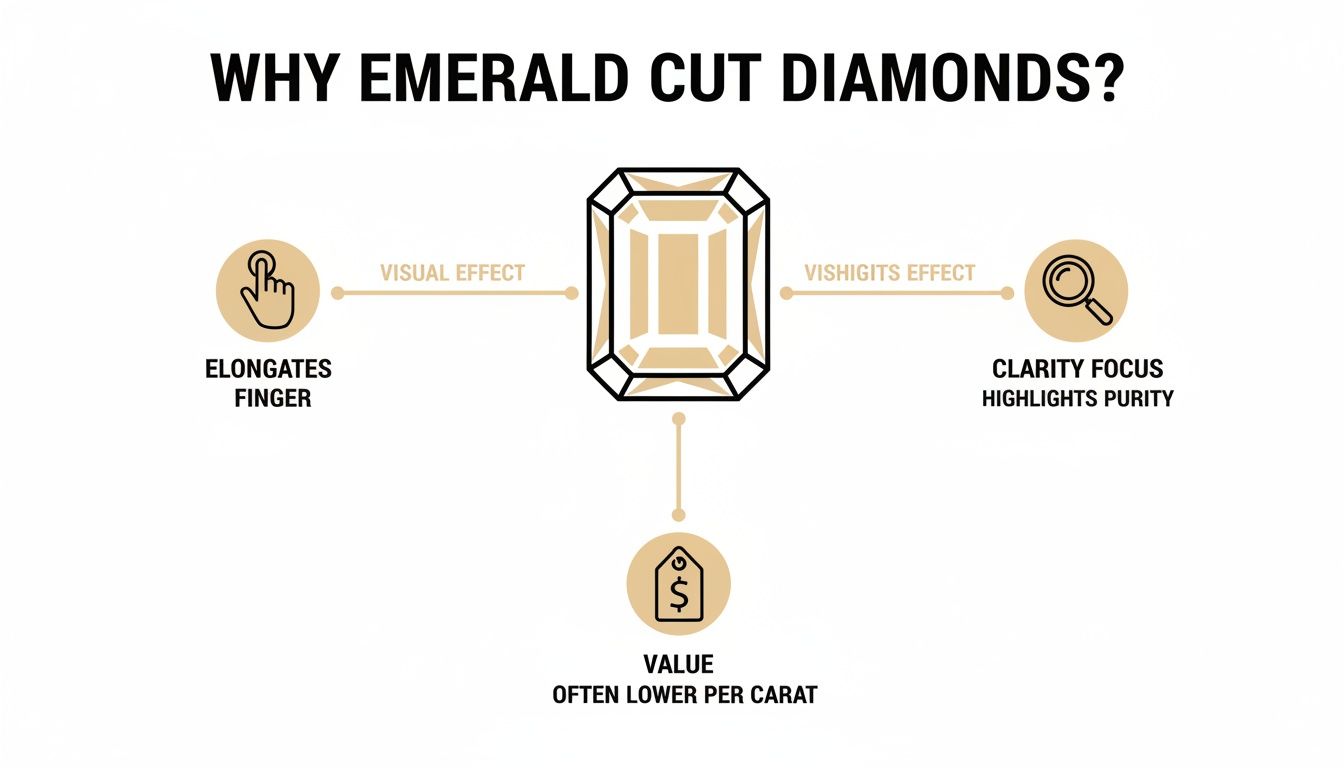
This infographic breaks down exactly why discerning buyers are drawn to the cool, understated elegance of an emerald cut.
As you can see, the decision often comes down to its flattering effect on the hand, its emphasis on pristine clarity, and the fantastic value it offers.
Prioritise Clarity Above All Else
With an emerald cut, clarity is king. It's non-negotiable. Those long, stepped facets and that wide-open table are unforgiving; any inclusions (natural internal characteristics) will be far more obvious than in a round or cushion cut. It's the difference between looking through a perfectly clean pane of glass versus a textured one—the clear pane reveals everything.
For this reason, we always recommend a clarity grade of VS2 (Very Slightly Included 2) or higher. At this level, any inclusions are almost always invisible to the naked eye, keeping that mesmerising "hall of mirrors" effect perfectly clean and uninterrupted. You might find an eye-clean SI1 stone, but it takes a very keen eye and, ideally, an expert opinion.
Investing in a higher clarity grade for an emerald cut isn't just a technicality; it's a commitment to preserving the clean, geometric beauty that makes the style so special.
Find the Sweet Spot for Colour
Just as an emerald cut reveals inclusions, it can also show hints of colour more easily than brilliant cuts. Because it doesn't break up light with the same intensity, there's less sparkle to disguise any underlying warmth in the diamond.
To get the best balance of beauty and value, we suggest looking in the near-colourless range, specifically grades G or H. These stones will appear icy white, especially when set in white gold or platinum, but you won't be paying the premium that comes with the top D-F colourless grades.
If you’re planning on a yellow or rose gold setting, you have even more wiggle room. The warm glow of the metal complements a diamond with a slightly lower colour grade (like an I or J) beautifully, making it a very savvy way to make the most of your budget.
Master the Length-to-Width Ratio
Beyond the 4 Cs, the actual proportions of an emerald cut have a huge impact on its final look. The length-to-width ratio is what determines whether the stone is a long, slender rectangle or something closer to a square. There’s no right or wrong answer here—it’s purely down to personal taste.
The Classic Elongated Look: A ratio between 1.40 and 1.50 is considered the timeless sweet spot. It creates a graceful, slimming effect on the finger.
A Slightly Wider Feel: Ratios from 1.30 to 1.40 give a broader, more substantial look while still being clearly rectangular.
Almost Square: Anything below 1.30 starts to look more square-like, a bold and modern style that some people absolutely love.
The rising popularity of this cut isn't just something we're seeing in our workshop; the numbers back it up. Recent 2024 data shows the emerald cut is the UK's leading engagement ring style, pulling in an incredible 4,013 monthly searches. This reflects a bigger shift towards elegant, step-cut diamonds. You can explore more about these wedding planning trends at Index Digital.
Pairing Your Diamond with the Ideal Setting and Metal
Choosing your emerald cut diamond is a huge first step, but the journey doesn’t end there. The setting and metal you pick are like the perfect frame for a masterpiece; they don't just protect the diamond, they define the ring's entire personality. An engagement ring emerald cut can go from minimalist and modern to a vintage treasure based purely on its surroundings.
The goal is to strike a balance between your personal style, your lifestyle, and the security of the stone. The setting needs to guard the diamond's more vulnerable corners, while the metal colour should flatter both the stone and your skin tone. Let's walk through the most popular options to help you create a ring that’s both beautiful and built for life.
The Most Flattering Settings for an Emerald Cut
The clean, geometric lines of an emerald cut diamond are incredibly versatile, lending themselves to a wide range of settings. Each style brings out a different side of the stone’s character, so you can really tailor the final look.
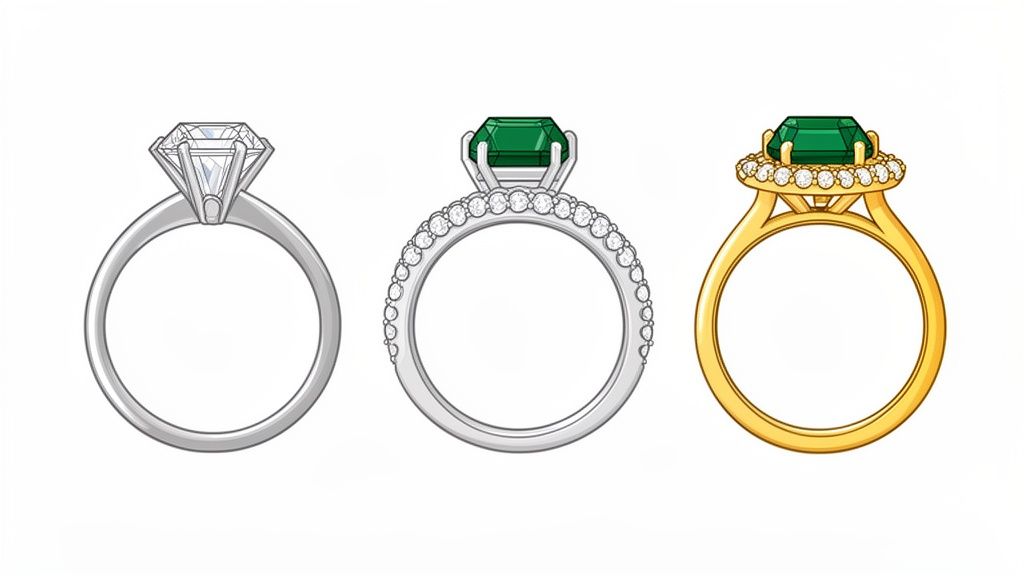
The Solitaire Setting: This is the ultimate choice for timeless minimalism. A classic four or six-prong solitaire holds the diamond up high, letting light flood in to create those signature flashes. It’s a confident look that says the diamond is the undeniable star of the show.
The Halo Setting: Love the emerald's shape but crave a little more sparkle? The halo setting is the perfect answer. A delicate frame of small, brilliant-cut diamonds wraps around the centre stone, creating a stunning contrast in light play and making the emerald cut look even bigger.
The Three-Stone Setting: This deeply symbolic design represents a couple's past, present, and future. Flanking the central emerald cut with smaller diamonds—often tapered baguettes or trapezoids—adds beautiful dimension and a symmetrical appeal that harks back to the stone's Art Deco roots.
A well-chosen setting does more than just hold the diamond; it enhances its unique beauty. A solitaire champions its clean lines, while a halo adds a layer of brilliance, proving the emerald cut's remarkable versatility.
The popularity of this cut is only growing, with its distinct elegance capturing the imagination of modern couples. Recent Google UK search data shows emerald engagement rings are a major trend for 2025, pulling in an impressive 5,500 monthly searches. This reflects a real fascination with unique cuts that offer character beyond just sparkle. You can see the full analysis of UK engagement ring trends on handt.co.uk.
Choosing the Right Metal Colour
The metal you choose has a huge impact on the final feel of your engagement ring. It can either amplify the diamond's icy coolness or create a warm, striking contrast.
Cool Tones: Platinum and White Gold
Platinum and white gold are incredibly popular choices for emerald cut rings, and for good reason. Their bright, silvery-white hue acts like a mirror, enhancing the diamond's whiteness for a seamless, icy look. This works especially well for diamonds in the D-H colour range, making them appear even more colourless.
These metals provide a crisp, modern backdrop that lets the diamond's clean lines take centre stage. If you're weighing up these two, it’s worth understanding their key differences in durability and maintenance. You can explore a detailed comparison in our guide on the difference between white gold and platinum.
Warm Tones: Yellow and Rose Gold
For a touch of classic warmth or a more romantic feel, yellow and rose gold are stunning options. Yellow gold creates a beautiful, bold contrast against the white diamond, giving the ring a traditional or vintage vibe that never goes out of style.
Rose gold offers a more contemporary, romantic alternative. Its soft, pinkish hue provides a gentle warmth that complements a huge range of skin tones. Both yellow and rose gold can also be a clever choice for diamonds with a slight warmth (I-J colour grades), as the metal's glow makes any subtle yellow in the stone far less noticeable.
Expert Care and Maintenance for Your Ring
An emerald cut engagement ring is a treasure for life, and with the right care, its unique beauty will last for generations to enjoy. Unlike brilliant cuts that hide smudges behind a busy sparkle, the large, open table of an emerald cut is like a clear window. It shows everything. This means oils from your skin, lotions, and daily dust can quickly dull its signature lustre.
Think of cleaning as routine housekeeping for your most precious piece. A little bit of regular, gentle cleaning prevents grime from building up and ensures your diamond keeps delivering those clean, mirror-like flashes you fell in love with.
Gentle At-Home Cleaning
You don’t need harsh chemicals to bring back your ring's brilliance. A simple and safe cleaning solution can be made right in your kitchen.
Prepare a Gentle Soak: Fill a small bowl with warm water and add a few drops of mild washing-up liquid. Steer clear of any soaps with moisturisers, as they can leave a film behind.
Let It Soak: Pop your ring in the solution for 20-30 minutes. This gives the soapy water time to gently loosen any built-up oils and dirt without any harsh scrubbing.
Use a Soft Brush: After its bath, use a very soft brush—a baby toothbrush is perfect—to carefully clean around the setting, under the diamond, and between the claws. This is where grime loves to hide.
Rinse and Dry: Rinse the ring well under warm running water to get all the soap off. Then, pat it dry with a soft, lint-free cloth. Be gentle to make sure no fibres snag on the prongs.
Doing this simple routine every few weeks is the best way to maintain that day-one sparkle.
The Importance of Professional Maintenance
While home cleaning keeps the surface looking great, a professional service is vital for the long-term health and security of your ring. Here at our Hatton Garden workshop, Opulence Jewellery Services is set up to handle the specific needs of emerald cut rings, making sure they stay structurally sound for decades.
"Think of professional maintenance as an annual health check for your ring. We inspect the very foundation of the piece—the prongs, the band, the setting—to catch small issues before they become significant problems."
A regular professional check-up is the best preventative care you can give your ring. Our master jewellers recommend bringing it in once a year to assess any wear and tear that you might not be able to see yourself.
Here are a few common services we provide:
Prong and Claw Retipping: The corners of an emerald cut are its most vulnerable points. Over time, the metal claws holding the diamond in place can wear down. Retipping involves expertly adding a tiny amount of metal to build them back up, securely fastening your precious stone.
Shank Repair and Resizing: The band of the ring (the shank) can become thin after years of daily wear. We can repair worn sections or, if needed, resize the ring for a perfect, comfortable fit.
Expert Polishing and Plating: Our workshop uses professional-grade polishing equipment to remove fine scratches from the metal, restoring its original brilliant shine. For white gold rings, we can also re-apply the rhodium plating to bring back that crisp, bright-white finish.
Bringing Your Vision to Life with Custom Designs
An engagement ring is so much more than just a piece of jewellery. It’s a deeply personal symbol of your unique story. While choosing a ready-made ring is a wonderful option, the world of custom design opens up a chance to create something truly one-of-a-kind. An engagement ring emerald cut is the perfect canvas for that bespoke creativity.
Whether you're starting from scratch with a completely new idea or looking to breathe new life into a treasured family heirloom, customisation lets you craft a piece that perfectly captures your journey and style. This is your chance to turn a beautiful ring into an unforgettable masterpiece.
Personalising Your Emerald Cut Ring
The elegant, architectural lines of an emerald cut diamond lend themselves beautifully to personalisation. Even small adjustments can dramatically alter the ring's character, making it a true reflection of you. For those seeking fresh ideas, looking into the latest wedding trends can offer a great starting point for custom designs.
Here are a few popular ways our clients personalise their rings:
Adding a Diamond Halo: A halo of small, brilliant-cut diamonds around the centre stone adds a stunning layer of sparkle. It creates a beautiful contrast with the emerald cut's clean flashes of light and has the welcome effect of making the centre stone appear larger.
Incorporating Side Stones: Flanking your emerald cut with meaningful side stones, like tapered baguettes for an Art Deco feel or small sapphires for a pop of colour, adds symbolic depth and visual interest.
Choosing a Unique Band: A simple pavé band adds glamour, while an engraved or milgrain-detailed band can give the ring a vintage, antique feel. The choice of band texture and style is a powerful way to express your personality.
The Art of Ring Remodelling
Remodelling is a sentimental and sustainable way to create your perfect ring. It’s all about taking an existing piece—perhaps an inherited ring that isn't quite your style—and transforming it into something new. This process honours the past while celebrating your future.
Remodelling isn’t about erasing history; it's about continuing the story. By resetting a family diamond or updating a setting, you're weaving your own chapter into a piece's legacy.
Here in our Hatton Garden workshop, we often help clients with transformative remodelling projects. A common request is to take a classic yellow gold solitaire and reset the emerald cut diamond into a modern platinum setting, which completely changes its aesthetic. Another popular option is to add side stones or a halo to an existing ring, giving it a more substantial and brilliant presence.
The possibilities are nearly endless, and our experts can guide you through the process. To learn more, explore our comprehensive guide on creating a custom engagement ring.
Your Emerald Cut Questions, Answered
To help you feel completely confident in your choice, here are the honest answers to the questions we hear most often in our Hatton Garden workshop.
Do Emerald Cut Diamonds Sparkle Less?
They sparkle differently. An emerald cut won't give you that fiery, disco-ball brilliance you see in a round diamond. Instead, its long, clean facets create elegant, dramatic flashes of light. We call it a "hall of mirrors" effect—a sophisticated and confident gleam rather than an explosion of sparkle.
If you value clarity and understated glamour over intense, scattered light, then an emerald cut's unique flash is exactly what you're looking for.
Are Emerald Cut Diamonds More Expensive?
Not always. Carat for carat, emerald cuts can actually be a bit more affordable than round brilliant diamonds. The reason is simple: the cutting process is more efficient and wastes less of the original rough diamond.
The trade-off, however, is clarity. That big, open "table" (the top facet) is like a window into the diamond, making any inclusions much easier to spot. This means you'll likely want to invest in a higher clarity grade, such as a VS2 or better, to get that flawless look, which can balance out the initial cost savings.
The real value of an emerald cut is in its visual presence. Its elongated shape often makes it look larger than a round diamond of the same carat weight, giving you a bigger, bolder look for your budget.
How Do I Keep an Emerald Cut Ring from Getting Damaged?
The clipped corners are the diamond's most vulnerable points. The best way to protect them is with a setting designed specifically to shield these areas from life's inevitable bumps and knocks.
A Bezel Setting: This is your maximum-security option. A thin metal rim wraps around the entire edge of the diamond, holding it securely and protecting it from all angles.
A Claw Setting: A classic choice for a reason. A well-crafted claw (or prong) setting that securely covers each of the four corners is both a popular and very safe way to set the stone.
The most important thing is to have your jeweller check the claws regularly to make sure they're still tight. It's a simple step that guarantees lifelong security. For more ideas as you plan your big day, you can also explore some general wedding planning resources for wider inspiration.
At Opulence Jewellery Services, our Hatton Garden experts are here to help you care for, repair, or create the emerald cut engagement ring of your dreams. Visit us to explore our services.
Discover how to get the perfect fit for your big day. Our expert guide covers sizing wedding rings, resizing costs, and finding the right jeweller in London.
Learn the safe, expert way to diamond ring clean at home. Our guide shows you how to restore sparkle and avoid costly mistakes, straight from Hatton Garden.