04 December 2025 19 min read Hatton Garden, London
Need to resize wedding ring? Our UK jeweller's guide explains steps, costs, risks, and what to do when resizing isn't possible. Learn more.
The short answer? Yes, in most cases, a wedding ring can absolutely be resized. But whether it’s possible really comes down to the ring’s design, the metal it’s made from, and just how much bigger or smaller you need it to be.
Understanding When You Can Resize a Wedding Ring
A wedding ring is more than just jewellery; it’s on your hand day in, day out as a symbol of your commitment. Over a lifetime, it's completely normal for that perfect fit to change. Fingers can swell or shrink due to weight changes, pregnancy, the seasons, or even arthritis.
You might also have been given a precious family heirloom that doesn't quite fit, making a professional resize the only way to continue its legacy. For many, the need for a resize comes as a surprise years after the wedding. A ring that was once perfect might suddenly feel uncomfortably tight or dangerously loose. This is an incredibly common experience and, thankfully, one that any skilled goldsmith is well-equipped to handle.
Key Factors That Determine Resizability
Before you bring your ring into a workshop, it helps to understand what makes it a good candidate for resizing. It’s not a one-size-fits-all job, and a jeweller will first need to assess a few key aspects:
The Metal Type: Traditional precious metals like gold (yellow, rose, and white) and platinum are perfect for resizing. They are malleable metals that respond beautifully to being cut, soldered, and reshaped without losing their integrity.
The Band's Design: A simple, plain band is the most straightforward ring to resize. The more complex the design—think patterns, engravings, or mixed metals—the more challenging the work becomes.
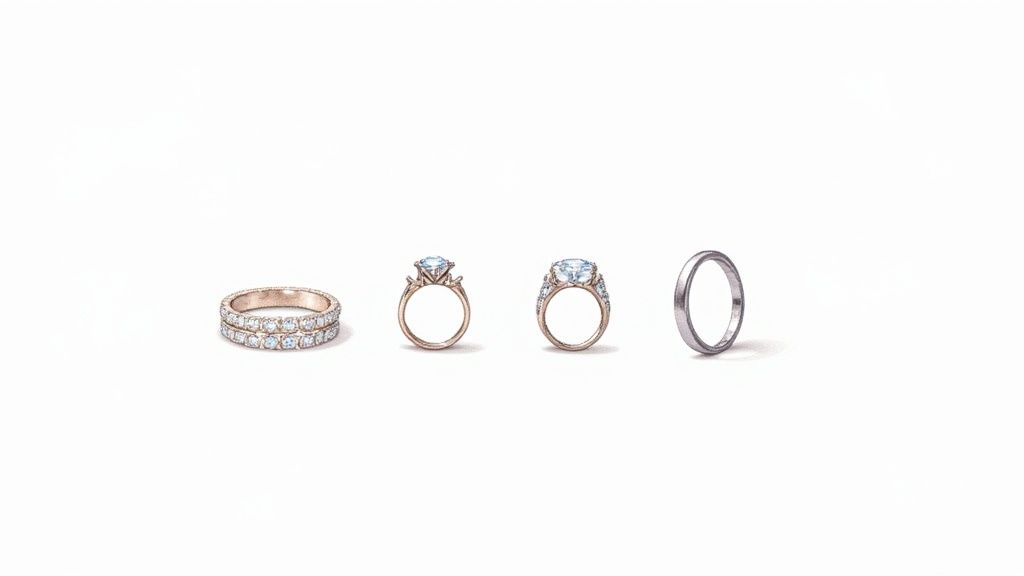
The Presence of Gemstones: Rings with stones, especially eternity rings where gems go all the way around the band, present the biggest challenge. Each stone’s setting may need to be checked and tightened, and sometimes even rebuilt.
The Required Size Change: A small adjustment of one or two sizes up or down is usually manageable. Drastic changes, however, can start to compromise the ring’s structural integrity and distort its original shape.
As a rule of thumb, a professional jeweller can typically resize a standard gold or platinum band up to two sizes without affecting its strength or appearance. Beyond that, more complex work might be needed to preserve the ring's original form.
Ultimately, resizing your wedding ring is a delicate balance between the material's properties and the artisan's skill. While many rings can be adjusted with relative ease, some designs—like those made from tungsten or featuring a continuous, uninterrupted pattern—are simply not built to be altered.
How Jewellers Actually Resize a Ring
Ever wonder what really happens to your wedding ring behind the workshop counter? It’s not just a quick tap with a hammer. A skilled jeweller uses precise, time-honoured techniques to alter its size, all while protecting its beauty and strength. The method they choose depends entirely on your ring's design, its metal, and whether it needs to be made smaller or larger.
Understanding the craft gives you the confidence to know what to ask for. Let's pull back the curtain on the main methods our goldsmiths use every day.
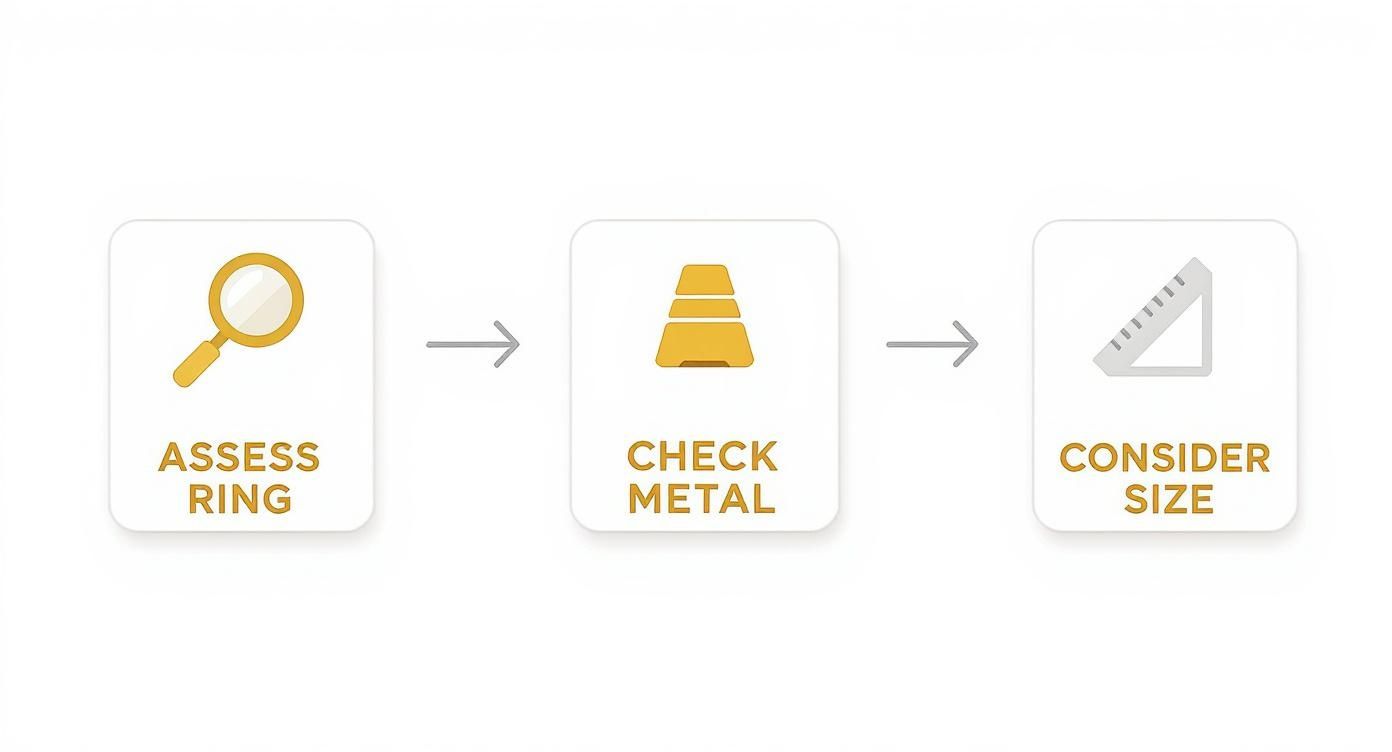
The first step is always a careful assessment. This dictates the entire approach, from the tools we’ll use to how long the job will take.
As you can see, every resize starts with a close look at the ring's material, design, and just how much of an adjustment is needed.
Making a Ring Smaller: The Cut and Solder Method
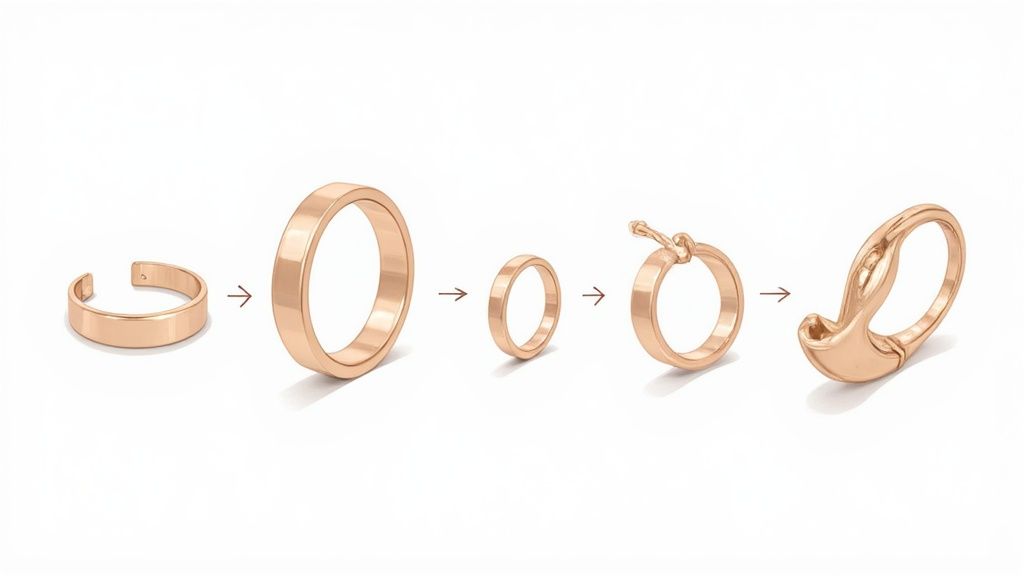
When your ring is too loose, the best and most common solution is the cut and solder technique. This is the gold standard for sizing down because it delivers a seamless, invisible finish that keeps the band perfectly round and structurally sound.
It's a meticulous process:
First, the jeweller calculates exactly how much metal needs to come out and marks a tiny section at the bottom of the shank (the back of the band).
Using a fine jeweller’s saw, they carefully cut out this small piece. Precision here is key to ensure the two ends will meet perfectly.
The jeweller then brings the two cut ends together, forming a new, smaller circle. The join has to be flawless to avoid any visible seam or weak point.
Finally, a special solder matching your ring’s metal and colour is applied to the join. Using a torch, the jeweller heats the area until the solder flows, permanently bonding the two ends.
This technique is perfect for precious metals like gold and platinum. The final step involves carefully filing, sanding, and polishing the area until the join is completely undetectable. The goal is simple: to make it look as if it was never altered at all.
Making a Ring Larger: The Main Techniques
If your ring has become too tight, a jeweller has a couple of options. The right choice depends on how much bigger it needs to be and its specific design.
Stretching for Minor Adjustments
For a plain wedding band without stones that only needs a slight increase—usually no more than half a size—stretching can be a great option. We use a specialised tool called a ring stretcher that gently expands the metal from the inside out.
However, this method does thin the band slightly. While it's quick and cost-effective, it isn’t right for every ring. Stretching can distort engravings or weaken bands with patterns or stone settings. We’ll only recommend this if it poses absolutely no risk to the ring's structure.
Adding Metal for Major Adjustments
For size increases of more than half a size, or for any ring set with stones, the best method is to add a new piece of metal. This is essentially the reverse of sizing down. The jeweller cuts the shank at the bottom and inserts a professionally matched piece of metal—gold, platinum, or whatever your ring is made of.
This new piece is then soldered securely into place. The use of advanced tools is crucial here; our article on laser welding for jewellery explains how this modern technology allows for incredibly precise joins with minimal heat, protecting any nearby delicate stones. Once soldered, the ring is polished to perfection, leaving no trace of the work.
This method is far superior for larger adjustments because it preserves the ring's original thickness and strength, ensuring it remains durable for years to come.
Comparing Common Ring Resizing Methods
Here’s a quick look at the primary techniques jewellers use, outlining when each is the best choice and what to expect.
Method
Best For
Pros
Cons
Cut & Solder (Size Down)
Sizing down any ring, especially with stones.
Invisible finish; preserves ring thickness and strength.
Requires highly skilled craftsmanship.
Stretching (Size Up)
Plain bands needing a small increase (up to half a size).
Quick and cost-effective.
Thins the band slightly; not for stone-set or patterned rings.
Adding Metal (Size Up)
Sizing up more than half a size, or any stone-set ring.
Maintains original thickness and integrity; very strong.
More time-consuming and costly than stretching.
Ultimately, the right method ensures your ring fits perfectly without compromising its design or durability.
In the UK, the approach and cost to resize a wedding ring can vary. Simple jobs on softer metals like 9ct gold are often more affordable, sometimes costing under £80. However, complex work on platinum or 18ct gold, especially if a significant amount of metal needs to be added, can cost closer to £200. Generally, adjustments up to three sizes are considered safe for the ring's integrity.
When a Wedding Ring Cannot Be Resized
While most rings made from gold, platinum, or silver can be adjusted, it’s a crucial reality that some designs simply weren’t made to be altered. Trying to resize certain styles can compromise their structure, damage delicate stone settings, or completely ruin an intricate pattern.
Knowing these limitations upfront can save you a lot of time and potential heartbreak. It's not about being discouraging; it's about setting realistic expectations. Some rings are designed as a perfect, unbroken circle, and changing that isn't always on the cards.
Eternity Bands and Intricate Stone Settings
One of the most common challenges we see is with full eternity bands. These beautiful rings feature a continuous line of gemstones, like diamonds, set all the way around. There is simply no plain metal area for a jeweller to work on.
To make a ring smaller, a piece of the band has to be cut out. In an eternity ring, this would mean removing gemstones and destroying the setting's symmetry. Making it larger requires adding metal, which creates an obvious gap in the stone pattern. Either way, the ring's design is permanently compromised.
Similarly, rings with complex pavé or channel settings can be just as tricky.
Pavé Settings: These feature lots of tiny gemstones held by small metal beads. Bending the ring’s curve can loosen these stones, causing them to fall out.
Channel Settings: Here, stones are set inside a channel carved into the band. Changing the ring's shape can distort this channel, again risking the security of the stones.
Complex Patterns and Engravings
Does your ring have a detailed pattern like a Celtic knot or milgrain detailing that wraps all the way around? If so, resizing becomes a huge challenge. These designs are meant to be continuous.
When a goldsmith cuts into a patterned band, they inevitably break that flow. While a highly skilled artisan can try to re-engrave or match the design over the new join, getting a truly seamless finish is incredibly difficult. More often than not, the repair will be visible, disrupting the original craftsmanship.
If your ring has a sentimental engraving inside, sizing it down means a piece of that message will be cut away. While re-engraving is often an option, the original inscription will be permanently lost.
The Challenge of Modern Metals
The material of your ring is often the most definitive factor. While gold and platinum are malleable and perfect for resizing, many modern metals are not. Their incredible hardness—the very quality that makes them so appealing—also makes them impossible to work with using traditional tools.
The two main culprits are:
Tungsten Carbide: This is one of the hardest materials used in jewellery. It's so brittle that it can't be bent or soldered. Trying to resize it would simply cause the ring to shatter.
Titanium: Known for its strength, titanium can sometimes be stretched up by a tiny amount (less than half a size). However, it cannot be soldered like gold, so sizing it down isn't a viable option for most jewellers.
If you have a ring made from one of these materials, the standard practice isn’t resizing—it’s replacement. Many brands that specialise in these metals offer exchange programmes for this exact reason. When you choose tungsten or titanium, you're essentially committing to its original size.
UK Costs and Timelines for Ring Resizing
When you decide to resize a wedding ring, two things are probably on your mind: how much will it cost, and how long will it take? In the UK, the price isn't a simple flat fee. It reflects the skill, time, and materials needed to get the job done perfectly. Several key factors will influence the final quote from any trusted jeweller.
The ring's metal is the biggest one. Platinum, with its high melting point and density, is tough work. It demands more labour and specialised tools, which is why it’s the most expensive metal to resize. Yellow and rose gold are far more malleable and generally easier on the wallet. White gold sits in the middle—it almost always needs a fresh coat of rhodium plating after resizing to bring back that bright white finish, adding another step to the process.
Breaking Down the Costs
The complexity of your ring’s design is another major part of the puzzle. A simple, plain band? That’s about as straightforward as it gets, and the price will reflect that. But things get more delicate if your ring has gemstones, especially if they’re set near the bottom of the band.
A jeweller might need to:
Carefully un-set the stones to protect them from the heat of the soldering torch.
Perform the actual resizing.
Securely re-set every stone and check each prong to make sure it's tight.
Each extra step adds to the labour and, naturally, the final cost. It’s easy to see why making an 18ct white gold ring with pavé diamonds two sizes larger will cost more than taking a plain 9ct gold band down by a single size.
As a ballpark, a simple resize on a 9ct gold or silver ring might start from as little as £40 - £60. For more common jobs, like a standard 18ct gold engagement ring, you can expect to pay between £80 and £150. For complex work on platinum or rings with lots of stones, the cost can push past £200.
It's interesting to see how the UK's wedding market has shifted over the years. With marriage rates changing, keeping customers happy with expert after-sales care like resizing has become a huge priority for jewellers. This helps explain why resizing costs, which often top out around £200 even for big jobs, strike a balance between covering expert craftsmanship and helping you preserve a piece you love. You can see more data on the wedding jewellery market on straitsresearch.com.
Understanding the Typical Timeframe
Just as costs vary, so do turnaround times. How long it takes to get your ring back depends on the workshop's workload, how complex the resize is, and whether any special materials need to be ordered.
As a general guide, most UK jewellers will take between one and two weeks for a standard resizing. This gives the goldsmith enough time to do the work meticulously, without rushing the crucial finishing and polishing stages. If your white gold ring needs re-plating, that can add another day or two.
But we know that sometimes you just can't wait. A special occasion might be right around the corner. At Opulence Jewellery Services, our Hatton Garden workshop is set up for speed. We offer a same-day, while-you-wait resizing service for many common jobs. You can often bring your ring in and walk out with it fitting perfectly a few hours later, without ever having to leave it overnight.
Ultimately, the only way to get a precise quote and timeline is to bring the ring in. A jeweller needs to see it, measure your finger properly, and assess the work involved before giving you a firm price and completion date. It’s the best way to avoid surprises and move forward with confidence.
Clever Alternatives to Traditional Resizing
Discovering your ring can’t be resized the traditional way isn't a dead end. For tricky designs like full eternity bands or stubborn metals like tungsten, there are some brilliant workarounds that restore a perfect fit without ever cutting the band.
These clever solutions give you comfort and security, proving there's almost always a way to keep wearing the ring you love.
Non-Permanent and Temporary Fixes
If your ring is only a little loose, or if larger knuckles make a snug fit difficult, a non-permanent fix is the perfect first step. They’re quick, affordable, and completely reversible.
Sizing Beads: This is a fantastic and popular option. A jeweller solders two small metal balls (usually gold or platinum to match) onto the inner back of the ring. They grip your finger just enough to stop the ring from spinning and feel surprisingly comfortable. They’re especially useful if your finger size changes with the weather.
Spring Inserts: Think of a small, U-shaped metal strip soldered inside the band. This insert acts like a spring, flexing as you slide the ring over your knuckle and then gently snapping back for a secure fit. It's an excellent fix for anyone with arthritis or prominent knuckles.
Clip-On Ring Guards: This is the quickest and most temporary solution. These small plastic or metal clips simply wrap around the bottom of the shank, filling the gap. They aren't a long-term answer, but they’re perfect for an immediate fix while you consider something more permanent.
Permanent Solutions for Non-Resizable Rings
When you need a lasting fix for a ring that can’t be cut, it's time to call on some real craftsmanship. These methods involve more intricate work but deliver beautiful, permanent results that honour the original design.
One of the best techniques is a shank replacement. Here, a goldsmith removes the entire plain bottom section of your ring and builds a new, perfectly sized shank in its place. This is the go-to solution for rings where the top half is covered in detail or stones. It keeps the design you love while giving it a new foundation that fits you perfectly.
Another beautiful option is to repurpose the entire ring. A skilled jeweller can carefully remove the gemstones and melt down the original metal to cast a completely new ring in your correct size. It’s a wonderful way to preserve the materials and sentiment of the original piece, reborn into something bespoke you can wear forever.
Even if you can’t resize a wedding ring the conventional way, you’re never out of options. From simple sizing beads to a full shank replacement, a skilled jeweller can find a solution that works for both your finger and your ring’s unique character.
How to Find a Jeweller You Can Trust
Handing over your wedding ring, a piece with such profound sentimental value, requires absolute confidence. The thought of having it cut or altered can be nerve-wracking, which makes choosing the right craftsperson the single most important step in the entire process.
A trustworthy jeweller doesn’t just have the technical skill; they understand the emotional weight your ring carries. You’re looking for a workshop with a proven track record, transparent practices, and the expertise to handle your specific ring with care.
Preparing Your Ring for Assessment
Before you even begin your search, take a moment to prepare. Give your ring a gentle clean with some mild soap and warm water. This helps the jeweller clearly see any hallmarks or delicate details that might influence the work.
It’s also a great idea to take a few clear, well-lit photos of your ring from several angles. This personal record is a useful 'before' reference, giving you complete peace of mind.
Once that's done, it's time to find the right expert. For a detailed breakdown of your options, our guide on where to have a ring resized offers some valuable local insights.
Entrusting your ring to an expert is about more than just the repair; it's about preserving its story. A great jeweller will always treat your piece with the same respect you do, ensuring its legacy continues for years to come.
Key Questions to Ask Your Jeweller
A professional consultation is non-negotiable. This is your opportunity to gauge a jeweller's expertise and professionalism, so don't be shy about asking direct questions. A confident craftsperson will be more than happy to answer them.
Here are the essential questions you should be asking:
Do you have experience with my ring’s metal? Working with platinum is a world away from working with 9ct gold. Make sure they’re skilled with your specific material.
Is the resizing work done on-site? Many high-street shops send jewellery away. A workshop that does the work in-house, like ours in Hatton Garden, offers far better security and often a much faster turnaround.
What is your insurance policy for items in your care? You absolutely need to know that your ring is fully covered while it's in their possession.
Will you provide a firm quote before starting? Avoid any nasty surprises. Get a detailed, written quote that outlines all the work and costs involved.
Do you guarantee your resizing work? A reputable jeweller will always stand by their craftsmanship.
This initial conversation will tell you everything you need to know. It will help you make an informed decision and move forward with total confidence that your ring is in safe hands.
Common Questions About Ring Resizing
Even with the process laid out, you probably have a few specific questions swirling around. Let's tackle the most common ones we hear every day in our Hatton Garden workshop, giving you straight answers based on years of hands-on experience.
How Many Sizes Can a Ring Actually Be Changed?
As a general rule, we can comfortably resize a wedding ring up to two sizes larger or smaller. This is the sweet spot where we can maintain the ring’s strength and original proportions without any issues. Going beyond that is often possible, but it requires a very careful look at the ring first.
The real answer, though, depends entirely on your ring's design. A thick, plain gold band has a lot more metal to work with, giving it more flexibility for a big adjustment. A delicate, thin band, on the other hand, can become too weak if stretched too far or if too much is cut away. Stone settings also reduce the workable area, making large adjustments more complex.
A jeweller’s priority is to preserve the ring's strength and beauty. We'll always advise on the safest possible adjustment for your specific piece, ensuring it remains durable for a lifetime of wear.
Will Resizing Damage or Devalue My Ring?
This is a crucial question, and the answer is a firm no—as long as the work is done by a skilled professional. A proper resize should be completely invisible, leaving no weak spots or visible seams. When done correctly, the process does not devalue your ring in any way.
In fact, making a ring wearable again significantly increases its personal and practical value. The only real risk comes from inexperienced workmanship, which can lead to a poor solder join, a distorted shape, or loose stones. This is exactly why choosing a reputable jeweller with an on-site workshop is so important to protect your investment.
What Happens to the Engraving if I Resize My Ring?
The engraving inside your ring holds deep sentimental value, so it’s always a major consideration. What happens to it really depends on which way we’re resizing the ring.
Making a Ring Larger: When we add a piece of metal to increase the size, your existing inscription is usually left untouched and stays perfectly intact.
Making a Ring Smaller: This is where it gets a bit trickier. To reduce the size, we have to cut out a small section of the band, which might include a portion of your engraving.
If the inscription is partially removed, the only path forward is to polish the inside smooth and have it re-engraved. While the original can't be saved in this scenario, a skilled engraver can replicate it beautifully, preserving your original message. We always discuss this possibility with you before starting any work.
At Opulence Jewellery Services, our expert jewellers handle every resize with the utmost care and precision. Visit our Hatton Garden workshop for a same-day consultation and see how we can restore the perfect fit to your treasured ring. Learn more at https://www.opulencejewelleryservices.co.uk.