05 December 2025 17 min read Hatton Garden, London
replacing diamond in ring? Get expert jeweller tips on costs, choosing a new stone, setting, and aftercare to help you decide.
Of course. Replacing a diamond in a ring is something we do all the time. Whether you're looking to repair a damaged stone, upgrade to a larger or higher-quality diamond, or simply bring a treasured piece up to date, it's a very manageable process for a skilled jeweller.
The real key is working with a professional who can properly assess your ring’s condition and, most importantly, set the new stone securely.
Is Replacing Your Diamond the Right Decision?
Deciding to change a diamond is often a deeply personal choice, balancing practicality with sentiment. Sometimes, the decision is made for you, but other times it comes from a desire for something new. Getting clear on your own reasons is the first step to a result you'll be happy with for years.
Common Reasons for Diamond Replacement
One of the most common triggers we see is damage. Diamonds are famously hard, but they aren't indestructible. An unlucky knock against a hard surface can easily cause a chip, a fracture, or even a crack, which compromises not just the look but the integrity of the stone. In these situations, replacement is less of a choice and more of a necessity to bring the ring back to life.
An upgrade is another popular driver. A ring that was perfect ten years ago might not match your style or circumstances today. Many of our clients choose to mark a big anniversary or milestone by moving up to a larger carat weight, a better clarity grade, or a different cut that gives off more sparkle.
Choosing to replace a diamond isn't just a transaction; it's an evolution of your personal story. Whether you're restoring a damaged heirloom or upgrading to the stone you've always dreamed of, the goal is to create a piece that feels uniquely yours.
Modernising Heirlooms and Evolving Tastes
Heirloom rings carry huge sentimental value, but their styles can sometimes feel a bit dated. A simple change, like replacing an old European cut with a modern Round Brilliant, can breathe new life into a family treasure without losing its history. It’s a wonderful way to honour the past while making the ring feel right for a new generation.
The rise of high-quality, lab-grown diamonds has also opened up exciting new possibilities. They offer a much more accessible route to getting a larger or more flawless stone, making a significant upgrade a realistic option for many people. This means you can achieve a dramatic new look while keeping the original, meaningful setting.
Ultimately, it helps to think about what you're trying to achieve. Are you looking for:
Restoration: Fixing damage to bring a beloved ring back to its former glory.
Enhancement: Upgrading the size or quality of the stone to better reflect your current style.
Modernisation: Updating an heirloom to suit contemporary tastes while keeping its sentimental core intact.
What a Jeweller Looks for During an Inspection
When you hand your ring over, a professional jeweller begins a meticulous diagnostic process. This isn't just a quick glance; it's a deep dive into the structural health of your ring to make sure the setting can securely hold a new stone. We’re essentially checking the foundation before building on it.
The immediate focus is the setting itself, often called the "head" of the ring. This includes the prongs or claws that grip the diamond. Daily wear and tear can cause them to thin out, bend, or even develop tiny cracks. Even a minor weakness here could put your new diamond at risk.
Assessing the Prongs and Setting Integrity
We look at each prong under high magnification. Are they still solid and substantial, or have they become thin and flattened over time? We hunt for any micro-fractures or stress points that could lead to failure down the line.
This is where you might hear the term prong retipping. It's a precise repair where a goldsmith adds a tiny amount of matching metal—like gold or platinum—to the tip of each worn prong. This restores its original shape and, more importantly, its strength. It’s a very common and vital step when replacing a central stone.
In more severe cases where the whole setting is compromised, a full head replacement might be the only safe option. This means removing the old setting entirely and soldering a brand-new one onto the band, giving your new diamond a completely secure home.
The goal of a thorough inspection is simple: guarantee the long-term safety of your new diamond. By addressing wear and tear before the new stone is set, we prevent the heartbreak of losing it later.
Evaluating the Ring Shank and Overall Condition
Beyond the prongs, we check the ring's band, which we call the shank. We’re looking for any thinning, especially at the base where it gets the most contact. A shank that's too thin can warp or even snap. If you're curious about what's involved in those kinds of jobs, our guide on how to fix a broken ring explains the process in more detail.
This overall assessment also takes into account the new stone you're choosing. A growing trend in the UK is swapping natural diamonds for lab-grown alternatives, and for good reason. A natural 1-carat diamond can easily cost upwards of £20,000, whereas a lab-grown stone of the same quality might be closer to £1,500. This affordability is a huge factor for many clients.
Finally, our inspection covers any smaller diamonds in a halo or pavé setting. Are they all held tightly? Are the tiny metal beads that secure them still intact? Catching and fixing these smaller issues beforehand ensures the entire ring is returned to you in perfect, durable condition, ready for you to wear with complete confidence.
Right, with the ring itself checked and ready for its new stone, we get to the best part: choosing the diamond. This is where it gets personal. You're balancing the look, the story behind the stone, and of course, the budget. What you decide here will define the ring for years to come.
One of the first, and biggest, decisions is whether to go for a natural diamond or a lab-grown one. A decade ago, this conversation barely existed. Today, lab-grown diamonds are a brilliant alternative, completely identical to mined diamonds in every way except their origin. They're real diamonds, just made by science instead of geology.
This choice really boils down to what matters most to you. Some people are captivated by the billion-year journey of a natural diamond, a tiny piece of Earth's history. Others appreciate the incredible technology and transparent origins of a lab-grown stone. There's no right or wrong answer.
The Rise of Lab-Grown Diamonds in the UK
We're seeing a definite shift in how people view diamonds. The latest figures show around 29% of UK adults are now open to buying lab-grown diamonds, which tells you a lot about how far they've come. That's backed up by sales, too, with unit sales jumping by 12% to 18% year-over-year, especially for those popular ring sizes under 1.5 carats. You can get a deeper look at these market trends and learn about the UK diamond market forecast on NBDiamonds.co.uk.
For most people, though, the cost is the game-changer. A lab-grown diamond can be 30-50% less than a natural one of the exact same quality and size. That price difference is huge. It could mean upgrading to a noticeably larger stone or a higher quality grade without stretching your budget.
A lab-grown diamond isn't a "fake" or a substitute; it's a genuine diamond with a different origin story. Choosing one allows you to maximise your budget for size and quality, making that dream upgrade a tangible reality.
To help you weigh the pros and cons, here’s a straightforward comparison of the key factors you'll want to consider when making your choice.
Natural vs Lab-Grown Diamonds At a Glance
Feature
Natural Diamond
Lab-Grown Diamond
Origin
Formed over billions of years deep within the Earth's crust.
Created in a controlled laboratory setting in a matter of weeks.
Composition
Pure carbon, chemically identical to a lab-grown diamond.
Pure carbon, chemically and optically identical to a natural diamond.
Price
Higher price per carat due to rarity and mining costs.
Typically 30-50% less expensive for the same quality and size.
Value
Historically holds its value better, seen as a long-term asset.
Resale value is still evolving and generally lower than natural diamonds.
Ethics
Sourcing can be complex; look for conflict-free certification.
Traceable origin ensures ethical and environmental peace of mind.
Ultimately, whether you choose a diamond from the earth or the lab, you are getting a stone that is visually stunning and physically identical. The decision rests on your priorities: the romance and rarity of a natural stone, or the value and modern appeal of a lab-grown one.
Understanding the Four Cs
Whichever route you take, a diamond’s quality and price come down to the Four Cs: Cut, Colour, Clarity, and Carat. Getting your head around these is key to making a smart choice when replacing a diamond.
Cut: Honestly, this is the most important 'C'. It’s all about how well the diamond’s facets interact with light. A superb cut gives you that mesmerising sparkle and fire. A poor cut just looks lifeless, no matter how good the other specs are.
Colour: Diamonds are graded from D (completely colourless) down to Z (light yellow). For that classic, bright white look, most people aim for something in the D-H range. You'd be hard-pressed to see any colour in those with the naked eye.
Clarity: This measures the tiny imperfections, or 'inclusions', inside the diamond. The scale runs from Flawless (FL) to Included (I3). The sweet spot for value is often in the VS (Very Slightly Included) and SI (Slightly Included) grades, where any inclusions are invisible without a jeweller's loupe.
Carat: This is simply the diamond's weight, which directly relates to its size. When you're upgrading, even a small jump—say, from 0.80ct to a full 1.00ct—makes a huge difference on the finger.
Think of the Four Cs as a balancing act. You might decide an excellent cut is non-negotiable for maximum sparkle, even if it means choosing a slightly lower colour grade. Or maybe you’d rather have a larger carat weight and are happy with a stone that's "eye-clean" rather than technically flawless. It’s all about finding the combination that gives you the look you love for the budget you have.
The Craft of Removing and Setting a Diamond
Swapping a diamond isn't a simple case of 'out with the old, in with the new'. Think of it more like a delicate surgical procedure performed by a skilled jeweller, where precision is absolutely everything. The entire process is a real testament to fine craftsmanship, making sure your new stone is both stunning and completely secure.
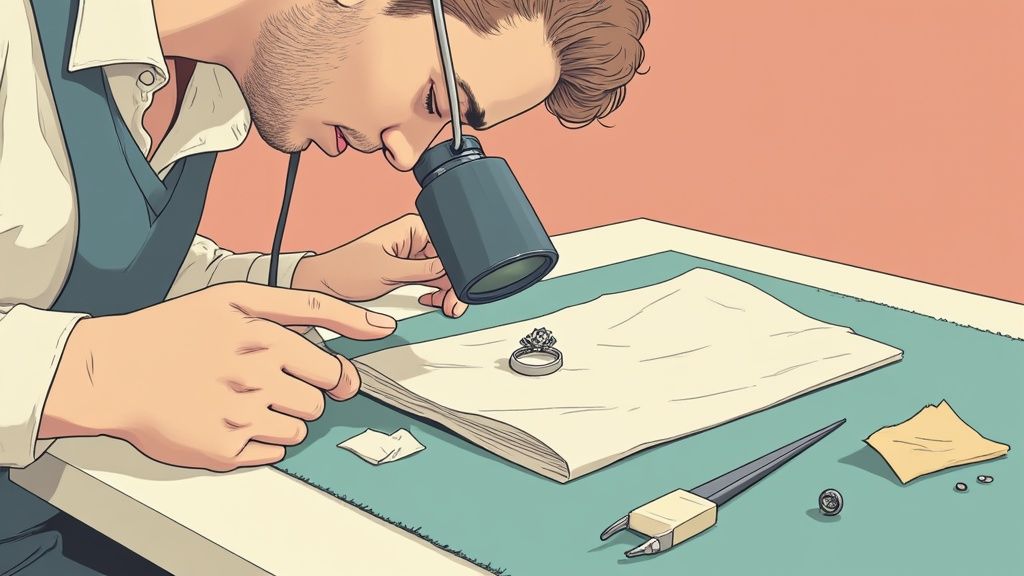
The journey starts with the careful removal of the original diamond. A jeweller will use specialised tools to gently manipulate the prongs or bezel setting, easing them back just enough to release the stone without scratching it or damaging the mount. The goal here is always to preserve the ring’s integrity, especially with delicate or vintage pieces where the metal can be more fragile.
Preparing the Setting for a New Diamond
Once the old stone is out, the empty setting—what we call the 'head'—is meticulously cleaned and inspected under magnification. This is a crucial step. Why? Because the new diamond will almost certainly have slightly different proportions to the old one, and even a fraction of a millimetre can make a huge difference to the final look and security.
The jeweller then prepares the "seat" where the diamond will rest. This often involves using a tiny, precise burr to reshape the inner groove of the setting, ensuring the new stone sits perfectly level and flush. If you're going for a larger stone, the prongs might be too short, which means they may need to be rebuilt or retipped before we can even think about setting the new diamond.
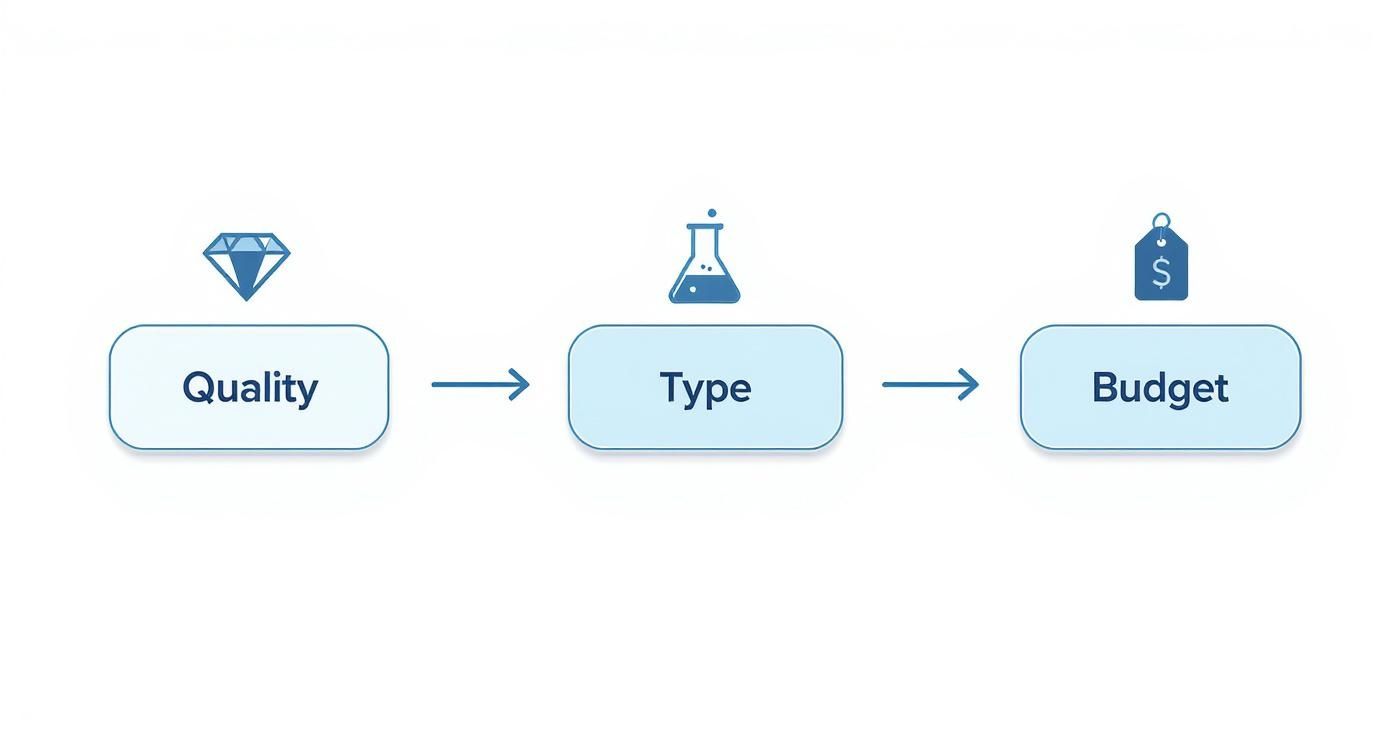
This infographic shows the key decisions that need to be made before any of this intricate workshop magic can begin.
As you can see, balancing the diamond’s quality and type with your budget is fundamental before the jeweller can even pick up a tool.
Securing Your New Stone
With the setting perfectly prepped, the new diamond is carefully placed. The jeweller uses a prong pusher to methodically and evenly press each prong back over the stone’s girdle. The pressure has to be just right—too little, and the stone will be loose; too much, and you risk chipping the diamond or snapping a prong.
The final step is often the most satisfying: the jeweller meticulously checks that the diamond is tight in its setting. There should be absolutely no movement. This is our guarantee that your precious new stone is safe for daily wear.
Of course, the techniques vary hugely depending on the style of the mount.
Prong Settings: Require careful bending and shaping of each individual claw.
Bezel Settings: Involve pushing a solid metal rim securely over the diamond's entire edge.
Pavé Settings: Need extreme precision to secure dozens of tiny stones with minuscule beads of metal.
Each style demands a unique approach and a deep understanding of how metal behaves. For a closer look at these techniques, you can explore more about the art of the diamond jewellery setting and see what makes each one special. This careful, methodical work ensures your ring is not just repaired, but perfectly reborn.
Costs, Timelines and Protecting Your Investment
Once you've picked the perfect new diamond, the conversation naturally shifts to cost and how long it will all take. Knowing the logistics of a diamond replacement helps you plan and makes the whole process feel much smoother from start to finish. The final price tag isn't just about the diamond itself; it's a reflection of the specialist skill needed to do the job perfectly.
The total cost breaks down into a few key parts. The biggest chunk will be the new diamond, of course. Then there's the labour cost for the goldsmith's time—this covers carefully taking out the old stone, checking and prepping the setting, and then securely setting the new one. For a straightforward setting, this work typically starts from around £60-£80, but it will be more for complex designs.
Finally, you might have costs for small repairs like retipping worn prongs or resizing the ring. We always check for these things because they're vital for keeping your ring secure for years to come. For a more detailed look at what different repairs entail, our guide to the jewellery repair price list in the UK gives a clear, transparent view of common workshop services.
How Long Will It Take?
The turnaround time for a diamond replacement can vary a fair bit, depending on the jeweller’s current workload and how tricky the job is. A simple swap in a classic solitaire setting might only take a few business days. Here at Opulence, our on-site workshop means we can often offer a same-day, while-you-wait service for simpler jobs.
More intricate work, however, will naturally need a little more time.
Complex Settings: Rings with pavé, channel, or bezel settings demand more precision and patience.
Sourcing Stones: If we need to find a perfectly matched diamond to sit alongside others in your ring, sourcing can add to the timeline.
Additional Repairs: If the ring needs a completely new head or extensive prong work, it’s best to allow one to two weeks.
Always ask for a clear timeline before committing. A good jeweller will give you a realistic estimate based on what your specific ring needs.
Think of your newly upgraded ring as a brand-new investment. Just like any other valuable asset, taking steps to protect it straight away is just common sense.
Protecting Your New Investment
With your beautiful new diamond securely in place, the last job is to make sure it's protected. Your jeweller should provide a workmanship warranty, which is their guarantee on the quality of the setting work for a set period. This covers you if a stone becomes loose due to the setting process itself, though it won’t cover damage from everyday knocks and bumps.
The most important thing you must do is update your insurance policy. Your ring is now worth more, sometimes significantly more if you've upgraded the diamond. Get in touch with your insurer immediately with the new valuation or receipt. This ensures that if the ring is ever lost, stolen, or damaged, you’re covered for its full, current replacement value. It's a small admin task that could save you a huge headache down the line.
Common Questions About Replacing a Diamond
Even with a clear process, it’s completely normal to have a few questions before you commit to replacing a diamond. We get asked these all the time in our Hatton Garden workshop, so we’ve put together the ones that come up most often to give you clear, straightforward answers.
Making an informed decision is key. Understanding every part of the process helps you feel confident and genuinely excited about your ring's new look.
What Happens to the Original Diamond?
One of the first things people ask is what they can do with their old diamond once it’s been taken out. You have some great options, and the right choice really comes down to your personal preference and what the stone means to you.
Many clients choose to repurpose the diamond. We can set it into a new piece of jewellery, like a simple, elegant pendant or a pair of classic stud earrings. It’s a wonderful way to keep the memory attached to the stone while giving it a fresh start.
Alternatively, you could sell the diamond to a reputable buyer or just keep it as a loose stone for its sentimental value. There's no single best answer—it’s about what feels right for you.
Understanding the Risks Involved
The thought of a jeweller working on a cherished ring can be a bit nerve-wracking. Is there any real risk of damage? Honestly, when you trust your ring to a skilled and experienced professional, the risk is exceptionally low. A master goldsmith has the right tools and years of expertise to handle even the most delicate settings with total precision.
However, it's true that older rings—especially antique or very intricate pieces—can be fragile. The metal might be worn thin, or the prongs could have become brittle over time.
A true professional will always inspect the ring thoroughly before starting any work. If they spot any potential issues, like a weak shank or fragile claws, they will point them out and discuss them with you upfront. They'll recommend any necessary repairs to make sure the whole process is safe and successful.
Verifying Your New Diamond's Quality
Finally, how can you be certain that the beautiful new diamond you've picked out is exactly what you paid for? This is where official paperwork is absolutely non-negotiable.
Your new diamond should always come with an independent grading report from a respected gemological lab. The most recognised labs are:
GIA (Gemological Institute of America) The global authority and industry standard.
IGI (International Gemological Institute) Highly regarded, especially for lab-grown diamonds.
This certificate is your proof of quality and authenticity. It meticulously details your diamond’s specific characteristics—the Four Cs—and often includes a unique serial number that’s laser-inscribed on the stone's girdle. Think of it as your guarantee and the essential document you'll need for insurance.
At Opulence Jewellery Services, our expert jewellers in Hatton Garden are here to answer all your questions and guide you through every step of replacing a diamond. With our on-site workshop, we can often provide a same-day service, so you can see the craftsmanship for yourself. Visit us to discuss your ideas and let us help you restore or upgrade your cherished piece with confidence. Find out more about our expert stone replacement services.