01 December 2025 16 min read Hatton Garden, London
Thinking you need to resize a ring? Our expert UK guide covers methods, costs, and finding a trusted jeweller for a perfect, lasting fit.
It’s a question we hear all the time: a beloved ring is suddenly too tight, or an heirloom is spinning on your finger. Can anything be done? Almost always, yes. But whether it’s a straightforward job or a more complex one comes down to the ring itself.
A simple gold or silver band? That's usually an easy fix for a skilled jeweller. An eternity band set with diamonds all the way around, or a ring made from titanium? That’s where things get tricky. The best first step is always to let a professional take a look and give you an honest assessment.
Can Your Ring Be Resized?
Life changes. Weight fluctuates, fingers swell during pregnancy, and even the weather can make a difference in how your jewellery fits. When your favourite ring no longer feels comfortable, it doesn't have to be tucked away in a jewellery box forever. In most situations, an expert resizing can restore that perfect, secure fit.
Just how possible it is to resize your specific ring hinges on a few key things that any jeweller will look at right away. Understanding these will help you know what to expect before you even walk into a workshop. It really boils down to two main things: the metal it’s made from and the complexity of its design.
Quick Resizing Check: Can Your Ring Be Altered?
Before you bring your ring in, this quick checklist can give you a good idea of what to expect. Use it to see whether the job is likely to be simple or if it might need a more specialised approach.
Ring Feature
Usually Straightforward to Resize
Challenging or Impossible to Resize
Metal Type
Gold, Silver, Platinum, Palladium
Tungsten, Titanium, Ceramic, Stainless Steel
Band Design
Plain band, solid shank
Full eternity band, intricate engraving all around
Stone Settings
Solitaire, prong-set, half-eternity
Channel-set, tension-set, pavé all around
Amount of Change
Up or down by 1-2 sizes
More than 2 sizes (may weaken the ring)
Remember, this is just a guide. A good jeweller can often find creative solutions for even the most difficult rings, so it's always worth getting an expert opinion.
What We Look for First
A simple, plain band made of a traditional precious metal like gold, silver, or platinum is the ideal candidate for resizing. For a skilled goldsmith, the process is routine and, when done right, leaves no trace behind. The job gets more involved, however, when other design elements come into play.
Here’s what makes a difference:
The Metal: Softer precious metals are malleable and easy for us to work with. Harder, alternative metals like tungsten or titanium, on the other hand, often can't be resized using traditional methods at all.
The Gemstones: If your ring has stones, especially those in delicate pavé or channel settings, we have to be incredibly careful. The process of heating and bending the metal can easily loosen them if not handled with precision.
The Overall Design: Eternity bands, with their continuous circle of gemstones, are the biggest hurdle. Resizing them often isn't possible without completely rebuilding the ring from scratch.
The real question isn't just if your ring can be resized, but by how much. Most rings can be safely adjusted up or down by two sizes without compromising the design or the strength of the band.
It's no surprise that this is such a common request. In the UK, rings are the heart of the jewellery market, making up 36.26% of the industry’s revenue. They mark life's biggest moments—engagements, weddings, anniversaries—and a perfect fit is non-negotiable. You can discover more insights into the UK jewellery market and its trends, but the bottom line is that expert resizing services are in high demand, ready to make sure your treasured pieces fit you perfectly today.
The Craft Behind Professional Ring Resizing
Ever wonder what actually happens when you hand your ring over for resizing? It’s not magic, but a blend of time-honoured skill and incredible precision that happens right at the jeweller's bench. The goal is always the same: a perfect fit with a completely invisible finish, no matter if we're going up or down in size.
Making a ring smaller is usually the more straightforward of the two. We carefully snip out a tiny piece of the band, almost always from the bottom of the shank to keep any patterns or hallmarks safe. The two ends are then brought together perfectly and soldered, forming a new, seamless circle.
But the real art is in the finishing. That fresh join is meticulously filed, sanded, and polished until it vanishes. For a simple gold wedding band, it's a routine job. For an intricately engraved platinum piece, however, every step is taken with extreme care to preserve the original design.
Making a Ring Larger
If a ring is too tight, we have a couple of routes we can take, depending on the ring's design and just how much bigger it needs to be.
Stretching: For a very small adjustment—think half a size or less—we can sometimes gently stretch the metal. The ring is placed on a special tool called a mandrel, and even pressure is applied. This method is really only suitable for plain bands without any stones, as the process could loosen settings.
Adding Metal: For anything more than a tiny stretch, adding a new piece of matching metal is the proper way to go. It’s essentially the reverse of sizing down. A clean cut is made in the shank, and a new piece of perfectly matched gold, platinum, or silver is inserted and soldered into place on both sides.
The key is a flawless match. A master goldsmith’s work will be so seamless—in both colour and carat—that you’ll never know where the new piece was added. The ring’s integrity and value are completely preserved.
The Tools of the Trade
This kind of delicate work demands specialist tools and years of experience. A jeweller's bench is kitted out with everything from saws finer than hair to powerful torches for soldering and a range of polishing wheels to bring back that brilliant shine.
In a modern workshop like ours, another piece of equipment has become indispensable: the laser welder. This technology allows us to perform incredibly precise welds at much lower temperatures. It’s a game-changer for rings set with heat-sensitive gems like emeralds or opals, which would be at risk with a traditional torch.
You can learn more about how laser welding protects delicate jewellery in our detailed guide. It's this fusion of old-world skill and modern tech that makes a professional resize so effective. Ultimately, we choose the right technique for your specific ring, ensuring the safest method for that perfect, comfortable fit.
Professional Work Versus Quick DIY Fixes
When a treasured ring starts to slip or feels a little too snug, it’s tempting to look for a quick fix online. But it's vital to understand the difference between a temporary stopgap and a proper, professional resizing.
A professional resize by a master goldsmith is a permanent, secure solution that invests in your jewellery's future. It’s seamless. The ring’s original integrity is restored, with no visible signs of the work and no clunky add-ons. For any piece with sentimental or financial value—especially engagement and wedding rings—this is the only path we'd ever recommend.
When Temporary Fixes Make Sense
That said, DIY options like plastic ring guards, sizing beads, or even a coat of clear nail varnish can have their place in very specific, short-term situations.
Waiting for a Professional: A simple plastic guard can stop a loose ring from slipping off your finger while you're waiting for your workshop appointment.
Fluctuating Finger Size: Many people find their fingers swell in the summer and shrink in the winter. A temporary adjuster can help you manage these seasonal changes without committing to a permanent resize.
Arthritic Knuckles: Sizing beads—small metal balls soldered inside the band by a jeweller—can help a ring slide over a larger knuckle but still fit snugly at the base of the finger.
The key takeaway is this: DIY fixes are for temporary wear, not long-term security. A plastic guard can snap and other methods can feel bulky or fail unexpectedly, putting your ring at risk of being lost for good.
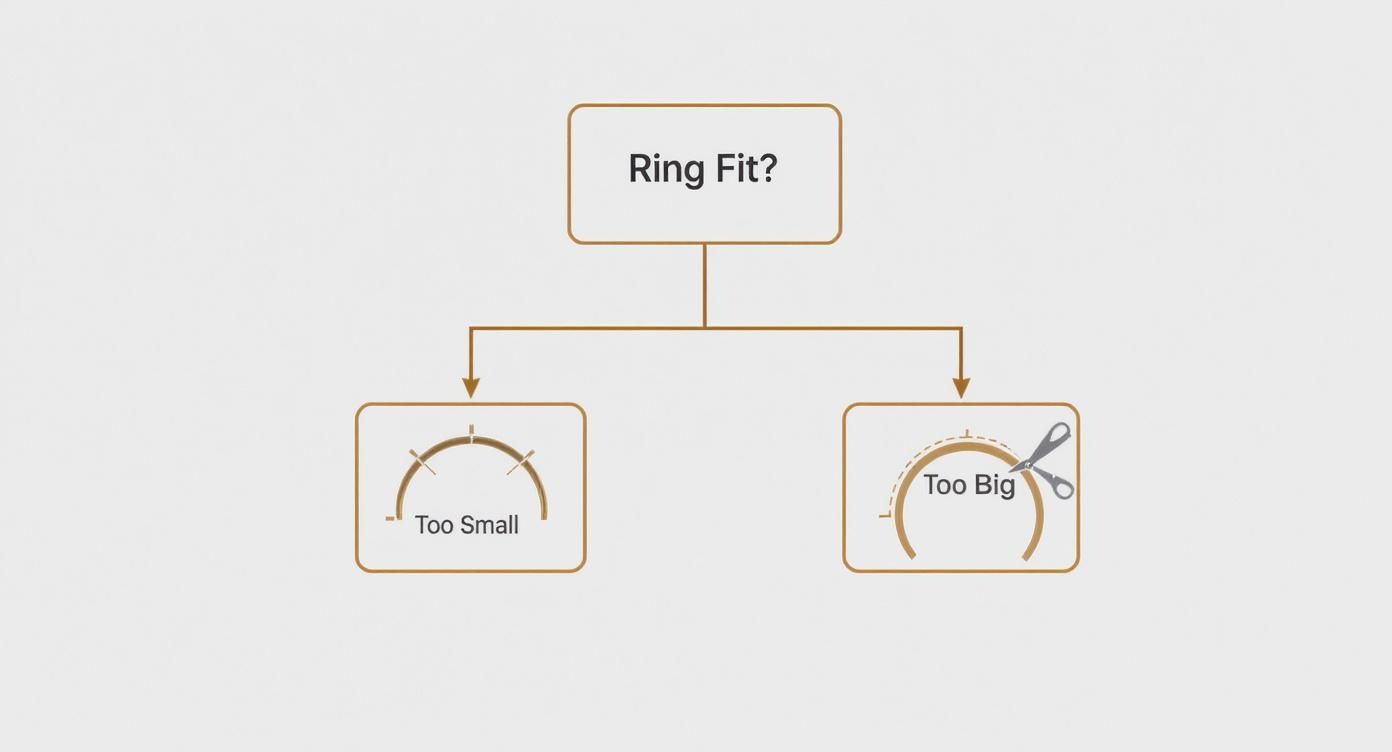
This chart can help you decide on the best course of action for your ring.
As you can see, whether your ring is too big or too small, a professional jeweller has a dedicated process to correct the fit permanently and safely.
The need for resizing is incredibly common, particularly with the boom in the second-hand market. Research shows that around 50% of UK jewellery buyers now purchase pre-owned pieces, which almost always need adjusting for their new owner. This highlights just how important it is to have access to reliable, expert services.
For those who need a swift, trustworthy solution, professional help is often closer than you think. Here in Hatton Garden, modern workshops offer exceptional services, often with surprisingly fast turnarounds. In fact, you can find out more about our same-day ring resizing service, which provides a secure, permanent fit while you wait.
How Your Ring's Design Impacts Resizing
Not all rings are created equal, and that becomes incredibly clear when it's time for an adjustment. The idea to resize a ring might seem simple, but the journey from a poor fit to a perfect one is dictated entirely by its material, style, and the gemstones it holds.
A plain gold wedding band is one thing; an intricate platinum eternity ring is another challenge entirely.
The metal your ring is crafted from is the first major factor. Traditional precious metals like gold and silver are relatively soft and malleable, making them the most cooperative materials for resizing. A skilled jeweller can cut, solder, and reshape them with predictable and seamless results.
Platinum, however, is a different story. Known for its incredible density and durability, it requires much higher temperatures to work with. This demands more specialised equipment and a higher level of skill to achieve a flawless finish, which is why resizing a platinum ring is almost always more expensive than a gold one.
The Metal Makes a Difference
Understanding how each metal behaves is key to setting your expectations for both the process and the final cost. Harder, more modern metals can be particularly tricky.
The table below gives you a rough idea of how the metal type influences the work involved.
Resizing Difficulty Based on Metal
Metal Type
Resizing Difficulty
Typical UK Cost Impact
Yellow & Rose Gold
Low
Standard pricing, typically starting from £40-£60 for simple jobs.
White Gold
Low to Medium
Similar to yellow gold, but requires rhodium replating, adding £30-£50 to the final cost.
Silver
Low
Generally the most affordable option due to the metal's workability and lower value.
Platinum
High
More labour-intensive and requires specialist tools, often starting from £80-£100 or more.
As you can see, the process isn't just about the work itself; it's about the tools and additional finishing steps required to bring the piece back to its original state.
When Gemstones Complicate Things
Adding gemstones to the mix introduces a whole new layer of complexity. The primary concern here is heat. The soldering process involves a high-temperature torch, which can be disastrous for certain delicate stones if not handled with extreme care.
Fragile gems like emeralds, opals, and tanzanites are particularly vulnerable to thermal shock, which can cause them to crack or shatter.
To protect them, a jeweller might need to carefully remove the stones before resizing and then reset them afterwards—a process that adds significant time and cost to the job. Even diamonds, the hardest natural material on earth, can be damaged by sudden temperature changes, and their settings can become loose during the reshaping of the band.
A professional jeweller’s first priority is always the safety of your gemstones. This might mean using advanced techniques like laser welding, which localises heat, or painstakingly unsetting and resetting each stone to guarantee their protection.
The Challenge of Eternity Bands and Intricate Designs
Finally, the ring's overall structure plays a huge role. An eternity band, with stones set continuously around the entire shank, is the most difficult—and often impossible—ring to resize using traditional methods.
Cutting a section out would disrupt the pattern of the settings and compromise the ring's structural integrity. Adding a piece of metal would create an unsightly blank space. While minor tweaks are sometimes possible, a significant change often requires completely rebuilding the ring, which is a far more involved and costly job than a standard resize.
Likewise, rings with intricate engravings or detailed patterns that wrap all the way around the band pose a similar problem. Preserving these details requires exceptional skill. A jeweller must work to ensure the pattern remains uninterrupted, which is why any resize is almost always done at the plainest part of the shank, usually the very bottom.
Finding a Trusted Jeweller and What to Expect on Cost
Once you’ve decided a ring needs resizing, two questions almost always follow: “Who can I trust with this?” and “What’s it going to cost me?” They’re fair questions, especially when you’re handing over something with sentimental or serious financial value.
The good news is, finding a skilled artisan and getting a fair price is straightforward when you know what to look for.
Your search should start locally. Look for workshops with a solid reputation, backed up by genuine online reviews and a clear portfolio of their work. Don’t hesitate to ask about their experience, particularly with rings similar to yours in metal and design.
Vetting Your Jeweller
A good jeweller is transparent and happy to walk you through the process. Before you commit, here’s what to check:
On-Site Workshop: Does the jeweller do the work in-house? A business with an on-site workshop, common in places like London's Hatton Garden, means a faster, more secure service because your ring never leaves the premises.
Detailed Quotes: A professional will always give you a detailed, no-obligation quote before starting. It should break down labour, any extra materials (like gold or rhodium plating), and VAT.
Credentials and Insurance: Look for credentials from respected industry bodies and confirm they have proper insurance to cover your jewellery while it's with them.
A great jeweller does more than just resize a ring; they care for it. As part of the service, they’ll inspect settings, check for loose stones, and give it a professional clean and polish. It should come back to you looking better than when you dropped it off.
Understanding the Cost to Resize a Ring
The price for resizing a ring in the UK varies quite a bit, so it helps to know what drives the cost. A simple silver band is a world away from a complex platinum engagement ring.
The main factors are the metal type, the complexity of the design, and whether you’re sizing up or down.
Sizing down is usually cheaper. It involves cutting out a small piece of metal, which is less labour-intensive. Sizing up requires the jeweller to add a perfectly matched piece of metal, adding to both the material and labour costs.
As a general guide, sizing a plain wedding band down by one size can cost between £20 and £60. Going up by one size usually ranges from £40 to £120.
Harder metals like platinum demand specialised tools and techniques, so resizing costs are higher—often starting from £80 and going over £250 for a straightforward job. For a more detailed breakdown, have a look at this guide on UK ring resizing costs.
Ultimately, the price reflects the skill, time, and materials needed to do the job perfectly. Investing in a reputable workshop doesn’t just guarantee a flawless fit; it protects the integrity and beauty of your ring for the long haul. Don’t be tempted by the lowest price—focus on finding the best value and expertise.
Your Ring Resizing Questions, Answered
Even after understanding the process, it’s completely normal to have a few questions before you hand over a treasured piece. We’ve pulled together the most common queries we hear in our workshop to give you total confidence in your decision.
How Much Can a Ring Be Resized?
As a general rule, most rings can be safely adjusted up or down by two full sizes. Trying to go further than this can put a lot of stress on the ring's structure, which might weaken the band or, even worse, compromise the settings holding your stones.
Plain bands without any stones are the most forgiving and offer the most wiggle room for bigger adjustments. On the other hand, rings with complex patterns or a continuous line of stones—like a full eternity band—often have very little to no room for change. The only way to know for sure is to have an expert take a look.
Will Resizing Devalue My Ring?
Not if it’s done properly. A professional resizing job by a skilled jeweller should be completely seamless, leaving no visible sign that the ring was ever altered. The whole point is to preserve the ring's original beauty and structural integrity, and with it, its value.
A ring that fits correctly is a ring you can actually wear, which hugely increases its personal and sentimental value. The only real risk comes from a shoddy job that leaves visible seams or loose stones—and that just highlights why choosing a reputable workshop is so important.
How Long Does Ring Resizing Take in the UK?
The turnaround time really depends on the complexity of the ring and how busy the jeweller is.
Simple Adjustments: For a plain gold or silver band that only needs a small change, the work can often be done in a few hours or even on the same day. This is a pretty standard service in specialist areas like London's Hatton Garden.
Complex Work: If you have an intricate ring made from platinum, or one with multiple gemstones and detailed settings, you should plan for it to take between one and two weeks. This gives the jeweller the time they need for meticulous work and thorough quality checks.
Can an Engraved Ring Be Resized?
Yes, it can, but you'll need to chat with your jeweller about it first. If you’re making the ring smaller, the section with the inscription might be the part that gets cut out. Most jewellers can re-engrave the message for you, though this will usually come with an extra cost.
If you’re sizing up, the new piece of metal is typically added to the back of the shank, which leaves the original engraving untouched. It’s always best to discuss this beforehand so you know exactly what to expect for your specific piece.