Your Complete Guide to Wedding Ring Resizing in the UK
16 December 2025 21 min read Hatton Garden, London
Need a wedding ring resizing? Our UK guide covers methods, costs, and what to expect from a master jeweller for a perfect, seamless fit.
It’s a funny thing, but the perfect fit of your wedding ring isn't always permanent. Life happens. Your body changes, seasons come and go, and that once-snug band can start to feel a little too tight or worryingly loose. A professional wedding ring resizing isn't a repair; it's just a simple, routine adjustment.
Why a Perfect Fit for Your Wedding Ring Matters
A wedding ring is so much more than a piece of jewellery. It’s on your hand every single day, a constant symbol of your commitment, so it needs to be comfortable enough that you barely notice it's there. It's incredibly common for that fit to change over the years.
Think of resizing as a tailoring service for your most precious possession, ensuring it continues to fit you flawlessly through every new chapter. This guide will walk you through exactly how it works, turning any worries you might have into a clear, straightforward understanding of the craft. We’ll show you how skilled jewellers, right here in London's historic Hatton Garden, create a seamless, invisible finish.
Common Reasons for Resizing
Life is dynamic, and your ring size can be too. There are a few common reasons why your ring might feel different, making a resize necessary for both comfort and security.
Weight Fluctuations: Gaining or losing even a small amount of weight can have a surprising impact on your ring size.
Pregnancy and Parenthood: Swelling in the fingers is a very common side effect of hormonal changes and fluid retention, both during and after pregnancy.
Seasonal Temperature Changes: You're not imagining it! Many people find their rings feel tighter in the summer heat and looser during a cold winter.
Ageing and Health: Natural changes over time, including conditions like arthritis, can affect the size of your knuckles and fingers.
The Importance of a Professional Assessment
Before you jump to a decision, getting a professional measurement is crucial. A seasoned jeweller won't just measure your finger; they'll consider the shape of your knuckle and how the ring needs to pass over it. You can learn more about the details in our guide on how to measure a ring size in the UK. This initial chat is the key to getting a comfortable fit that lasts.
At Opulence Jewellery, we see resizing as an essential part of a ring's lifecycle. A proper fit ensures your cherished symbol of love is secure and comfortable enough to wear every single day, just as it was intended.
The need for a resize is far more common than you might think. In fact, it's a frequent service in the UK, with jewellers noting that 25-30% of newlyweds come back for an adjustment within the first couple of years. Here in London’s Hatton Garden, a hub for wedding jewellery, over 15,000 resizing jobs were handled in one year alone. It just shows how normal and necessary this service is for keeping your wedding band safe and comfortable for a lifetime.
Exploring the Craft of How Rings Are Resized
At its heart, resizing a ring is a delicate art, a blend of age-old goldsmithing skill and modern precision. It’s far more than a simple tweak; it’s a craft that ensures your most treasured symbol fits perfectly once again. Whether your ring has become uncomfortably tight or dangerously loose, our master jewellers have several expert methods to call upon.
The right approach always depends on your ring's metal, its design, and how much of a size change is needed. Understanding these techniques helps you appreciate the care that goes into preserving the beauty and strength of your piece.
Making a Wedding Ring Smaller
If your ring is too big, the classic and most reliable method is the "cut and solder" technique. Think of it like a master tailor altering a bespoke suit. A jeweller carefully removes a tiny, precise section from the bottom of the ring’s shank (the back of the band).
The two ends are then expertly brought back together, fused with a perfectly matched metal alloy, and meticulously polished until the join is completely invisible. Done right, this method keeps the ring's shape and strength fully intact, leaving no trace of the alteration.
Sometimes, a ring is only slightly loose, or it might have a top-heavy design that makes it spin on the finger. In these cases, a less permanent fix is often better. We can add two tiny metal balls, known as sizing beads, to the inner band. They create a snugger fit without permanently changing the ring's size.
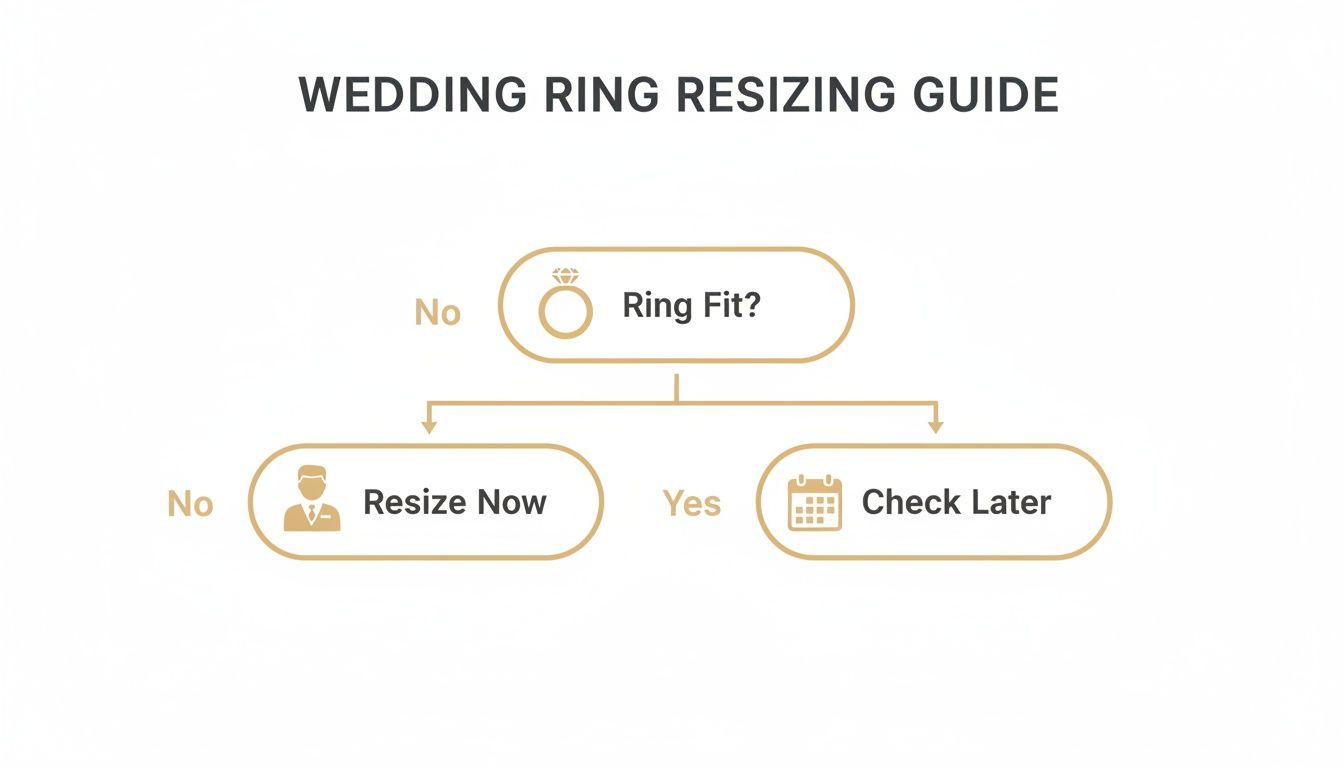
This simple decision tree shows the choices involved when you're considering a wedding ring resize, helping you decide whether to act now or just keep an eye on the fit.
As the flowchart shows, a poor fit needs attention, while a good fit just means checking again later. It makes the whole process feel much more manageable.
Making a Wedding Ring Larger
Making a ring bigger means adding material, a process that demands even greater precision. The best technique involves cutting the shank and seamlessly inserting a new piece of perfectly matched metal. Your jeweller will source a piece of gold or platinum that is identical in carat and colour, ensuring a flawless result.
Once the new section is soldered into place, the entire ring is re-rounded and polished. The goal is to make the addition completely undetectable, both to the eye and to the touch.
Another method, stretching, can work for minor adjustments—typically less than half a size up. This is best for plain bands without stones, as it involves gently expanding the metal itself. However, because stretching can slightly thin the band, we don’t recommend it for intricate designs or rings that have already been resized before.
Here's a quick look at how the different methods stack up.
Comparing Common Ring Resizing Methods
This table outlines the primary methods for resizing a wedding ring, their best use cases, and key considerations for each.
Method
Best For
Size Adjustment Range
Pros
Cons
Cut & Solder
Most gold, platinum, and silver rings, both up and down.
Up to 2-3 sizes typically.
Strong, seamless, and preserves ring thickness.
Not suitable for some eternity rings or hard metals.
Stretching
Plain bands (no stones) needing a small increase.
Up to half a size.
Quick and cost-effective for minor adjustments.
Thins the band slightly; not for complex designs.
Sizing Beads
Rings that spin or are only slightly loose.
Creates a snug fit (approx. half a size smaller).
Reversible and preserves original size.
Can take time to get used to the feel.
Laser Soldering
Delicate rings, heat-sensitive stones, or complex settings.
Varies by design.
Extremely precise with minimal heat transfer.
Requires specialised equipment; may cost more.
Each technique has its place, and a professional assessment is key to choosing the right one for your specific ring.
Advanced Techniques for Complex Designs
Modern technology has brought incredible precision into the workshop. For delicate or heat-sensitive pieces—like those with intricate filigree or fragile gemstones—laser soldering is a game-changer.
This technique uses a highly focused beam of light to weld metal at a microscopic level, generating very little heat. It allows a jeweller at a specialist workshop like Opulence Jewellery to work right beside a gemstone without risking any damage, preserving even the most complex designs.
Understanding the Limits of Resizing
While many rings can be resized, some designs and metals present real challenges. A plain gold band offers a lot of flexibility, but a full eternity ring with diamonds all the way around is a different story.
Industry experience shows that while 75% of plain gold rings can be resized up or down by as many as three sizes, this figure drops to just 50% for diamond-set bands. These complexities mean that about 8% of rings require a full replacement shank instead of a simple resize each year. You can explore more about these trends in the latest insights on UK wedding ring resizing. This is exactly why a professional assessment is so crucial before any work begins.
Can Your Specific Wedding Ring Be Resized?
The first question we hear when a ring stops fitting is always the same: "Can this actually be resized?" It’s a great question, because the answer really comes down to two things: the metal it’s made of and how complex the design is. While most rings are quite straightforward to adjust, some present unique challenges that need a specialist's touch.
Fortunately, the vast majority of traditional wedding rings are crafted from metals that are very cooperative. Think of them as being forgiving in the hands of a skilled goldsmith.
Metals That Welcome Resizing
The most common precious metals used in wedding jewellery are perfect for resizing. It’s all down to their inherent properties. They can be cut, soldered, and polished back to a flawless finish, leaving absolutely no trace of the work.
Gold (Yellow, White, and Rose): As a relatively soft and workable metal, gold is one of the easiest materials to resize.
Platinum: While denser and stronger than gold, platinum is also highly workable. It can be resized beautifully, though it does require higher temperatures and specialised tools.
Silver: Much like gold, silver is a soft metal that is a simple job for any experienced jeweller to adjust.
These metals aren't just prized for their beauty, but for their ability to adapt as your life changes. If you want to dive deeper, our guide on the difference between white gold and platinum has some fantastic insights.
Challenging Metals and Designs
On the other hand, some materials and designs can make a simple resizing quite tricky, or in some cases, impossible. This isn't about a jeweller's skill—it’s about the fundamental physics of the material or the way the ring was constructed.
Not all rings are created equal when it comes to resizing. The metal's hardness and the ring's design, especially the setting of any stones, are the two most critical factors a jeweller must assess. An expert evaluation is essential to protect the ring's integrity.
Certain modern metals are chosen for their extreme durability, but that same strength makes them resistant to being changed.
Tungsten: This metal is incredibly hard and brittle. Trying to cut or bend it would almost certainly cause it to shatter, making resizing impossible.
Titanium: Known for being lightweight yet extremely strong, titanium is very difficult to work with. Minor adjustments are sometimes possible, but they require specialist equipment and expertise.
Stainless Steel: Similar to titanium, the hardness of stainless steel makes it a real challenge for traditional resizing techniques.
How Your Ring's Setting Affects Resizing
Beyond the metal itself, the design of your ring plays a huge role. A simple, plain band is always the most straightforward candidate. The more complex the setting, the more care and precision are needed.
Rings with gemstones, for example, require meticulous attention. The heat from soldering can damage certain stones, and changing the band's curve can loosen the very settings that hold them in place.
Here are a few designs that demand an expert's eye:
Eternity Bands: With stones set all the way around, there's simply no bare metal to work on. Resizing these often means completely remaking the band.
Pavé or Channel Settings: These styles feature lots of small stones set closely together. Altering the ring’s arc can disrupt the tension holding them, risking stones becoming loose or falling out.
Tension Settings: Here, the main stone is held in place by the pressure of the band itself. Changing that tension, even slightly, could compromise the security of the gem.
For these intricate pieces, a specialist workshop like Opulence Jewellery in Hatton Garden is essential. Our jewellers will meticulously assess your ring, determining the safest method to protect every stone and preserve the original design. This way, you'll know exactly what’s possible for your unique and cherished ring before any work begins.
Your Resizing Journey, from Consultation to Collection
To take the mystery out of wedding ring resizing, it helps to know what to expect. Imagine walking into a specialist workshop like ours here in London’s Hatton Garden. The whole experience is designed to be clear, professional, and reassuring from the moment you arrive.
It all starts with a conversation, not a tool. This first step is a professional consultation where the only goal is to get the perfect fit for you.
Step 1: The Professional Consultation and Measurement
Your journey begins with an accurate measurement. A skilled jeweller knows that a simple ring sizer doesn't tell the whole story. We’ll measure not just the base of your finger but also your knuckle, making sure the ring slides on comfortably but won't be loose enough to slip off.
We’ll also chat about your lifestyle. Do your hands swell in the heat or after a workout? These little details are vital for finding a fit that feels just right, all day, every day.
This is also when we give your ring a thorough inspection. We’ll carefully examine its construction, checking the metal type, the style of any stone settings, and where any hallmarks or engravings are placed. This careful assessment is key to choosing the safest and best resizing method.
A professional consultation is about more than just getting a size. It's about understanding. We listen to your concerns and inspect every detail of your ring to create a plan that guarantees a perfect, secure, and comfortable fit.
Step 2: Receiving Your Quote and Timeline
Once we’ve assessed your ring, you’ll get a clear, no-obligation quote. It will break down the work needed and the cost, so there are absolutely no surprises. We’ll also give you a realistic timeline.
At Opulence Jewellery, many straightforward resizing jobs can be done with our same-day service. You can leave your ring with us and pop back to collect it just a few hours later. For more complex designs, we’ll give you a clear timeframe—usually just a few days—so you know exactly when your beautifully resized ring will be back on your finger.
Step 3: The Expert Craftsmanship in the Workshop
With your go-ahead, your ring heads into our on-site workshop where our experienced goldsmiths get to work. Whether we’re making a tiny cut to remove a section or seamlessly adding a new piece of perfectly matched metal, every single step is done with meticulous care.
The process involves a few key stages:
Precise Alteration: The ring is carefully altered using the chosen method, like cutting and soldering or inserting new metal.
Reshaping: It’s then expertly reshaped on a mandrel to make sure it’s perfectly circular again.
Finishing and Polishing: Finally, it goes through a multi-stage polish and clean to erase any sign of our work, restoring its original shine.
Step 4: The Final Fitting and Collection
This is the best part: the collection. When you return, we’ll ask you to try your ring on. This is the moment to confirm the fit is exactly what you wanted—snug enough to feel secure, but comfortable enough for everyday wear.
You can inspect the craftsmanship up close, where you’ll see the work is completely invisible. A professional resize leaves no seams, no discolouration, and no hint of an alteration. You simply leave with your cherished wedding ring, perfectly tailored to you and ready for many more years of happy memories.
Understanding Resizing Costs and Timelines
When you first realise your wedding ring doesn't fit, two things usually spring to mind: how much will it cost, and how long will I be without it? The truth is, it all comes down to your specific ring – its metal, how complex the design is, and just how much bigger or smaller it needs to be.
Getting a handle on the factors that shape the price helps set the right expectations. A simple resize on a plain gold band is always the most straightforward and affordable job, whereas more intricate rings naturally demand more time and skill from the goldsmith.
Key Factors Influencing the Cost
The final quote for a wedding ring resizing isn't just about the time spent at the bench. It covers the precious metals needed, the specialist tools used, and the level of care required to work around delicate settings.
Here’s what every jeweller considers:
Metal Type: Platinum is tougher and needs much higher temperatures and specific equipment to work with compared to gold, so resizing it is always going to cost a bit more.
Size Adjustment: Making a ring bigger means we have to add a small piece of matching precious metal, which adds to the material cost. Sizing down is usually less expensive as it's primarily a labour-only job.
Ring Design: A plain, simple band is the easiest job by far. Rings with detailed patterns, pavé set diamonds, or multiple stones require a huge amount of precision to make sure every single element is perfectly secure and aligned afterwards.
Estimated Wedding Ring Resizing Costs in the UK
To give you a clearer idea, the table below provides a quick look at typical costs for common resizing jobs here in the UK.
A quick note: these figures are a great starting point for standard adjustments. If your ring has a very complex design or needs a significant size change, we’ll always provide a bespoke quote after seeing it.
Estimated Wedding Ring Resizing Costs in the UK
Metal Type
Resizing Smaller (Average Cost)
Resizing Larger (Average Cost)
Notes
Yellow/Rose Gold
£40 - £70
£60 - £100
The most common and straightforward metal to work with.
White Gold
£50 - £80
£70 - £120
This includes the cost of rhodium re-plating to restore its bright white finish.
Platinum
£70 - £110
£90 - £150+
A high-skill job requiring specialised workshop equipment.
Palladium
£60 - £100
£80 - £140
Similar to platinum, it needs specific techniques for a seamless finish.
These estimates give a good ballpark figure, but for anything intricate, a personalised quote is the only way to be certain.
How Long Will the Resizing Take?
The turnaround time really depends on the complexity of the work and how busy the workshop is. Most standard resizing jobs are finished within a few days to a week. The industry average tends to be around 7-10 days, but this can stretch out for very detailed rings like full eternity bands, which can have complication rates of around 15%.
For simpler jobs, a while-you-wait service is often possible. Here at Opulence Jewellery in Hatton Garden, we’re proud to offer a same-day resizing service for many straightforward adjustments. You can often have your ring back on your finger, perfectly fitted, in just a few hours.
If you’re in a hurry, this express option is the perfect solution. You can get a much deeper understanding by reading our full guide on how long ring resizing typically takes. It breaks down the timelines for all sorts of different rings, so you’ll know exactly what to expect.
Choosing a Trusted Jeweller to Protect Your Ring
Handing over your wedding ring for resizing is a big deal. It’s more than just a piece of jewellery; it’s a symbol of your commitment, and placing it in the wrong hands comes with very real risks. A botched job can leave you with visible seams, mismatched metal colour, or weakened settings that put your precious stones in jeopardy.
This is why choosing the right expert is the most important step in the whole process. A true craftsman doesn't just aim for a perfect fit—they protect the structural integrity and sentimental value of your ring. The reward for finding a specialist, especially in a renowned hub like London's Hatton Garden, is total peace of mind and a flawless finish that honours the original piece.
Your Checklist for Vetting a Jeweller
To feel confident in your choice, you need to know what to look for and what questions to ask. A reputable workshop will be transparent and happy to give you all the information you need. Use this checklist to guide your decision and make sure your ring gets the expert care it deserves.
Do They Have On-Site Goldsmiths? A workshop with its own team, like ours at Opulence Jewellery, means your ring never leaves the building. This drastically reduces the risk of it getting lost and lets you speak directly with the person doing the work.
Can You See Recent Customer Reviews? Check for genuine, recent feedback on platforms like Google. Reviews offer an unfiltered look into other customers' experiences with wedding ring resizing, telling you everything you need to know about a jeweller's quality, service, and reliability.
Do They Offer a Guarantee? A confident jeweller will always stand behind their work. Ask if they provide a guarantee on all resizing. It shows they're committed to a high standard of craftsmanship and your long-term satisfaction.
Choosing a jeweller is like choosing any other skilled professional. You're looking for experience, transparency, and a proven track record. Never hesitate to ask questions; a true expert will welcome the chance to put your mind at ease.
Questions to Ask Before You Commit
Before you hand anything over, have a conversation. The answers you get will tell you a lot about their expertise and how they treat their customers.
What specific technique will you use for my ring? An expert will explain why they recommend a certain method (like cutting and soldering versus stretching) based on your ring’s specific design, metal, and condition.
Will there be any visible signs of the work? The only right answer is "no." A professional resize should be completely seamless and invisible to the naked eye.
How will you protect the stones in my setting? This is vital for rings with diamonds or other gems. They should be able to explain their process for securing the settings and preventing any heat damage during soldering.
By taking these simple steps, you can confidently pick a trusted workshop in Hatton Garden. You’ll get your cherished wedding ring back fitting perfectly and looking just as beautiful as the day you first put it on.
Frequently Asked Questions
Even after you've got the basics down, you probably have a few more specific questions. It's only natural when you're talking about one of your most sentimental possessions. We've put together the most common queries we hear in our Hatton Garden workshop to give you clear, direct answers from our experts.
Think of this as the final piece of the puzzle, so you can feel completely confident about what's next for your ring.
How Many Times Can a Wedding Ring Be Resized?
This is a fantastic question, and the answer really comes down to the ring itself. A simple, solid gold or platinum band is quite tough—it can often be resized two or even three times over a lifetime without any issues. When done by a pro, each adjustment is strong and seamless.
However, it's a different story for more complex designs. Rings with intricate settings, or those needing a big change (more than two sizes up or down), can be weakened by repeated work. The metal might get thinner, or the settings holding the stones could lose some of their tension. That’s why we always assess a ring properly first, to give honest advice on what's safe.
Will Resizing My Ring Weaken or Devalue It?
When a skilled goldsmith resizes your ring, it absolutely will not weaken or devalue it. In fact, we see it as standard, essential maintenance to make sure you can wear it for a lifetime. The solder join, for example, is just as strong as the rest of the band.
The risk only comes from poor-quality work. An inexperienced jeweller might create a weak seam, use solder that doesn't match the colour, or damage nearby stone settings. This is precisely why choosing a reputable expert is the most important decision you'll make in this whole process.
What if My Ring Is Only a Little Loose in Winter?
It's completely normal for your fingers to change size with the seasons—a bit looser in the cold, a bit tighter in the heat. If your ring is just a little loose during the winter months, a full, permanent resize might not be the best move.
For minor, seasonal fit issues, a temporary adjustment is often the ideal choice. It gives you security without permanently altering the ring, offering flexibility as your finger size naturally changes.
We usually recommend two great temporary options:
Sizing Beads: We can add two tiny, discreet metal beads to the inside of the band. They create a snugger fit but are completely hidden when the ring is on your finger.
Plastic Ring Guards: These are small, clear plastic coils that wrap around the bottom of the shank. They invisibly tighten the fit and are easy to remove when you don't need them.
Can You Resize a Ring with an Engraving?
In most cases, yes. The good news is that almost all resizing work is done on the bottom of the shank, which is the plainest part of the ring. If your engraving is inside the band but away from this area, it won't be touched at all.
If your message wraps all the way around, a small part of it might be removed during the sizing. But don't worry—a skilled jeweller can often re-engrave that small section perfectly, restoring your message so it looks like it was never altered.
At Opulence Jewellery Services, our Hatton Garden specialists are here to answer any other questions you have and provide expert care for your most cherished pieces.
Discover the professional way to polish a diamond and restore its fire. Learn the risks of DIY methods and how experts bring back that brilliant shine.