How to Polish a Diamond and Restore Its Brilliant Shine
30 December 2025 16 min read Hatton Garden, London
Discover the professional way to polish a diamond and restore its fire. Learn the risks of DIY methods and how experts bring back that brilliant shine.
Ever wondered why your diamond has lost its 'wow' factor, even after a good clean? You're not alone. The secret lies in a highly skilled process that goes far beyond just removing grime: professional diamond polishing. It's the craft of restoring a diamond's perfectly smooth facets, the very surfaces responsible for that incredible fire and brilliance.
More Than a Clean: How Diamond Polishing Restores Sparkle
It’s easy to confuse cleaning your jewellery with the expert craft of diamond polishing. While a proper clean is great for lifting surface oils, lotions, and fingerprints, it can’t do a thing about the physical wear and tear that builds up over years of love and enjoyment.
Think about an engagement ring worn every day. It bumps against desks, keys, and door handles, accumulating countless microscopic scratches and tiny abrasions on its facets. These imperfections, totally invisible to the naked eye, create a frosted effect that disrupts how light travels through the stone.
The result? Your once-vibrant diamond starts to look dull, hazy, or just lacks the fire it had on day one.
The True Goal of Polishing
Professional polishing isn't just a quick buff. It’s a meticulous art form, focused on restoring the geometric perfection of every single facet. Using specialised equipment, a master jeweller carefully resurfaces the diamond, skimming off a minuscule damaged layer to reveal the flawless, mirror-like finish underneath.
This process is absolutely essential for:
Maximising Brilliance: A perfectly smooth surface creates optimal light reflection, giving you that dazzling, head-turning sparkle.
Restoring Fire: Polishing enhances the diamond’s ability to split light into a vivid rainbow of colours.
Improving Clarity: By removing surface-level blemishes, the diamond appears cleaner and far more vibrant.
This restoration isn’t just about looking good; it has a real impact on a diamond's value. A professionally polished diamond can look brand new, which can significantly boost its visual appeal and, in turn, its market worth.
Here in London's Hatton Garden, the historic heart of the UK jewellery trade, diamond polishing is a cornerstone of luxury craftsmanship. This level of expertise directly supports a market valued at over £295 million for the UK diamond sector, where a high-quality finish can boost a stone's price by up to 20-30%. You can dig deeper into these UK diamond market insights to see the full picture.
Ultimately, choosing to polish a diamond is an investment in its beauty and longevity. It ensures a cherished piece, like an engagement ring, continues to captivate for generations to come.
The Hidden Dangers of DIY Diamond Polishing
When your diamond starts looking a bit dull, a quick Google search might tempt you with what look like easy home fixes. You'll see everything from toothpaste to baking soda recommended, but let me be clear: trying to polish a diamond yourself is one of the fastest ways to cause permanent, heartbreaking damage.
These so-called "remedies" aren't just a waste of time; they are genuinely dangerous for your jewellery.
It all comes down to basic physics. A diamond is a 10 on the Mohs hardness scale—the hardest natural substance known. To actually polish it, you need something equally hard or harder, which in the professional world means using incredibly fine diamond dust itself. Anything softer, like the abrasives in toothpaste, won't make a dent on the diamond's surface.
But the precious metal holding that diamond? That's another story. Gold, for instance, is only a 2.5 to 3 on the Mohs scale. It’s incredibly soft in comparison. This means any abrasive you use will aggressively scratch, scuff, and wear away the setting long before it ever affects the stone.
The Real Risks of At-Home Polishing
Going at it yourself opens up a Pandora's box of risks that go way beyond just scratching the band. Without the specialised tools and years of experience a professional has, you can easily damage the diamond itself. A diamond's fire and brilliance are created by the perfect geometry of its facets; even a tiny change to those angles can completely kill its sparkle.
Here’s what we often see happen after a DIY attempt goes wrong:
Abrading Facet Edges: Applying uneven pressure can round off the crisp, sharp lines between facets. This makes the diamond look blurry and dull.
Creating New Scratches: Using the wrong cloth or a contaminated abrasive can etch new, deep scratches into the stone that then need a professional to remove.
Chipping the Girdle: The girdle—that thin edge around the diamond's circumference—is its weakest point. One clumsy move can easily cause a chip or fracture.
Damaging the Setting: As I mentioned, the metalwork is very vulnerable. Delicate claws can be bent, scratched, or worn down, putting the security of your diamond at risk.
You have to understand that professional diamond polishing is a subtractive art. A trained artisan skims a microscopic layer off the diamond's surface to restore it. An amateur attempt risks grinding away far too much material, which can permanently lower the carat weight and value of your stone.
It’s also vital to know the difference between cleaning and polishing. You can, and should, safely clean your jewellery at home to get rid of everyday grime and oils. Polishing, however, is a different beast entirely and should never be a DIY job. For some solid, risk-free advice, our guide on cleaning diamond rings safely walks you through the proper methods.
To put it simply, trying to polish a diamond with household items is like trying to perform surgery with a butter knife. The potential for a costly disaster is immense.
DIY vs Professional Diamond Polishing: A Risk Comparison
To make the stakes perfectly clear, here's a direct comparison of what can go wrong versus the safety of a professional service.
Aspect
DIY At-Home Attempt
Professional Service (e.g., Opulence)
Tools Used
Toothpaste, baking soda, rough cloths—all ineffective and damaging to metal.
High risk of chipping, scratching, or rounding facet edges, ruining brilliance.
Microscopic layer removed by experts, preserving facet geometry and brilliance.
Risk to Setting
Almost certain scratching, scuffing, and wear on gold/platinum. Prongs can be bent or weakened.
Setting is protected. Claws are checked and tightened as part of the service.
Outcome
A scratched setting and a still-dull diamond. Potential loss of value.
A flawless, mirror-like finish on both the diamond and the metal. Restored sparkle.
Expertise
None. Guesswork based on unreliable internet advice.
Decades of hands-on experience by master goldsmiths and lapidarists.
The bottom line is clear. While the DIY impulse is understandable, the risks are simply too high for something as valuable as a diamond. The only truly safe and effective way to bring back its original fire is to leave it in the hands of a professional with the right expertise and equipment.
Inside a Hatton Garden Workshop: The Polishing Process
Step inside a Hatton Garden workshop, and you'll find it's a world of focused precision. Restoring a diamond’s fire isn't just a quick buff and shine; it’s a careful, multi-stage process where every move is backed by years of hands-on experience. The journey to a perfect polish begins long before the diamond ever meets the wheel.
It all kicks off with an almost forensic inspection. Using a high-powered loupe or microscope, our jewellers meticulously examine every facet. They’re hunting for that nearly invisible network of scratches, tiny nicks, and abrasions that build up from daily wear. This crucial first look dictates the entire plan of attack.
For some pieces, especially those with very delicate or intricate settings, the only safe route is to carefully un-set the diamond first. This gives the artisan total access to every angle, guaranteeing a flawless, uniform polish without putting the surrounding metalwork at risk. It takes extra skill, but it’s often the only way to get a truly perfect result.
The Tools of the Trade
Once the diamond is prepped, the real work begins. The star of the show is the polishing lap, a horizontal rotating disc that looks deceptively simple. But this isn’t just any spinning wheel; its surface is engineered to be perfectly flat, which is absolutely critical for keeping the diamond's facet edges sharp and crisp.
The real magic, though, is in the polishing compounds.
Diamond Dust Compounds: We use a series of progressively finer pastes and powders made from diamond dust. It’s the cardinal rule of gemmology: only a diamond can effectively polish another diamond.
Progressive Grits: The process starts with a slightly coarser grit to tackle the more obvious surface wear. From there, the artisan methodically works through finer and finer grits, with each stage refining the surface until it becomes a perfect, flawless mirror.
The jeweller holds the diamond against the spinning lap with a specialised tool called a tang. This clever device lets them control the exact angle and pressure on each individual facet. It's an incredibly tactile skill that relies on the artisan's trained feel and experience to remove just enough material to erase the damage—and not a micron more.
A common myth is that polishing reshapes the diamond. A master jeweller's goal is the exact opposite: to restore the original facet geometry with absolute fidelity. The amount of material removed is so tiny it has no measurable impact on the carat weight, but the visual transformation is immense.
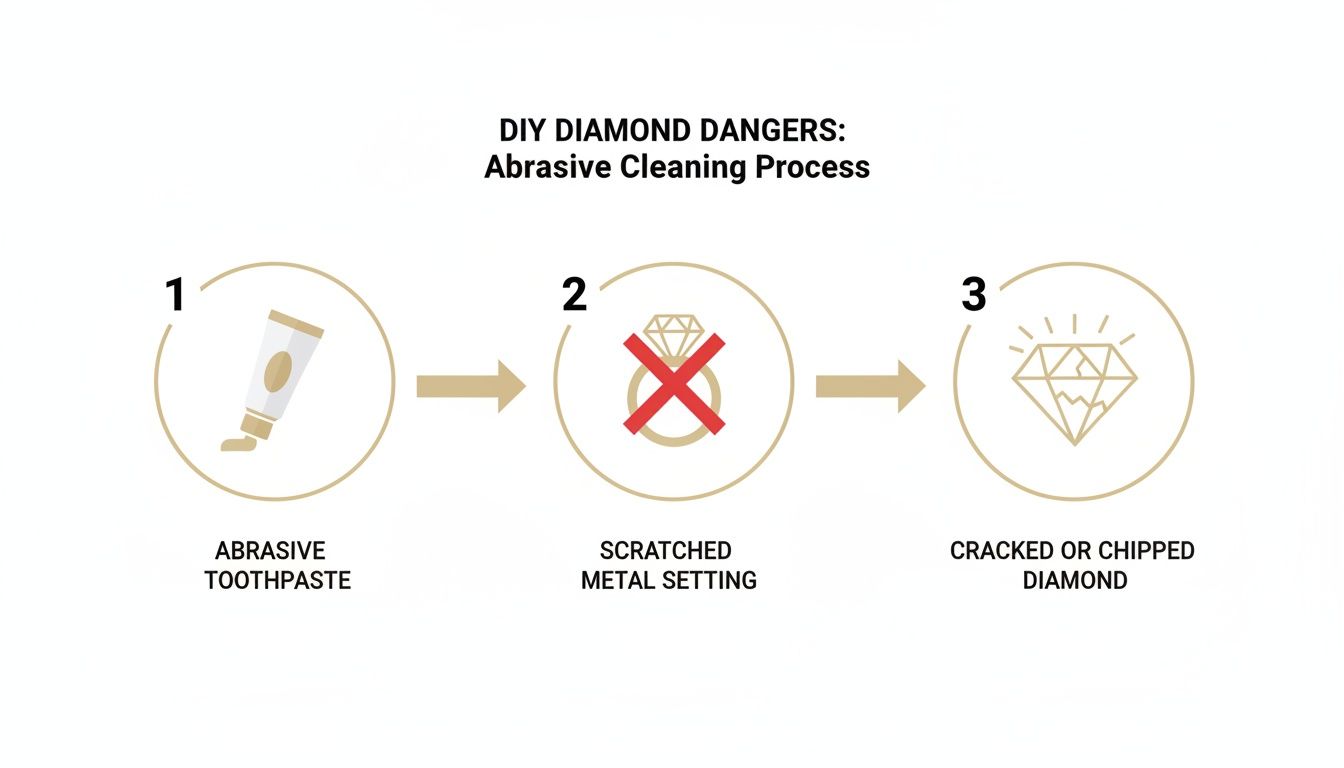
This is a world away from DIY "polishing" hacks. As this infographic shows, using the wrong methods at home often causes far more harm than good.
Trying to polish a diamond with abrasive household products can easily scratch the metal setting or, even worse, damage the stone itself.
Achieving the Final Lustre
The final stages are all about refinement. The jeweller works meticulously, facet by facet, until every single surface reflects light with absolute clarity. This is what unlocks that sharp, dazzling flash of light—the scintillation—that makes a diamond so captivating.
Once the diamond is perfected, it gets a final, thorough clean to remove any trace of polishing compound. If the stone was un-set at the start, it’s now expertly reset into its mounting. The jeweller then inspects the prongs and security of the setting, a vital quality-control step included in all our professional services.
Finally, the entire piece of jewellery is polished, making sure the metal shines just as brilliantly as the newly restored diamond. This holistic approach is the hallmark of true craftsmanship. You can learn more about the full scope of what we do in our guide to jewellery repair in Hatton Garden.
Is It Time for a Professional Polish?
It can be tricky to tell if your diamond just needs a good clean or if it’s time for a proper professional polish. They can both leave your stone looking a bit lacklustre, but the root causes—and the fixes—are worlds apart. Knowing how to spot the difference is key to bringing back that showroom sparkle.
A simple clean lifts away the daily build-up of oils, lotions, and grime that coat the surface. Polishing, on the other hand, physically restores the diamond's facets. If you've given your ring a thorough clean and it still looks lifeless, that’s a pretty solid clue that something more is at play.
Key Signs Your Diamond Needs Polishing
Think about your engagement ring after a decade of constant wear. It’s been through life with you, and that story often leaves its mark. Over time, you’ll start to see signs that surface grime isn't the only thing dulling its fire.
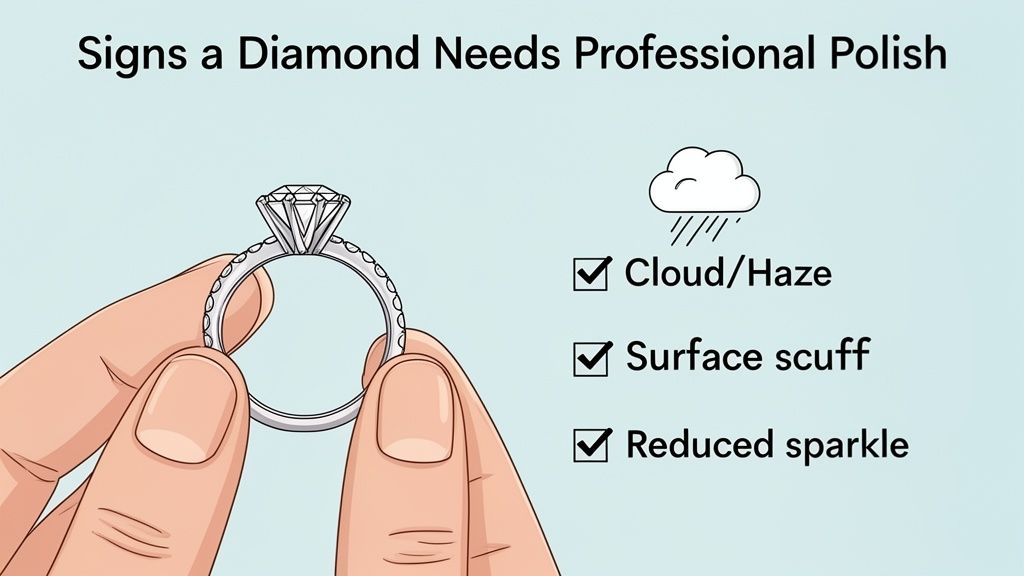
Here’s a quick checklist to help you see what’s really going on:
A Persistent Cloudy Look: Even after a good soak and scrub, does the stone have a milky or hazy film? This is usually caused by a network of microscopic scratches scattering light before it can bounce back out.
Visible Scuffs or Nicks: Hold your diamond under a bright light and turn it slowly. Can you spot tiny abrasions or little nicks on the facets? These are clear signs of physical wear.
Noticeably Less Fire: Does your diamond seem to have lost those vibrant flashes of rainbow colour it once had? A loss of fire is a classic symptom of worn facets that can’t refract light properly.
If your diamond looks dull from every angle no matter how much you clean it, it’s almost certainly time to talk to an expert. Cleaning can help, but only a professional polish can correct the surface imperfections that truly kill its brilliance.
When to Seek Expert Advice
As a rule of thumb, it’s wise to have cherished pieces like an engagement ring professionally checked every couple of years. An experienced goldsmith can spot subtle wear and tear long before it becomes a problem and will tell you honestly if a polish is needed.
This kind of check-up not only keeps your diamond looking its best but also gives the jeweller a chance to inspect the setting and make sure your stone is secure.
For those in London looking for an expert eye, understanding the benefits of professional jewellery polishing services is the perfect next step. A quick chat can determine exactly what’s needed to bring back that original, breathtaking sparkle.
Finding a Jeweller You Can Trust with Your Diamond
Choosing the right artisan to polish a diamond is as critical as the polishing technique itself. You’re not just handing over a stone; you're entrusting someone with an item of immense financial and sentimental value. The difference between a master jeweller and a less reputable service can be the difference between a beautifully restored heirloom and a costly, irreversible mistake.
One of the biggest factors to consider? Whether the jeweller has an on-site workshop. Many high-street shops are just middlemen. They’ll take your precious items and send them away to a third-party facility you know nothing about. This instantly adds risk, delays, and a complete loss of oversight on your part.
An established, in-house workshop gives you a level of peace of mind you just can't get otherwise. You know exactly who is handling your jewellery and where it is at all times.
The Power of an On-Site Workshop
A workshop-based jeweller like Opulence Jewellery Services offers transparency that’s simply not possible when your jewellery is shipped off-site. When the work is done right there on the premises, you often get the chance to speak directly with the goldsmith who will be restoring your diamond.
This direct line of communication is invaluable. It ensures your concerns are heard and that the final result meets your exact expectations.
The benefits are crystal clear:
Complete Security: Your diamond never leaves the secure, state-of-the-art workshop.
Faster Turnaround: Services like same-day polishing are possible because there are no shipping delays to factor in.
Expert Oversight: Master jewellers are overseeing every step of the process, ensuring the highest standards of quality control from start to finish.
The ability to see where your jewellery is being worked on provides a level of comfort and assurance that is priceless. There’s no substitute for knowing your cherished piece is being handled with expert care just a few feet away, not in a nameless, faceless facility hundreds of miles away.
Verifying a Jeweller’s Reputation
Before you commit, a little bit of research goes a long way. When choosing someone to trust with your diamond, their online presence and public perception are key indicators. Understanding the importance of online reputation can help you quickly assess their trustworthiness.
Look for genuine customer reviews across multiple platforms. Pay close attention to feedback that mentions specific services, like polishing or repairs. Do previous clients praise their attention to detail, transparency, and craftsmanship? A consistent pattern of positive, detailed reviews is a strong sign of a reliable business.
Also, seek out a jeweller who offers transparent, upfront pricing. There should be no hidden fees or surprises down the line; you should receive a clear, itemised quote before any work begins. This kind of integrity is the hallmark of a professional you can count on to polish a diamond to perfection.
Your Diamond Polishing Questions Answered
Deciding to polish a diamond is a big step—it's a valuable piece, and you naturally want to understand what's involved. We get asked a lot of questions here in our Hatton Garden workshop, so we've put together some clear, straightforward answers to the most common ones.
Knowing the specifics around cost, timing, and what happens to your stone will give you the confidence that you're making the right choice.
How Much Does It Cost to Polish a Diamond in the UK?
The cost really depends on the diamond's condition. For a simple surface polish to clear up minor cloudiness as part of a general service, the price is usually quite modest.
If your diamond has more noticeable scuffs or scratches, however, the price will reflect the extra time and skill needed to restore it. No reputable jeweller will give you a price without seeing the stone first. They'll need to inspect it under magnification to give you a transparent quote before any work begins. That way, there are no surprises.
Will Polishing Remove a Deep Chip or Scratch?
This is a really important distinction. Professional polishing is fantastic for tackling the microscopic, surface-level wear that makes a diamond look dull or hazy. It can bring that mirror-like facet finish right back.
But for deeper chips or significant fractures, polishing alone might not be the whole answer. That kind of damage can require re-cutting a facet, which is a much more involved process. An expert can assess the depth of the flaw and tell you the best way forward. Even so, a polish can still make a huge difference to the diamond's look by smoothing the surrounding area, even if a deeper flaw remains.
The goal of a skilled artisan is always to achieve the maximum visual improvement while removing the absolute minimum amount of material from the stone.
How Long Does Professional Diamond Polishing Take?
This almost completely comes down to the jeweller's setup. Many high-street shops send jewellery away to a central workshop, which can easily take days or even weeks. You're left waiting without your precious item.
In contrast, a specialist with a fully equipped, on-site workshop can turn things around much faster. For most standard polishing jobs, it's very possible to have your ring back the same day, sparkling like it was brand new. This "while-you-wait" or same-day option is safer and saves you a long, anxious wait.
Does Polishing Affect My Diamond's Carat Weight?
An excellent and very common question. Technically, yes—polishing removes an incredibly tiny layer from the diamond's surface. However, the amount of material taken off by a skilled professional is so microscopic that it’s considered completely negligible.
The change in carat weight is far too small to be measured on standard scales and will have no impact on your diamond's official grading or its value. The stunning improvement in brilliance and fire you get from the process far outweighs this microscopic loss.
Ready to bring back your diamond's original, breathtaking sparkle? The master jewellers at Opulence Jewellery Services use decades of Hatton Garden experience and state-of-the-art equipment to deliver flawless results, often on the very same day. Let us bring your cherished pieces back to life. Visit our workshop or get a quote online.