Redipping White Gold: A Quick Guide to redipping white gold Shine
14 December 2025 15 min read Hatton Garden, London
Discover why white gold loses its shine and how redipping white gold can restore brilliance. Learn costs, steps, and care tips.
Looked in the mirror recently and noticed your brilliant white gold ring has taken on a faint, warm, almost yellowish tint? Don’t panic. This is completely normal and expected.
That signature, crisp, mirror-like shine you love comes from a micro-thin layer of a precious metal called rhodium. With daily wear, this coating simply wears away, revealing the natural, slightly off-white colour of the gold alloy underneath.
Why Your White Gold Looks Yellow
The key to understanding why white gold needs a refresh lies in how it’s made. Despite its name, there's no such thing as naturally "white" gold. Gold, in its raw form, is always yellow.
To create the white gold you see in the shop, jewellers mix pure yellow gold with white metal alloys like palladium, nickel, or silver. This creates a strong, durable metal, but its natural colour is more of a soft, champagne-like off-white. It's beautiful, but it isn't the dazzling, bright white that makes diamonds pop. To get that iconic look, one final step is needed.
The Role of Rhodium Plating
Think of rhodium plating as a luxurious, high-performance topcoat for your jewellery. Applied using an electrochemical process, this layer of rhodium—a member of the platinum family—does two crucial things:
A Brilliant Finish: Rhodium gives the piece that exceptionally bright, cool-toned white surface. It’s incredibly reflective, which is why it enhances the sparkle of diamonds and other gemstones so well.
Added Durability: It also acts as a protective barrier, helping to shield the gold alloy from the minor scratches and scuffs of everyday life.
But this layer is microscopic. Over months and years, contact with skin, lotions, soaps, and hard surfaces gradually wears it down. This isn't a flaw in your ring; it's just the nature of the material. The "yellowing" you see is simply the true colour of the white gold alloy peeking through as the rhodium thins out.
This entire process is purely cosmetic and doesn’t harm the gold itself. Re-dipping white gold is just routine maintenance—like polishing silver or servicing a watch—designed to restore its original, showroom-fresh appearance.
How quickly this happens really depends on you and your lifestyle. An engagement ring you wear every day will show signs of wear much faster than a pair of earrings you only bring out for special occasions. When you start to notice that gentle shift in colour, it’s a clear sign that it’s time for a professional touch-up.
The Rhodium Plating Process Demystified
So, what’s the secret behind restoring that brilliant, mirror-like finish to your white gold? The professional process of redipping white gold, officially called rhodium plating, is a meticulous craft blending deep cleaning with electrochemical science. It’s far more than a quick polish; it’s a complete renewal of the jewellery’s protective and aesthetic surface.
The journey starts with expert preparation. Before anything else, your jewellery gets a deep clean in an ultrasonic bath. This machine uses high-frequency sound waves to blast away microscopic dirt, oils, and lotions from every nook and cranny. This step is absolutely critical for ensuring the new rhodium layer bonds perfectly.
Polishing and Plating
Once perfectly clean, an expert jeweller will carefully polish the piece. This isn't just about creating a shine; it buffs away any surface scratches and, crucially, removes all the remaining fragments of the old, worn-out rhodium plating. For a brief moment, this reveals the true, slightly warmer hue of the white gold alloy underneath before its final transformation.
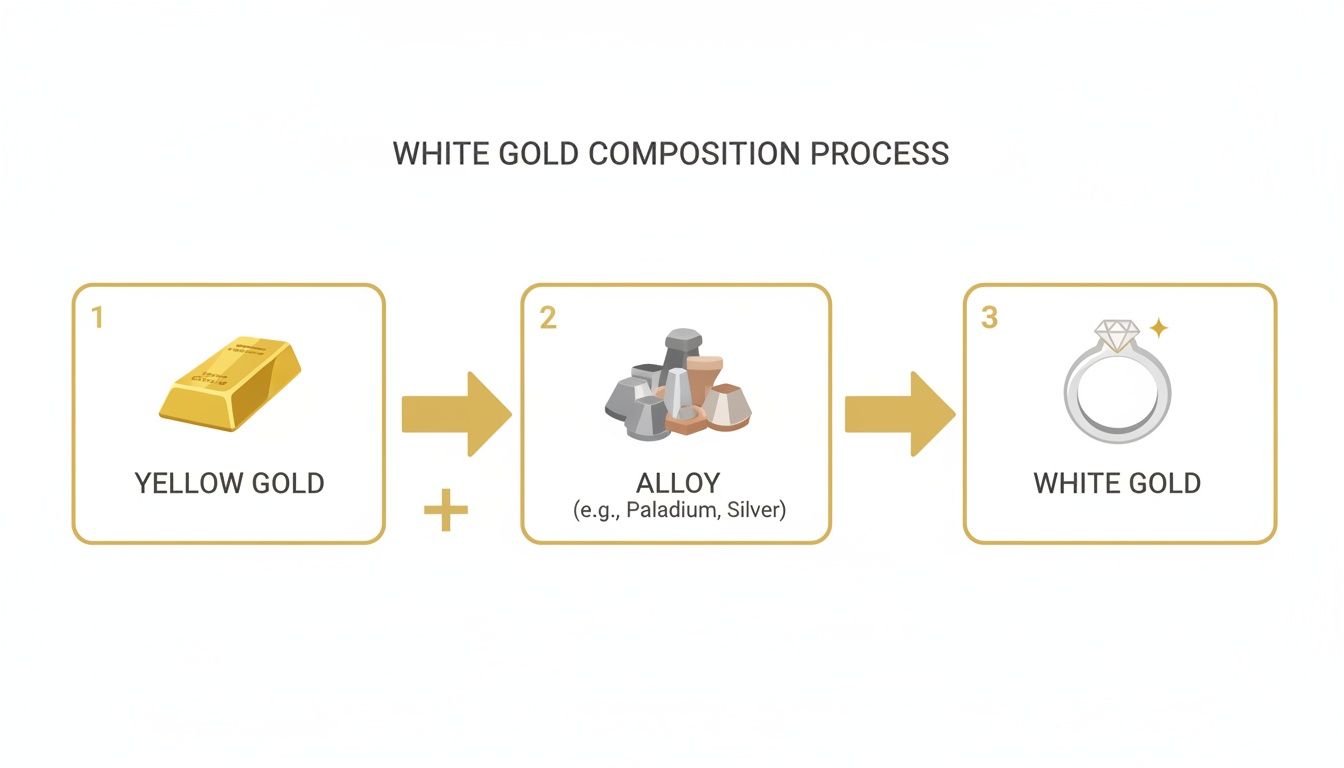
This quick diagram shows how the white gold alloy at the core of your jewellery is made in the first place, long before any plating is applied.
As you can see, pure yellow gold is blended with other white metals to create the strong, durable base for your ring or pendant.
With the surface pristine and ready, it’s time for the main event: electroplating. The item is submerged in a specialised rhodium solution, and a precise electrical current is passed through it.
This current triggers a chemical reaction, bonding a new, micro-thin layer of rhodium atoms directly onto the gold's surface. It’s this scientific process that guarantees an even, tough, and dazzlingly white finish.
Does Redipping Harm the Gold?
It’s a fair question: does this process wear away the actual gold? Thankfully, when done properly by a professional, the answer is no. The polishing stage is carefully controlled to remove only the old plating, not the gold itself.
As established in the jewellery trade, replating is an all-or-nothing job—the old layer must be polished off before a new one can be applied. But this process doesn’t routinely remove the base metal. As a result, having your jewellery replated over the years won't materially reduce its weight or gold content.
The meticulous steps a professional follows include:
Deep Ultrasonic Cleaning: Removes all hidden grime for a flawless bond.
Professional Polishing: Smooths away scratches and completely strips the old rhodium.
Electro-Cleaning: A final chemical clean to make the surface absolutely pristine.
Rhodium Electroplating: The new, bright white rhodium layer is applied using an electric current.
Final Rinse and Dry: The last step to reveal a stunning, showroom-fresh finish.
This proven sequence is our guarantee that your white gold jewellery will be returned to you looking just as bright and beautiful as the day you first wore it.
How Often to Redip White Gold Jewellery
There’s no single, one-size-fits-all rule for when to redip white gold. The right schedule is as personal as your lifestyle. The simplest answer? It’s time for a touch-up when you start seeing the warmer, slightly yellowish colour of the gold beneath peeking through.
Think of the rhodium plating like the tread on a car tyre. The more miles you cover and the rougher the roads, the faster it wears down. Several factors in your daily life will speed up how quickly that bright white finish begins to fade.
Key Factors That Influence Wear
How you live in your jewellery makes all the difference. Three main things determine how quickly that brilliant rhodium layer wears away:
Frequency of Wear: An engagement ring you wear every day will need attention far more often than a pair of earrings you save for special occasions. Constant contact just wears the plating away faster.
Your Skin's Chemistry: Everyone’s skin has a unique pH balance. If your skin is naturally more acidic, it can react with the plating and cause it to thin more quickly than it would on someone else.
Exposure to Chemicals: This is often the biggest culprit. Lotions, perfumes, soaps, and especially alcohol-based hand sanitisers can be surprisingly abrasive to that delicate rhodium layer.
Knowing the visual cues is your best guide. The most common sign is a noticeable yellowing on the bottom of a ring's band, as this is the area that experiences the most friction from gripping objects and resting on surfaces.
A Practical Timeline for Redipping
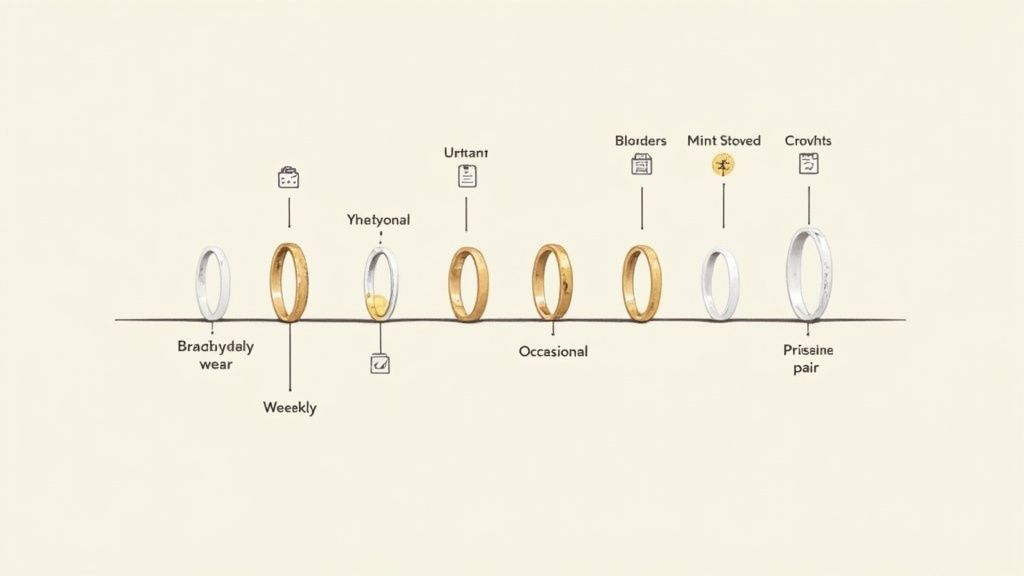
To give you a clearer idea, the table below offers a general guide based on the type of jewellery and how often it’s worn. It’s a good starting point for anticipating when your piece might need a professional refresh.
Recommended Redipping Frequency by Jewellery Type
Jewellery Type
Wear Pattern
Typical Redipping Frequency
Engagement Ring
Worn Daily
Every 12 to 18 months
Wedding Band
Worn Daily
Every 12 to 24 months
Bracelets/Chains
Worn Frequently
Every 2 to 3 years
Earrings/Pendants
Worn Occasionally
Every 3 to 5 years
Ultimately, you are the best judge of when your jewellery needs its sparkle back. While these timeframes are a helpful estimate, the most important factor is how the piece looks to you.
To get a better sense of the finish's durability, you can learn more about how long rhodium plating lasts in our detailed guide. A quick look at your jewellery every few months will help you catch any fading early, keeping your cherished items looking their absolute best.
What Does it Cost to Re-dip Jewellery in the UK?
Putting money into restoring your jewellery’s sparkle is just part of looking after it properly. When it comes to re-dipping white gold, the cost in the UK varies, but it’s a surprisingly affordable service that keeps your favourite pieces looking their best for years.
Think of it less like a quick clean and more like a specialist valet for your ring. The price reflects a meticulous, multi-stage process that includes professional cleaning, expert polishing to buff out scratches and remove what’s left of the old plating, and finally, the electroplating itself with precious rhodium. You're not just paying for a coating; you're investing in true craftsmanship.
Typical Price Range in London and Beyond
In the UK, a professional re-dipping service will typically set you back between £30 and £80 for a single item. Where it falls in that range really depends on the jeweller’s location and how complex your piece is.
A high-street chain, for instance, might quote you around £50. Head to a specialist workshop in London’s iconic Hatton Garden, and you’re likely to be at the higher end of that scale. The difference? It often comes down to the artisan’s experience and the hands-on, individual attention your jewellery receives.
The price isn't just for the rhodium itself but for the entire restoration process. You're paying for an expert to meticulously prepare, polish, and plate your jewellery, ensuring a flawless and durable finish that makes it look brand new.
How Precious Metal Prices Affect the Cost
The cost of re-dipping is also tied to the wider market for precious metals. Rhodium is part of the platinum family, and its price can swing up and down. The rising price of gold itself also has a knock-on effect on the economics of jewellery maintenance.
For example, with global gold prices climbing from roughly £1,560 per ounce in 2023 to about £1,870 in 2024, some people are weighing up the ongoing cost of re-dipping against buying a piece made from a naturally white metal like platinum from the get-go. You can find more insights on how market trends affect jewellery choices on SmithGreenJewellers.com.
Ultimately, the cost of re-dipping white gold is a small price to pay for bringing back the beauty and integrity of a piece you truly love. It’s a worthwhile investment to restore that original, dazzling shine.
Why You Should Avoid DIY Redipping Kits
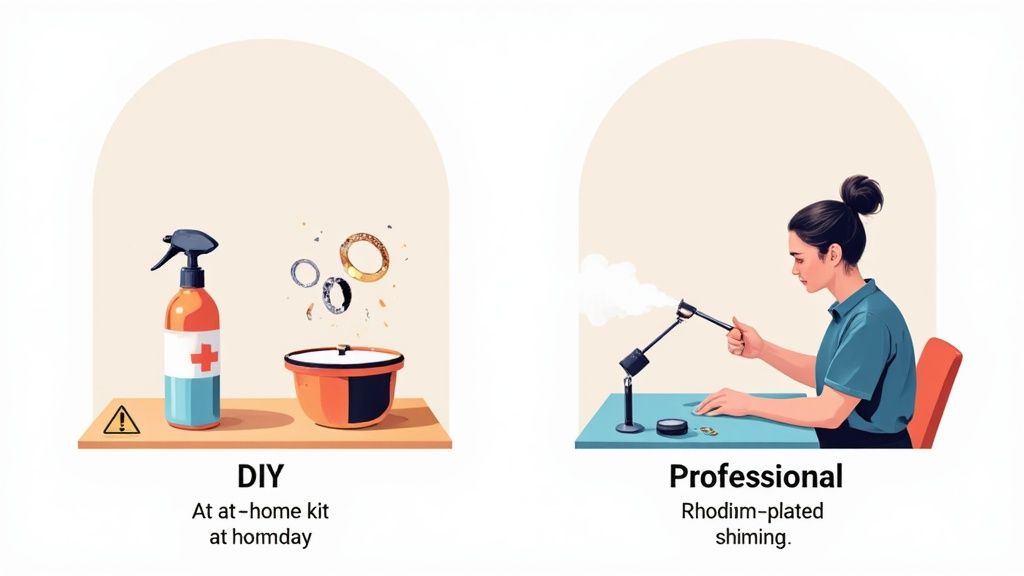
In a world full of at-home fixes, it's easy to see the appeal of a DIY redipping kit for your white gold. They promise a quick and cheap solution, but the reality is they often cause more problems than they solve, putting your valuable—and sentimental—jewellery at serious risk.
Think of it like trying to repaint a luxury car with a spray can from a hardware shop. You might technically apply a new coat, but you’ll never get the quality, durability, or flawless finish of a professional body shop. The same logic applies directly to redipping white gold.
The Dangers of At-Home Kits
Professional rhodium plating is a multi-stage process that needs specialised equipment, controlled chemicals, and a jeweller's expertise. A simple home kit just can't replicate that environment, which leads to a whole host of issues that can devalue or even ruin your jewellery.
Some of the most common problems we see from DIY attempts include:
A Blotchy, Uneven Finish: Without professional-grade surface prep and electroplating gear, the rhodium layer almost always goes on patchy or streaky. It just won't look right.
Poor Adhesion: A professional clean strips away microscopic residues that stop the new plate from bonding properly. DIY kits often result in a weak coating that flakes off in no time.
Risk of Chemical Damage: The solutions used in plating can be hazardous. If you don't know what you're doing, you could permanently discolour gemstones or damage the gold alloy underneath.
Attempting a DIY redip on something as precious as an engagement ring is a huge gamble. A professional service is the only way to guarantee a beautiful, lasting finish that truly protects your investment.
The Professional Advantage
When you bring your jewellery to an expert, you’re not just paying for a coat of rhodium; you’re paying for a meticulous process that a home kit can't begin to touch. A jeweller will use ultrasonic cleaners, professional polishing compounds, and precisely calibrated electroplating machinery to guarantee a perfect result.
They’ll carefully prepare the surface, removing every last trace of old plating and any microscopic dirt. This is the most crucial step—it’s what ensures the new rhodium layer is durable, brilliantly reflective, and seamlessly bonded to the gold.
At the end of the day, the small amount of money you might save with a DIY kit isn't worth the risk of a bad finish or irreversible damage. Investing in a professional redipping service is the right call, ensuring your treasured white gold is restored properly and protecting both its financial and sentimental value for years to come.
Get Same-Day Jewellery Restoration in London
One of the biggest anxieties we hear about is having to part with your jewellery for repairs. Being without a cherished engagement ring or wedding band for weeks at a time can feel genuinely unnerving, especially when it’s sent away to an unknown, off-site workshop.
That worry alone is often enough to make people put off essential upkeep like redipping white gold.
But what if you didn’t have to wait? Imagine booking an appointment, bringing your ring to a Hatton Garden expert, and having it restored to its original brilliance while you grab a coffee. That’s the peace of mind a same-day, on-site service provides.
The Power of a While-You-Wait Service
At Opulence Jewellery Services, our state-of-the-art workshop is right here in our London store. This simple fact completely changes the experience, cutting out the long, anxious waits that are so common with jewellery care.
Our entire process is built around your convenience and security:
No Shipping: Your jewellery never leaves our secure premises. Not for a single moment.
Expert Oversight: Our own skilled artisans handle every single step, right here in-house.
Fast Turnaround: You can walk out in just a few hours with your ring looking brand new again.
This kind of rapid service is vital in a city like London. The UK jewellery market is huge, valued at around £4.5 billion, with rings making up the largest slice of that pie. That means countless people need reliable, professional maintenance, and our same-day offering is designed to meet that demand head-on. You can read more about the UK jewellery market statistics on Cash4Gold-Now.com.
The ability to watch an expert restore your piece provides unmatched transparency and confidence. You see the meticulous care first-hand, knowing your sentimental items are in the safest possible hands from start to finish.
This commitment to in-house craftsmanship means you get professional, top-tier results without the typical delay. If you're looking for a trustworthy local specialist, our guide on finding rhodium plating services near you offers more helpful tips. With a same-day service, restoring your white gold’s brilliant shine is no longer an ordeal—it’s a simple, satisfying experience.
Your Questions Answered
Even after getting the hang of the process, it's normal to have a few more questions rattling around. Here are some quick, no-nonsense answers to the things our clients most often ask us here in our London workshop.
Will Re-dipping Damage My Diamonds or Gemstones?
This is probably the number one question we hear, and it's a very fair one. The short answer is no, not when it's done by a professional. Diamonds are incredibly tough and are completely unfazed by the rhodium plating process.
However, softer or more porous stones like pearls, opals, and some emeralds need a gentle touch. An experienced jeweller knows exactly how to handle these, carefully protecting them so they never even touch the plating solution. It's another solid reason to always leave this job to the experts.
Can I Plate My Yellow Gold Ring to Make It White?
Absolutely. We can rhodium plate yellow or rose gold to give it that crisp, bright white look. It’s a fantastic way to give a piece you already love a completely new feel without buying something new.
Just keep in mind that this is a surface treatment. As the rhodium coating wears down over time, the warmer yellow or rose gold beneath will start to peek through. This means you'll likely need to re-dip it more often to keep that white gold appearance.
Is There a Type of White Gold That Doesn’t Need Re-dipping?
Yes, it does exist, but it’s a more premium (and pricier) option. Some high-end white gold alloys are mixed with a large amount of palladium, a precious metal from the same family as platinum. This creates a beautiful, naturally greyish-white metal that doesn't need a rhodium coating for its colour.
While it saves you the hassle of re-dipping, the cost of palladium and the extra skill needed to work with it makes these pieces significantly more expensive.
How Long Does a Fresh Re-dip Last?
The lifespan of your new rhodium plate really comes down to how you wear the piece. For something you wear every day, like an engagement or wedding ring, you can expect it to last anywhere from 12 to 18 months.
For jewellery that sees less action, like a pair of earrings or a pendant, that brilliant finish can easily last for several years.
Ready to bring back that showroom shine? The goldsmiths at Opulence Jewellery Services offer a same-day, while-you-wait re-dipping service right here in our Hatton Garden workshop. We’ll have your treasured items looking brand new again, without the long wait. Book your appointment online or just stop by the workshop today.
Discover the professional way to polish a diamond and restore its fire. Learn the risks of DIY methods and how experts bring back that brilliant shine.
Discover the truth about rhodium in rings. This guide explains what rhodium plating is, why it's essential for white gold, and how to care for your jewellery.